
Daytime napping,
does it really help with Prevention of cognitive decline and dementia in later life?
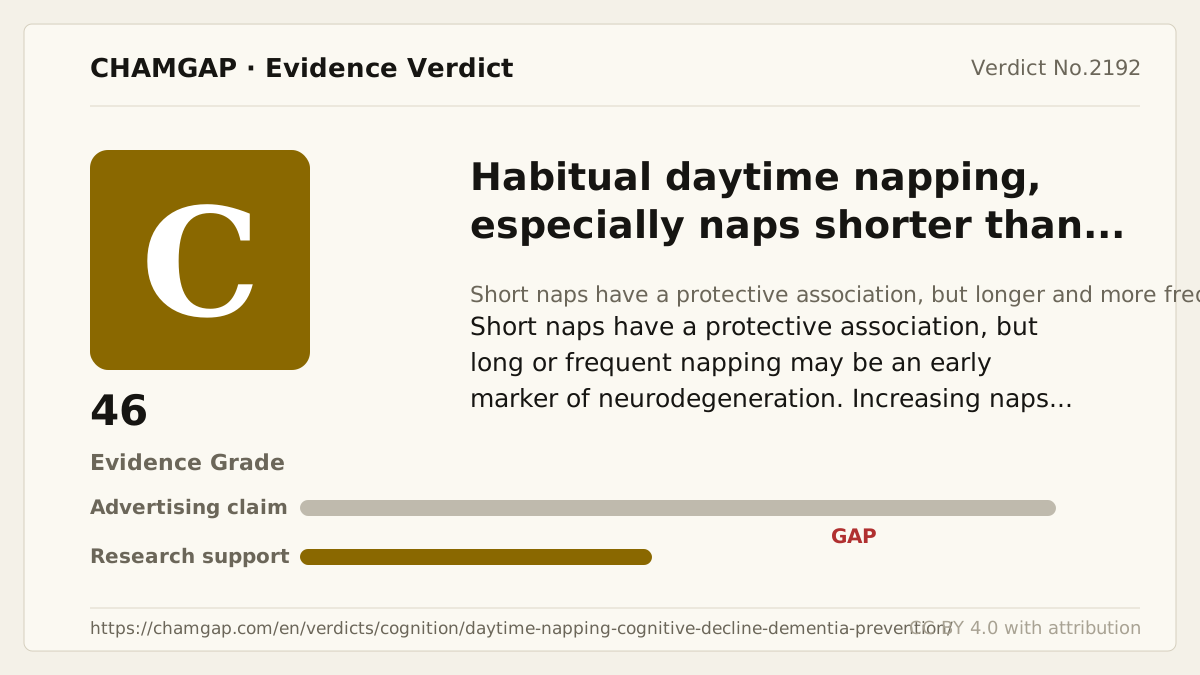
research showsThe grade is C with 54 points. A prospective Japanese cohort of 389 older adults associated 1-29 minute naps with less five-year cognitive decline, OR 0.47 (95% CI 0.23-0.96). In contrast, a Rush cohort with repeated actigraphy found that longer and more frequent naps predicted more Alzheimer dementia, while dementia progression more than doubled annual increases in napping. Genetic-instrument studies also disagree across brain volume, cognitive tests, and Alzheimer disease, so napping is not established as preventive therapy.
ads claimFeeling refreshed after a power nap is not evidence of dementia prevention years later. Current evidence does not justify prescribing naps as dementia prophylaxis; newly longer or more frequent naps warrant assessment of nighttime sleep, medication, depression, sleep apnea, and neurologic illness.
Useful facts when choosing a product
- Nap duration in the Japanese cohort was interview-based self-report, not actigraphy.
- Rush inferred naps with wrist actigraphy and found that dementia progression more than doubled annual increases in nap duration and frequency.
- Cardiovascular events from the same napping exposure are a different endpoint and require a separate verdict from cognition and dementia.
Chamgap Semantic Classification Code
Candidate index · review held
UNK.habitual-daytime-napping.UNK.cognitive-decline-and-dementia-in-later-life.prevent.UNKUnknown > Habitual daytime napping > Unknown > cognitive decline and dementia in later life > Occurrence-prevention claim > Unknown
An automated migration candidate, not an issued permanent code; exact claim scope remains under review. This machine-generated migration candidate helps retrieval but is not a permanent assignment. The original verdict ID and URL remain authoritative.
What the research actually shows
The Japanese study excluded baseline cognitive impairment, but an analysis excluding events in the first one or two years was not reported in the article. Rush used repeated actigraphy and annual cognition, directly showing that dementia progression accelerated later increases in napping. This demonstrates reverse causation in the data. The Japanese analysis retained 389 people after substantial selection from the original sampling frame and tested multiple sleep characteristics. Public research funding was confirmed for the pivotal studies.
Why this is classified as C (54)
Protective associations for short naps coexist with adverse associations for long or frequent naps, and objective repeated measurement directly demonstrates reverse causation. No randomized prevention trial exists, core outcomes do not resolve in one direction, and selection plus multiple-testing limitations give C with 54 points.
Counterpoint. Long-term work should prespecify no naps, under 30 minutes, 30-60 minutes, and over 60 minutes and ascertain incident dementia.
Rejudgment record. Cross-check applied — Prospective cohorts, repeated-actigraphy data, and genetic-instrument studies were cross-checked for duration-specific direction and exposure measurement; exclusion of events in the first one or two years was classified as not reported, and reverse causation was assessed
| Endpoint | H | Hard endpoint - actual events such as death |
| Replication | R1 | Single confirmatory trial |
| Independence | I2 | Decisive evidence is publicly or non-profit funded |
| Effect size | EX | The clinical size of the effect could not be judged |
Stored derived and displayed grades match; this is not a current recalculation or validity check (C).
Sub-claim grades by effect
This ingredient is marketed for several effects. A single overall grade blends strong and weak claims together, so each effect is graded separately here. The overall grade reflects the strongest disconfirming or core claim.
| Effect (sub-claim) | Grade | Basis |
|---|---|---|
| Naps shorter than 30 minutes prevent cognitive decline | C | One prospective cohort found a protective association, not a randomized causal effect. |
| Long and frequent naps prevent dementia | D | Objective repeated measurement instead associated them with more Alzheimer dementia. |
Cross-check — AI research and Codex final gate
Evidence Table
| Study | Design | Sample | Funding | Endpoint | Result | Weight |
|---|---|---|---|---|---|---|
| Kitamura K et al., BMC Geriatrics, 2021 | Five-year community prospective cohort | 389 analyzed after excluding baseline cognitive impairment | Japanese public research funding | Decline of at least 3 points on HDS-R | 1-29 minutes versus no naps: OR 0.47 (95% CI 0.23-0.96) | Protective short-nap association with self-report and selection limitations |
| Li P et al., Alzheimer's & Dementia, 2023 | Prospective cohort with repeated actigraphy | 1,401 participants, up to 14 years | US NIH public funding | Incident clinical Alzheimer dementia and change in napping | HR 1.23 (1.08-1.39) per SD of frequency; napping accelerated after dementia progression | Key objective evidence demonstrating reverse causation |
| Paz V et al., Sleep Health, 2023 | Mendelian-randomization analysis | Up to 378,932 UK Biobank participants | Public data and academic research support | Brain volume, reaction time, and visual memory | Total brain volume +15.80 cm3 (0.25-31.34); null hippocampal, reaction-time, and visual-memory results | Causal-inference support, but not a dementia event outcome |
Receipt — 3 References
All 3 cited sources were verified for existence at the original page (as of 2026-08-04).
Final verification and publication gate: Codex · Evidence date: 2026-08-04 · Corrections: none
Cite this verdict
[Chamgap] Daytime napping x prevention of cognitive decline and dementia — Evidence Grade C·54. 3 cited sources checked. Source: https://chamgap.com/en/verdicts/cognition/daytime-napping-cognitive-decline-dementia-prevention/ · CC BY 4.0CC BY 4.0 — free to use with attribution; do not distort grades, numbers, or verdict meaning.
What this document does and does not do
Chamgap is an information source. It reports what research has and has not confirmed; it does not tell readers what to take or buy. That decision belongs to readers and, when needed, medical or legal professionals. This verdict reflects literature available up to the search date and may change as new research appears. Nothing here is medical advice.