
Multivitamin-mineral supplement,
does it really help with Delayed decline in global cognition and episodic memory in older adults?
research showsA multivitamin-mineral supplement is rated C because it produced a very small positive signal for slowing decline on cognitive tests in older adults. A meta-analysis of 5,203 nonoverlapping participants from the three COSMOS cognitive substudies favored supplementation by 0.07 SD for global cognition (95% CI 0.03 to 0.11) and 0.06 SD for episodic memory (95% CI 0.03 to 0.10). These were not three independent confirmatory trials, however, but the Clinic, Mind, and Web substudies of one parent COSMOS trial. The effects were very small, their clinical perceptibility and functional importance are uncertain, and prevention of dementia or mild cognitive impairment was not demonstrated.
ads claimMarketing can expand a small cognitive-test difference into prevention of brain aging or dementia. The evidence directly supports only a very small average difference on cognitive tests over two to three years with the specific multivitamin studied, not proven dementia prevention or a clearly perceptible individual benefit.
Useful facts when choosing a product
- COSMOS tested one Centrum Silver tablet daily, a multivitamin-mineral formulation intended for older adults. The findings cannot automatically be generalized to products with different formulations.
- Standard-dose multivitamin-mineral products are generally well tolerated, but combining several supplements can produce excessive intakes of vitamins A, D, E, or K, iron, zinc, and other nutrients.
- People taking warfarin should review the vitamin K content with a clinician before starting or switching products because changes in vitamin K intake can alter anticoagulation.
- New or rapidly progressive cognitive decline warrants assessment of hearing, depression, sleep, thyroid disease, vitamin B12 deficiency, medication effects, and neurodegenerative disease rather than substitution with a supplement.
Chamgap Semantic Classification Code
Candidate index · review held
S.multivitamin-mineral-supplement.oral.delayed-decline-in-global-cognition-and-episodic-memory.reduce.MULTISupplements and nutraceuticals > Multivitamin-mineral supplement > Oral > Delayed decline in global cognition and episodic memory > Reduction claim > Multiple: primary unresolved
An automated migration candidate, not an issued permanent code; exact claim scope remains under review. This machine-generated migration candidate helps retrieval but is not a permanent assignment. The original verdict ID and URL remain authoritative.
What the research actually shows
COSMOS-Mind randomized 2,262 participants and reported a 0.07-SD benefit in telephone-based global cognition over three years. COSMOS-Web enrolled 3,562 participants and reported improved web-based immediate recall after one year. In 573 COSMOS-Clinic participants, the two-year difference was 0.06 SD for global cognition, with a confidence interval crossing zero, and 0.12 SD for episodic memory. After removing participant overlap, the investigators' meta-analysis of 5,203 people yielded differences of 0.07 SD for global cognition and 0.06 SD for episodic memory. In contrast, an adjudicated COSMOS-Mind analysis with 110 incident mild-cognitive-impairment cases and 14 dementia cases found no significant reduction in incidence and had low statistical power.
Why this is classified as C (44)
The 0.07-SD global-cognition and 0.06-SD episodic-memory results in 5,203 nonoverlapping participants were statistically positive, so D would be inaccurate. Clinic, Mind, and Web all came from the same COSMOS parent trial rather than independent replications, the effects were extremely small, and neither clinical importance nor dementia prevention was established. Rule ①-ⓒ and the small magnitude give C with 44 points.
Counterpoint. A multivitamin can have a nutritional role for an older adult with an inadequate diet or a risk of specific deficiencies. This verdict does not reject that role; it evaluates the separate claim that the product delays decline in global cognition and episodic memory.
Rejudgment record. Cross-check applied — Accepted the small positive effects on global cognition and episodic memory in the COSMOS meta-analysis of 5,203 nonoverlapping participants, but applied the rule ①-ⓒ ceiling of C because the three datasets are substudies of one parent trial rather than independent replications and clinical importance remains uncertain
Sub-claim grades by effect
This ingredient is marketed for several effects. A single overall grade blends strong and weak claims together, so each effect is graded separately here. The overall grade reflects the strongest disconfirming or core claim.
| Effect (sub-claim) | Grade | Basis |
|---|---|---|
| Delayed decline in global cognition in older adults | C | The within-COSMOS meta-analysis was positive by 0.07 SD, but the effect was very small and not an independent external replication. |
| Delayed decline in episodic memory in older adults | C | The benefit was 0.06 SD among 5,203 nonoverlapping participants, with uncertain perceptible clinical importance. |
| Prevention of incident mild cognitive impairment or dementia | D | COSMOS-Mind found no significant reduction in incidence, although only 14 dementia events limited power. |
Cross-check — AI research and Codex final gate
Evidence Table
| Study | Design | Sample | Funding | Endpoint | Result | Weight |
|---|---|---|---|---|---|---|
| Vyas CM et al. 2024 | Randomized double-blind COSMOS-Clinic substudy and meta-analysis of three cognitive studies within COSMOS | 573 in COSMOS-Clinic and 5,203 nonoverlapping participants in the meta-analysis | Public support including NIH, research support from Mars Edge, and tablets supplied by Pfizer Consumer Healthcare | Two-year change in global cognition, episodic memory, and executive function or attention | The meta-analysis favored supplementation by 0.07 SD for global cognition (95% CI 0.03 to 0.11) and 0.06 SD for episodic memory (95% CI 0.03 to 0.10). | Key synthesis, but an internal meta-analysis within one parent trial |
| Baker LD et al. 2023 | COSMOS-Mind 2-by-2 factorial randomized double-blind placebo-controlled trial | 2,262 older adults | NIH and COSMOS funding sources, with study tablets supplied by industry | Three-year telephone-based global-cognition composite | The multivitamin favored global cognition by 0.07 SD versus placebo (95% CI 0.02 to 0.12; P=0.007). | Large positive substudy |
| Sachs BC et al.; COSMOS-Mind Research Group. 2023 | Adjudicated analysis of incident mild cognitive impairment and dementia in COSMOS-Mind | 2,262 participants, with 110 mild-cognitive-impairment and 14 dementia cases | COSMOS support involving NIH, Mars Edge, and Pfizer | Three-year incidence of mild cognitive impairment and all-cause probable dementia | Multivitamin assignment did not significantly reduce mild cognitive impairment or dementia incidence, and event counts provided low power. | Limits the dementia-prevention claim |
Receipt — 3 References
All 3 cited sources were verified for existence at the original page (as of 2026-07-24).
Final verification and publication gate: Codex · Evidence date: 2026-07-24 · Corrections: none
Cite this verdict
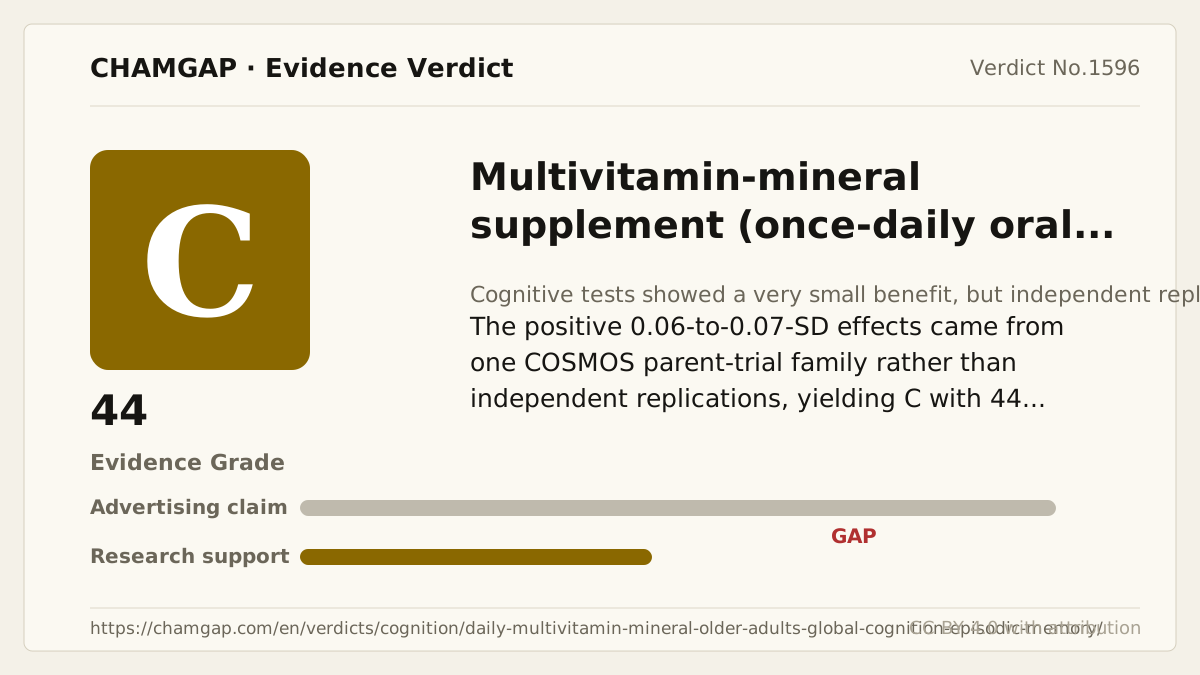
[Chamgap] Multivitamin-mineral supplement x delayed decline in global cognition and episodic memory in older adults — Evidence Grade C·44. 3 cited sources checked. Source: https://chamgap.com/en/verdicts/cognition/daily-multivitamin-mineral-older-adults-global-cognition-episodic-memory/ · CC BY 4.0CC BY 4.0 — free to use with attribution; do not distort grades, numbers, or verdict meaning.
What this document does and does not do
Chamgap is an information source. It reports what research has and has not confirmed; it does not tell readers what to take or buy. That decision belongs to readers and, when needed, medical or legal professionals. This verdict reflects literature available up to the search date and may change as new research appears. Nothing here is medical advice.