
Curry habit,
does it really help with Lower cognitive decline and incidence of mild cognitive impairment or dementia?
research showsThe grade is C with 54 points. In a 4.5-year cohort, some curry-frequency groups had less cognitive decline, and incident mild cognitive impairment or dementia decreased across frequency. Yet the fully adjusted trend for a two-point MMSE decline was null at P=0.15, and the study measured neither curry amount, turmeric, nor curcumin, so prevention by curry or curcumin is not established.
ads claimCurry is a meal containing multiple spices and ingredients, not isolated turmeric. Verdict 064 is C with 48 points for curcumin or turmeric extract and joint outcomes; this verdict addresses whole curry meals and cognitive events.
Useful facts when choosing a product
- Curry combines turmeric with other spices, fat, and main ingredients.
- A single curry-frequency question was used, and validation of that item itself was not reported. Serving grams, turmeric grams, and curcumin milligrams were not measured, so tablespoon or pinch conversion is impossible.
- The paper analyzed cognitive decline and incident MCI-dementia separately, and their fully adjusted patterns differed.
Chamgap Semantic Classification Code
Candidate index · review held
F.curry-meals-combining-turmeric-with-other-spices.food.cognitive-decline-and-incidence-of-mild-cognitive-impairment-or-dementia.reduce.UNKFoods and beverages > Curry meals combining turmeric with other spices > Food consumption > cognitive decline and incidence of mild cognitive impairment or dementia > Reduction claim > Unknown
An automated migration candidate, not an issued permanent code; exact claim scope remains under review. This machine-generated migration candidate helps retrieval but is not a permanent assignment. The original verdict ID and URL remain authoritative.
What the research actually shows
Of 5,035 participants with baseline curry data, 2,920 had follow-up MMSE data at a mean 4.5 years and 432 declined by at least two points. Incident MCI-dementia was analyzed separately in 2,446 cognitively normal participants. Exposure was a single curry-frequency question ranging from rare or never to daily, and validation of that item itself was not reported. Validation of a separate 163-item food-frequency questionnaire cannot substitute for validation of this question. Models adjusted for education but not income; serving weight, turmeric, and curcumin were not collected. No prospective analysis registration was presented, and public agencies funded the cohort.
Why this is classified as C (54)
A publicly funded prospective cohort found an important cognitive-event signal, but split core outcomes, unquantified exposure, and follow-up selection limit it to C with 54 points.
Counterpoint. C does not mean curry fails to prevent decline; it means the meal and dose capable of reproducing the association are unknown.
Rejudgment record. Cross-check applied — The 2025 article's two outcome tables, fully adjusted trends, selected analysis populations, exposure question, funding, and the existing curcumin verdict were cross-checked
| Endpoint | H | Hard endpoint - actual events such as death |
| Replication | R1 | Single confirmatory trial |
| Independence | I2 | Decisive evidence is publicly or non-profit funded |
| Effect size | EX | The clinical size of the effect could not be judged |
Stored derived and displayed grades match; this is not a current recalculation or validity check (C).
Sub-claim grades by effect
This ingredient is marketed for several effects. A single overall grade blends strong and weak claims together, so each effect is graded separately here. The overall grade reflects the strongest disconfirming or core claim.
| Effect (sub-claim) | Grade | Basis |
|---|---|---|
| Lower incidence of an MMSE decline of at least two points | D | Only one frequency group was significant and the fully adjusted overall trend was P=0.15. |
| Lower incident mild cognitive impairment or dementia | C | The frequency trend was positive but came from one observational cohort. |
| Curcumin alone explains the association | ? | Turmeric and curcumin amounts were not measured. |
Cross-check — AI research and Codex final gate
Evidence Table
| Study | Design | Sample | Funding | Endpoint | Result | Weight |
|---|---|---|---|---|---|---|
| Lu Y et al. 2025 Singapore Longitudinal Ageing Study | Population-based prospective cohort analysis | 2,920 with 432 cognitive-decline events; 2,446 assessed for incident MCI-dementia | Public funding from the A*STAR Biomedical Research Council and National Medical Research Council | MMSE decline of at least two points and incident MCI-dementia | Incident MCI-dementia ORs 0.61 (0.40-0.94), 0.56 (0.35-0.89), 0.54 (0.30-0.96), and 0.21 (0.09-0.49), trend P=0.021; MMSE-decline ORs 0.73 (0.53-1.01), 0.68 (0.48-0.95), 0.74 (0.50-1.11), and 0.66 (0.41-1.06), trend P=0.150 | Single observational cohort with divergent core outcomes |
Receipt — 1 References
All 1 cited sources were verified for existence at the original page (as of 2026-08-03).
Final verification and publication gate: Codex · Evidence date: 2026-08-03 · Corrections: none
Cite this verdict
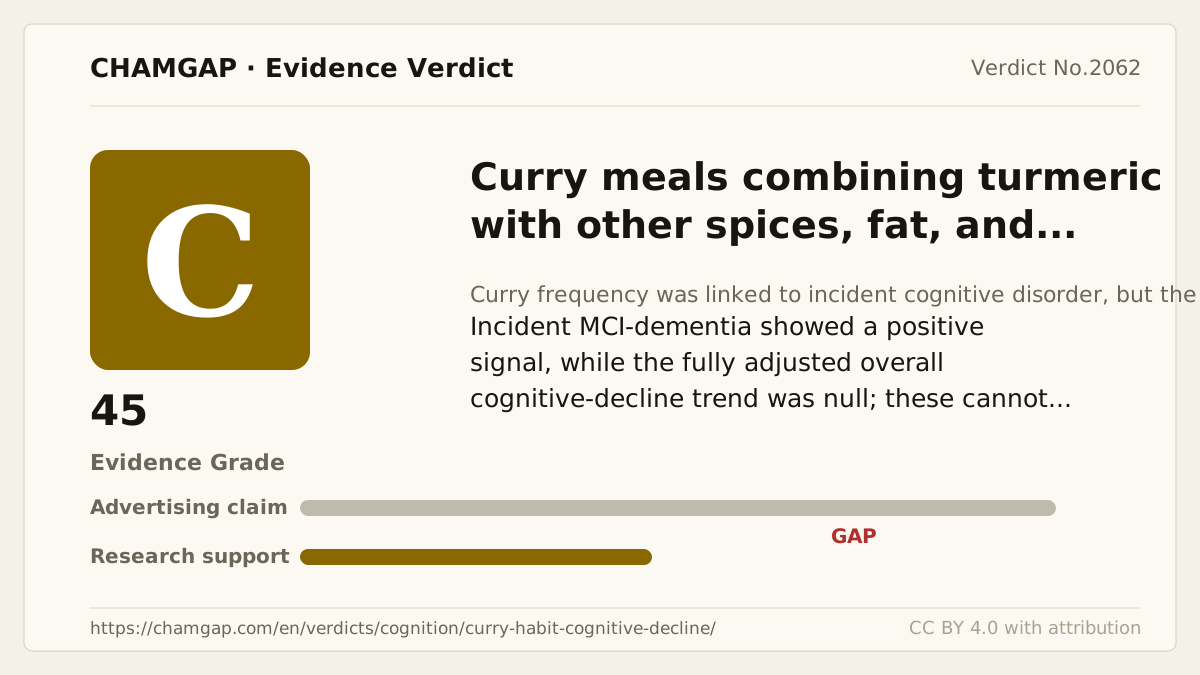
[Chamgap] Curry habit x less cognitive decline — Evidence Grade C·54. 1 cited sources checked. Source: https://chamgap.com/en/verdicts/cognition/curry-habit-cognitive-decline/ · CC BY 4.0CC BY 4.0 — free to use with attribution; do not distort grades, numbers, or verdict meaning.
What this document does and does not do
Chamgap is an information source. It reports what research has and has not confirmed; it does not tell readers what to take or buy. That decision belongs to readers and, when needed, medical or legal professionals. This verdict reflects literature available up to the search date and may change as new research appears. Nothing here is medical advice.