
Drinking coffee, at least 828 mL/day,
does it really help with Prevention of incident Parkinson disease?
research showsThe grade is C. In 8,004 Japanese-American men followed for 30 years, Parkinson disease occurred in 32/1,286 nondrinkers and 4/959 men drinking at least 28 oz/day; age-adjusted incidence was 10.4 versus 1.9 per 10,000 person-years. This was not randomized and cannot be generalized to women.
ads claimCaffeine content and a lower Parkinson incidence were associated, but lifelong genetic exposure is not today's cup and the cohort did not assign coffee.
Useful facts when choosing a product
- Twenty-eight fluid ounces is about 828 mL.
- Brewing method and measured caffeine content were not reported.
- FDA's general 113 to 247 mg per 355 mL regular brewed coffee is background, not a study measurement.
Chamgap Semantic Classification Code
Candidate index · review held
F.drinking-coffee.food.incident-parkinson-disease.prevent.UNKFoods and beverages > Drinking coffee > Food consumption > incident Parkinson disease > Occurrence-prevention claim > Unknown
An automated migration candidate, not an issued permanent code; exact claim scope remains under review. This machine-generated migration candidate helps retrieval but is not a permanent assignment. The original verdict ID and URL remain authoritative.
What the research actually shows
The cohort enrolled 8,004 Japanese-American men aged 45 to 68 in 1965 to 1968 and identified 102 cases over up to 30 years. Smoking was adjusted using pack-years measured at baseline and six years later. The earliest case occurred two years after baseline; there was no blanket early-years exclusion, though analyses split the first and second 15 years. Funding details could not be confirmed in the accessible article, so independent funding was not assumed.
Why this is classified as C (54)
A large hard-outcome association is limited by one male cohort, contaminated reference group, prodromal behavior, and few events, giving C with 54 points.
Counterpoint. Prospective midlife measurement and smoking-stratified analyses are real strengths.
Rejudgment record. Cross-check applied — A strong long-term male-cohort association remained limited by prodromal behavior, reference-group contamination, and a null genetic analysis
| Endpoint | H | Hard endpoint - actual events such as death |
| Replication | R1 | Single confirmatory trial |
| Independence | I1 | Mixed funding sources |
| Effect size | E+ | Meets the clinically important threshold |
Stored derived and displayed grades match; this is not a current recalculation or validity check (C).
Sub-claim grades by effect
This ingredient is marketed for several effects. A single overall grade blends strong and weak claims together, so each effect is graded separately here. The overall grade reflects the strongest disconfirming or core claim.
| Effect (sub-claim) | Grade | Basis |
|---|---|---|
| Reduced long-term Parkinson incidence in men | C | The prospective association was strong but not causal trial evidence. |
Cross-check — AI research and Codex final gate
Evidence Table
| Study | Design | Sample | Funding | Endpoint | Result | Weight |
|---|---|---|---|---|---|---|
| Ross et al. 2000 Honolulu Heart Program | Prospective male cohort | 8,004 men and 102 Parkinson cases | Detailed funding not confirmed in the accessible article | Incident Parkinson disease over up to 30 years | Adjusted relative hazard, nondrinkers versus at least 28 oz/day: 5.1 (1.8-14.4) | Core long-term observational evidence |
| Larsson et al. 2022 Mendelian randomization | Two-sample Mendelian randomization | FinnGen and IPDGC combined | Public research support | Parkinson disease | Genetically predicted plasma caffeine OR 0.92 (0.77-1.10) | Lifelong-exposure cross-check; null |
Receipt — 2 References
All 2 cited sources were verified for existence at the original page (as of 2026-08-04).
Final verification and publication gate: Codex · Evidence date: 2026-08-04 · Corrections: none
Cite this verdict
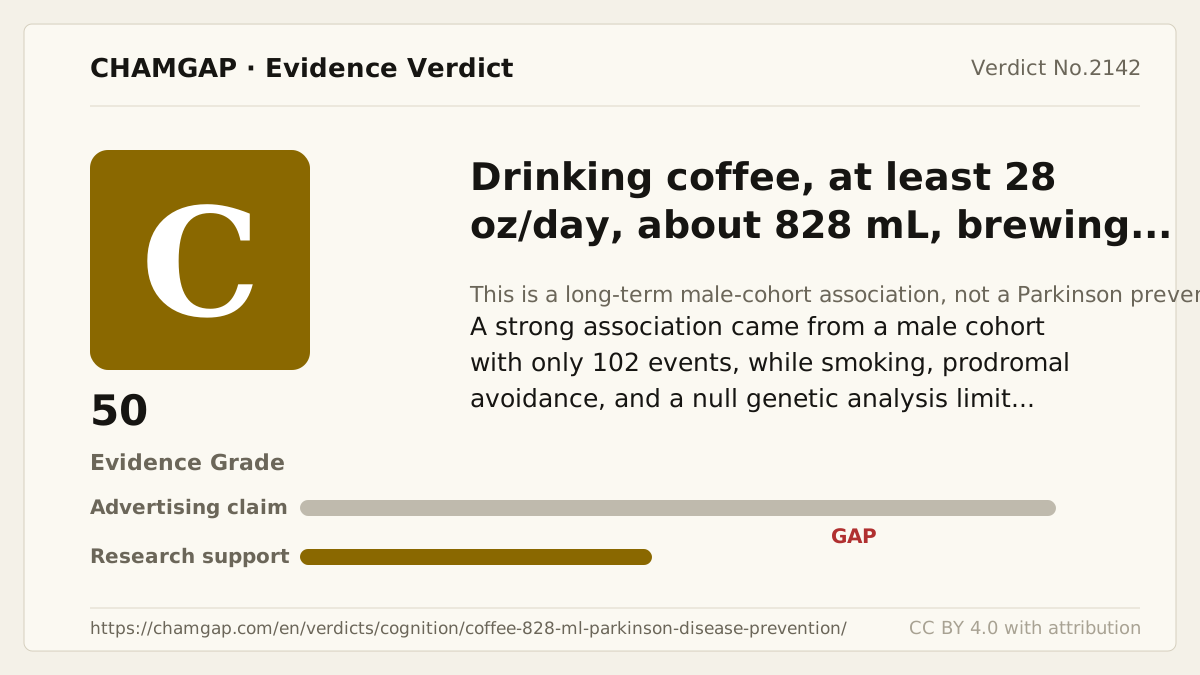
[Chamgap] Drinking coffee, at least 828 mL/day x Parkinson disease prevention — Evidence Grade C·54. 2 cited sources checked. Source: https://chamgap.com/en/verdicts/cognition/coffee-828-ml-parkinson-disease-prevention/ · CC BY 4.0CC BY 4.0 — free to use with attribution; do not distort grades, numbers, or verdict meaning.
What this document does and does not do
Chamgap is an information source. It reports what research has and has not confirmed; it does not tell readers what to take or buy. That decision belongs to readers and, when needed, medical or legal professionals. This verdict reflects literature available up to the search date and may change as new research appears. Nothing here is medical advice.