
Coenzyme Q10,
does it really help with Delayed UPDRS functional decline and disease progression in early Parkinson disease?
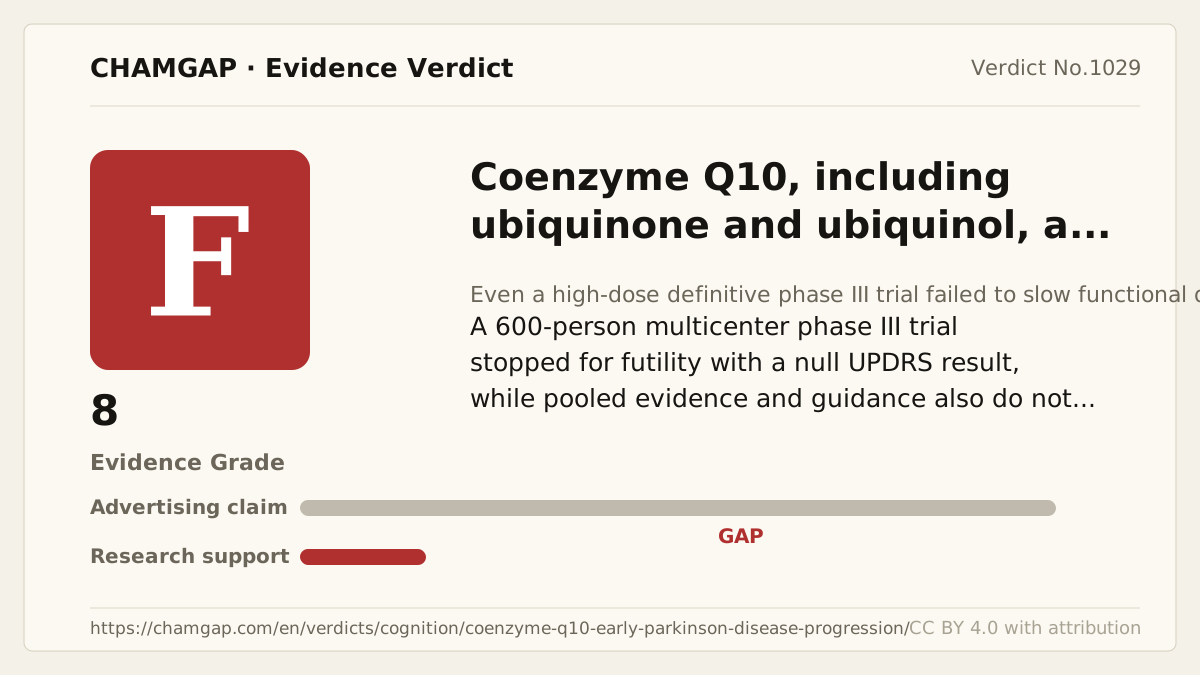
research showsCoenzyme Q10 is rated F because it does not delay UPDRS functional decline or disease progression in early Parkinson disease. The publicly funded phase III QE3 trial randomized 600 participants across 67 centers to placebo, CoQ10 at 1,200 mg/day, or CoQ10 at 2,400 mg/day, with vitamin E given to all groups. The study stopped after crossing its prespecified futility boundary, and adjusted total UPDRS worsening was 6.9 points with placebo, 7.5 points with 1,200 mg, and 8.0 points with 2,400 mg, showing no benefit at either dose. A meta-analysis of eight randomized trials and 899 participants found no advantage on UPDRS parts I, II, III, or total score, and NICE advises against neuroprotective use outside clinical trials. An early small positive study was refuted by definitive phase III and pooled evidence, giving F with 8 points. CoQ10 was generally tolerated, with mild gastrointestinal effects, but safety does not alter the null efficacy result.
ads claimMarketing links mitochondrial electron transfer, antioxidant activity, protection of dopaminergic neurons in animals, and higher blood CoQ10 levels to slowed Parkinson progression. QE3 showed that adequate plasma exposure did not slow clinical UPDRS decline, so mechanism and absorption markers cannot be converted into a disease-modifying outcome.
Useful facts when choosing a product
- CoQ10 supplements are sold as oxidized ubiquinone and reduced ubiquinol, and formulation and coadministration with fat can affect absorption and plasma concentration.
- QE3 used 1,200 to 2,400 mg/day, far above common supplement doses, and every group also received 1,200 IU/day of vitamin E, but neither CoQ10 dose slowed UPDRS progression.
- Management of motor and nonmotor Parkinson symptoms and medication adjustment requires neurological care, and CoQ10 should not delay initiation or modification of levodopa or other validated treatment.
- CoQ10 is generally tolerated, but nausea, heartburn, diarrhea, and other mild gastrointestinal effects can occur. Possible effects on warfarin response and blood pressure warrant review with a clinician for people taking anticoagulants or antihypertensive medicines.
Chamgap Semantic Classification Code
Candidate index · review held
S.coenzyme-q10.UNK.delayed-updrs-functional-decline-and-disease-progression-in-early-parkinson-disease.reduce.placeboSupplements and nutraceuticals > Coenzyme Q10 > Unknown > Delayed UPDRS functional decline and disease progression in early Parkinson disease > Reduction claim > Placebo
An automated migration candidate, not an issued permanent code; exact claim scope remains under review. This machine-generated migration candidate helps retrieval but is not a permanent assignment. The original verdict ID and URL remain authoritative.
What the research actually shows
QE3 enrolled people diagnosed within five years, with a Hoehn and Yahr stage of 2.5 or less and no immediate anticipated need for dopaminergic therapy, at 67 North American centers. Six hundred participants received placebo, CoQ10 at 1,200 mg/day, or CoQ10 at 2,400 mg/day, and every group received vitamin E at 1,200 IU/day. The study was powered for a three-point UPDRS difference, but adjusted mean worsening was 6.9, 7.5, and 8.0 points, respectively; the placebo comparisons yielded p=0.49 and p=0.21. The Storch trial in 131 people with midstage disease also found no difference in three-month UPDRS II plus III change with 300 mg/day. The 2017 meta-analysis found no motor benefit across eight trials and 899 participants with moderate-to-high certainty.
Why this is classified as F (8)
An independently publicly funded multicenter phase III trial in 600 people with early Parkinson disease stopped for prespecified futility and found no slowing of total UPDRS worsening at either high dose. A meta-analysis of eight trials and 899 participants was null across all major UPDRS domains, and NICE advises against neuroprotective use outside trials. The early small positive signal was repeatedly refuted by definitive and pooled evidence, giving F with 8 points. Generally favorable tolerability remains separate from efficacy.
Counterpoint. A different formulation such as ubiquinol or targeted delivery must show more than higher blood levels to change this verdict. An adequately powered independent multicenter placebo trial would need consistent benefit on prespecified clinical disease-modification endpoints, including UPDRS, time to symptomatic treatment, quality of life, and function.
Rejudgment record. New verdict — Applied F for repeated refutation and guidance against use because the publicly funded 67-center QE3 phase III trial in 600 people with early Parkinson disease stopped at its prespecified futility boundary and found total UPDRS worsening of 6.9 points with placebo, 7.5 with 1,200 mg, and 8.0 with 2,400 mg of CoQ10; a meta-analysis of eight trials and 899 participants was null on UPDRS parts I, II, III, and total score, and NICE advises against neuroprotective use outside clinical trials. Other CoQ10 efficacy axes were kept separate
Sub-claim grades by effect
This ingredient is marketed for several effects. A single overall grade blends strong and weak claims together, so each effect is graded separately here. The overall grade reflects the strongest disconfirming or core claim.
| Effect (sub-claim) | Grade | Basis |
|---|---|---|
| Delayed UPDRS functional decline in early Parkinson disease | F | Neither high dose slowed total UPDRS worsening in QE3, which stopped for futility. |
| Delayed disease progression in early Parkinson disease | F | The 600-person phase III trial and meta-analysis of eight randomized trials did not support delayed clinical progression. |
| Neuroprotection in early Parkinson disease | F | Preclinical mechanisms and the early signal were not replicated in the definitive trial, and NICE advises against use outside clinical trials. |
Cross-check — AI research and Codex final gate
Evidence Table
| Study | Design | Sample | Funding | Endpoint | Result | Weight |
|---|---|---|---|---|---|---|
| Parkinson Study Group QE3 Investigators. 2014 | Phase III randomized double-blind placebo-controlled trial at 67 centers | 600 participants with early Parkinson disease | Public grants from the United States NINDS, with minority-enrollment support from the Parkinson's Disease Foundation | Change in total UPDRS parts I through III over 16 months or until disability required dopaminergic treatment | The study stopped for prespecified futility; adjusted worsening was 6.9 points with placebo, 7.5 with 1,200 mg, and 8.0 with 2,400 mg, with no benefit at either dose. | Definitive large directly matching null trial |
| Zhu ZG et al. 2017 | Meta-analysis of placebo-controlled randomized trials | Eight studies and 899 participants | Academic synthesis; no industry funding reported in the PubMed abstract | UPDRS parts I, II, III, total score, and tolerability | Motor UPDRS part III had a weighted mean difference of 1.02 with p=0.54, and other UPDRS domains also did not differ from placebo. | Pooled repeated null evidence |
| NICE NG71 Parkinson's disease guideline | Evidence-based clinical guideline | Neuroprotective-treatment literature in Parkinson disease | Public guideline development in the United Kingdom | Neuroprotection and delayed disease progression | Recommended against use of CoQ10 as neuroprotective therapy except in a clinical trial. | Guidance against use for unproven efficacy |
Receipt — 4 References
All 4 cited sources were verified for existence at the original page (as of 2026-07-21).
Final verification and publication gate: Codex · Evidence date: 2026-07-21 · Corrections: none
Cite this verdict
[Chamgap] Coenzyme Q10 x delayed functional decline and progression in early Parkinson disease — Evidence Grade F·8. 4 cited sources checked. Source: https://chamgap.com/en/verdicts/cognition/coenzyme-q10-early-parkinson-disease-progression/ · CC BY 4.0CC BY 4.0 — free to use with attribution; do not distort grades, numbers, or verdict meaning.
What this document does and does not do
Chamgap is an information source. It reports what research has and has not confirmed; it does not tell readers what to take or buy. That decision belongs to readers and, when needed, medical or legal professionals. This verdict reflects literature available up to the search date and may change as new research appears. Nothing here is medical advice.