
Citicoline,
does it really help with Improved age-related memory and cognitive function in middle-aged and older adults?
research showsCiticoline is rated C rather than ? because randomized memory trials in middle-aged and older adults do exist, but findings conflict and are limited by small samples, post hoc subgroups, and branded-ingredient funding concentration. A 2021 trial of Cognizin 500 mg in 100 people improved secondary episodic- and composite-memory outcomes after 12 weeks, while the primary outcome was nonsignificant. A 1996 trial in 95 people also found delayed-recall benefit only in a post hoc subgroup with inefficient baseline memory rather than the full group, and EFSA concluded that a causal relationship had not been established.
ads claimMarketing expands brain-membrane renewal, restoration of aging memory, and global cognitive enhancement from a 12-week secondary outcome on specific computerized memory tasks. The signal cannot be generalized to dementia prevention, preserved daily function, stroke recovery, or better attention in every healthy person.
Useful facts when choosing a product
- Citicoline is also called CDP-choline, and studies and marketed supplements use branded ingredients such as Cognizin.
- The 2021 healthy older-adult trial used 500 mg per day for 12 weeks, and its positive findings were secondary episodic- and composite-memory outcomes.
- Evidence from post-stroke cognitive impairment, vascular cognitive impairment, or dementia belongs to a different clinical track from age-related memory claims in healthy adults.
- Short studies suggest generally good tolerability, but gastrointestinal discomfort, headache, insomnia, or agitation can occur and large long-term safety data remain limited.
Chamgap Semantic Classification Code
Candidate index · review held
S.citicoline.UNK.age-related-memory-and-cognitive-function-in-middle-aged-and-older-adults.improve.placeboSupplements and nutraceuticals > Citicoline > Unknown > age-related memory and cognitive function in middle-aged and older adults > Improvement claim > Placebo
An automated migration candidate, not an issued permanent code; exact claim scope remains under review. This machine-generated migration candidate helps retrieval but is not a permanent assignment. The original verdict ID and URL remain authoritative.
What the research actually shows
Nakazaki 2021 randomized 100 healthy adults aged 50 to 85 years with age-associated memory impairment to Cognizin 500 mg per day or placebo. Ninety-nine completed the trial; episodic memory and a composite of four tests improved, but these were secondary outcomes and the primary spatial short-term memory outcome was nonsignificant. Authors and funding were linked to ingredient supplier Kyowa Hakko Bio. Spiers 1996 randomized 95 adults aged 50 to 85 years to 1 gram per day or placebo, found no full-sample effect, and reported delayed-recall improvement only after identifying a subgroup with inefficient memory. The 2024 EFSA assessment reviewed three pertinent healthy-person intervention studies and concluded that benefits were inconsistent and a convincing human mechanism was lacking.
Why this is classified as C (42)
Randomized healthy-person trials rule out ?, but the 100-person trial missed its primary spatial short-term memory outcome and was positive only on some secondary outcomes, while the 95-person trial produced a post hoc subgroup signal. Small samples, ingredient-supplier concentration, and EFSA's synthesis of conflicting evidence yield C with 42 points. EFSA's unestablished-causality conclusion was not regulatory opposition to use and was not expanded to F.
Counterpoint. New or progressive memory difficulty calls first for evaluation of sleep, depression, hearing, medicines, thyroid disease, vitamin deficiency, and neurodegenerative disease. A small change on a cognitive task does not establish improved daily function or lower dementia risk.
Rejudgment record. New verdict — Excluded ? because randomized trials exist, but applied C for a nonsignificant primary spatial short-term memory outcome in the 100-person trial, only some positive secondary outcomes, a post hoc signal in the 95-person trial, small samples, supplier concentration, and EFSA's synthesis of conflicting evidence; EFSA was not treated as regulatory opposition to use
Sub-claim grades by effect
This ingredient is marketed for several effects. A single overall grade blends strong and weak claims together, so each effect is graded separately here. The overall grade reflects the strongest disconfirming or core claim.
| Effect (sub-claim) | Grade | Basis |
|---|---|---|
| Improved age-related memory and cognition in middle-aged and older adults | C | Small trials show limited positive signals, but the evidence conflicts and includes a null primary outcome, post hoc subgroup dependence, and supplier concentration. |
| Medical contexts such as stroke and vascular cognitive impairment | C | Disease-population studies exist, but differing designs, conditions, and co-treatments prevent direct attribution to healthy-aging memory claims. |
| Global cognitive enhancement and dementia prevention in all healthy people | ? | No adequate human efficacy literature directly evaluates long-term dementia incidence or daily function. |
Cross-check — AI research and Codex final gate
Evidence Table
| Study | Design | Sample | Funding | Endpoint | Result | Weight |
|---|---|---|---|---|---|---|
| Nakazaki E et al. 2021 | Randomized double-blind placebo-controlled trial | One hundred healthy adults aged 50 to 85 years with age-associated memory impairment; 99 completed | Funded by Kyowa Hakko Bio with ingredient-supplier employees among the authors | Primary spatial short-term memory outcome and secondary episodic, composite, and working-memory outcomes | After 500 mg per day for 12 weeks, secondary episodic- and composite-memory outcomes improved, but the primary outcome was nonsignificant. | Direct positive signal limited by secondary outcomes and supplier concentration |
| Spiers PA et al. 1996 | Randomized double-blind placebo-controlled parallel trial followed by a post hoc subgroup crossover study | Ninety-five healthy adults aged 50 to 85 years; 32 entered the post hoc inefficient-memory crossover study | United States public support and company-supplied drug; author patent and company interests disclosed in a correction | Immediate and delayed logical-memory recall | One gram per day for three months was ineffective in the full sample, with delayed-recall benefit only in a post hoc subgroup with inefficient baseline memory. | Key trial demonstrating conflict and subgroup dependence |
| EFSA NDA Panel 2024 | Scientific assessment of a health-claim application | Three pertinent healthy-person intervention studies plus supportive disease-population data | Independent European Food Safety Authority assessment | Causality for improving or maintaining memory or reducing memory loss in middle-aged and older adults | One positive trial was not supported by another healthy-person study or dementia data, so causality was judged unestablished. | Independent synthesis of the conflicting evidence |
Receipt — 3 References
All 3 cited sources were verified for existence at the original page (as of 2026-07-19).
Final verification and publication gate: Codex · Evidence date: 2026-07-19 · Corrections: none
Cite this verdict
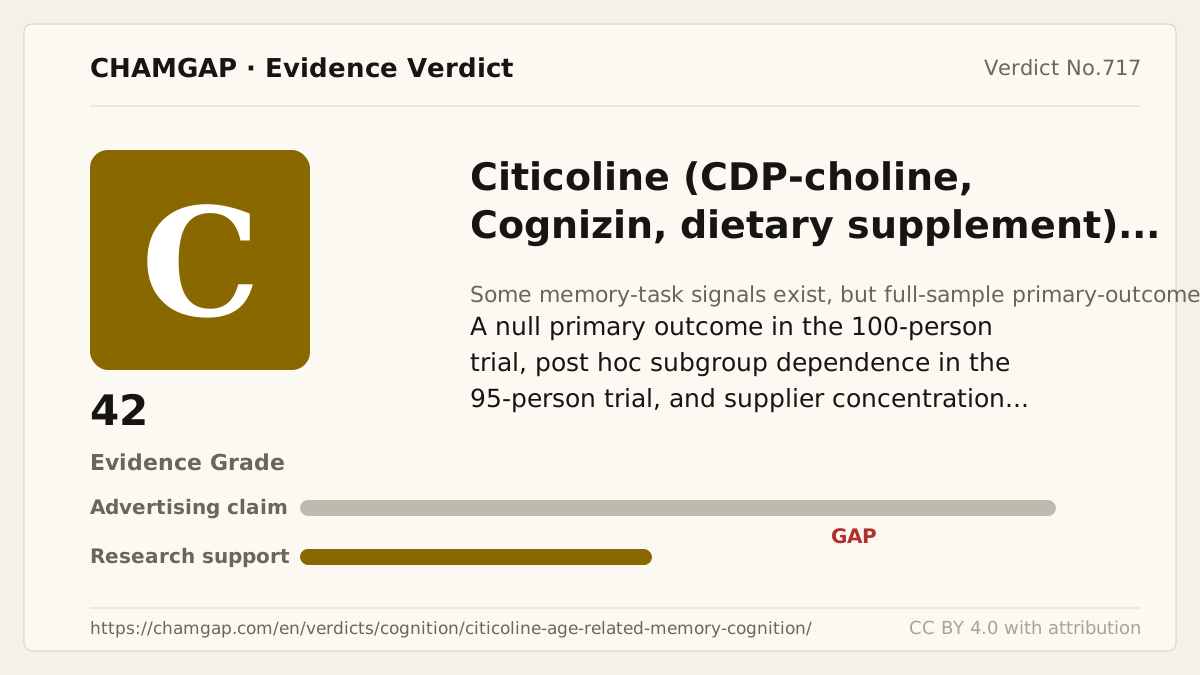
[Chamgap] Citicoline x improved age-related memory and cognitive function — Evidence Grade C·42. 3 cited sources checked. Source: https://chamgap.com/en/verdicts/cognition/citicoline-age-related-memory-cognition/ · CC BY 4.0CC BY 4.0 — free to use with attribution; do not distort grades, numbers, or verdict meaning.
What this document does and does not do
Chamgap is an information source. It reports what research has and has not confirmed; it does not tell readers what to take or buy. That decision belongs to readers and, when needed, medical or legal professionals. This verdict reflects literature available up to the search date and may change as new research appears. Nothing here is medical advice.