
Cataract surgery,
does it really help with Reduced incident dementia in older adults?
research showsThe grade is B. This is prospective cohort evidence, not a randomized trial. Among 3,038 ACT participants with cataract, 853 developed dementia over a mean 7.8 years, and dementia hazard after surgery was lower than during presurgical or nonsurgical person-time (HR 0.71, 95% CI 0.62 to 0.83). Surgery was time varying, so the paper did not report a valid fixed two-group crude dementia proportion. Healthy-surgery selection and reverse causation from emerging dementia delaying surgery cannot be fully removed.
ads claimAn observational association after surgery must not be presented as randomized proof of dementia prevention. Emerging dementia can delay surgery, and access, function, and baseline health can differ before surgery.
Useful facts when choosing a product
- The ACT analysis was a population-based prospective cohort, not a randomized trial, and treated surgery as a time-varying exposure.
- ACT reported 504 cases over 15,941 person-years before or without surgery and 320 over 7,603 person-years after surgery; these are time-varying rates, not fixed-group proportions.
- Verdict 1402 is B with 72 points for falls and fractures, whereas this verdict concerns the distinct endpoint of incident dementia.
Chamgap Semantic Classification Code
Candidate index · review held
P.cataract-extraction.procedural.incident-dementia.reduce.UNKProcedures, devices and tests > Cataract extraction > Procedural > incident dementia > Reduction claim > Unknown
An automated migration candidate, not an issued permanent code; exact claim scope remains under review. This machine-generated migration candidate helps retrieval but is not a permanent assignment. The original verdict ID and URL remain authoritative.
What the research actually shows
Lee and colleagues prospectively followed 3,038 ACT participants aged 65 years or older with cataract. Across 23,554 person-years, mean 7.8 years, 853/3,038 (28.1%) developed dementia and 1,382/3,038 (45.5%) underwent surgery. There were 504 cases over 15,941 person-years before or without surgery, 0.033 per person-year, and 320 cases over 7,603 person-years after surgery, 0.042 per person-year. These are crude time-varying person-time rates, not proportions from two fixed groups. Adjusted time-varying HR was 0.71; HR was 0.68 within five years after surgery and 0.76 thereafter. Analyses excluded a two-year prediagnosis interval and adjusted cognition at cataract diagnosis. Ma and colleagues followed 300,823 UK Biobank participants for a mean 8.4 years, observed 3,226 dementia cases, and reported HR 0.632 for surgery versus no surgery among those with cataract.
Why this is classified as B (76)
US ACT and UK Biobank had nonoverlapping authors and different funding and pointed in the same conceptual direction, but different populations and exposure definitions prevent same-estimand replication. ACT performed lag, cognition-adjusted, marginal-structural, and negative-control analyses, giving B with 76 points.
Counterpoint. Cataract surgery remains standard care for visual impairment. This verdict only asks whether dementia prevention is established as an additional benefit.
Rejudgment record. Cross-check applied — Cross-check of ACT and UK Biobank for prospective design, time-varying exposure, reverse-causation analyses, negative control, author overlap, funding, and event estimates
| Endpoint | H | Hard endpoint - actual events such as death |
| Replication | R1 | Single confirmatory trial |
| Independence | I2 | Decisive evidence is publicly or non-profit funded |
| Effect size | E+ | Meets the clinically important threshold |
Stored derived and displayed grades match; this is not a current recalculation or validity check (B).
Sub-claim grades by effect
This ingredient is marketed for several effects. A single overall grade blends strong and weak claims together, so each effect is graded separately here. The overall grade reflects the strongest disconfirming or core claim.
| Effect (sub-claim) | Grade | Basis |
|---|---|---|
| Reduced incident dementia after cataract surgery | B | Two prospective cohorts replicated a lower association, but causality is not established. |
Cross-check — AI research and Codex final gate
Evidence Table
| Study | Design | Sample | Funding | Endpoint | Result | Weight |
|---|---|---|---|---|---|---|
| Lee CS et al. 2022 ACT | Population-based prospective cohort with time-varying exposure | 3,038 participants with cataract; 23,554 person-years; mean 7.8 years | Public and nonprofit funding including the US National Institute on Aging and National Eye Institute | Incident all-cause dementia adjudicated by expert consensus | Before or without surgery, 504 cases/15,941 person-years (0.033/person-year); after surgery, 320/7,603 (0.042/person-year); adjusted time-varying HR 0.71 (95% CI 0.62 to 0.83). | Primary prospective cohort |
| Ma LZ et al. 2023 UK Biobank | Prospective cohort | 300,823 participants; mean 8.4 years; 3,226 dementia cases | Public funding including the National Natural Science Foundation of China | Incident all-cause dementia | Among participants with cataract, surgery versus no surgery HR 0.632 (95% CI 0.421 to 0.947), with no author overlap with ACT. | Independent replication |
Receipt — 2 References
All 2 cited sources were verified for existence at the original page (as of 2026-08-06).
Final verification and publication gate: Codex · Evidence date: 2026-08-06 · Corrections: none
Cite this verdict
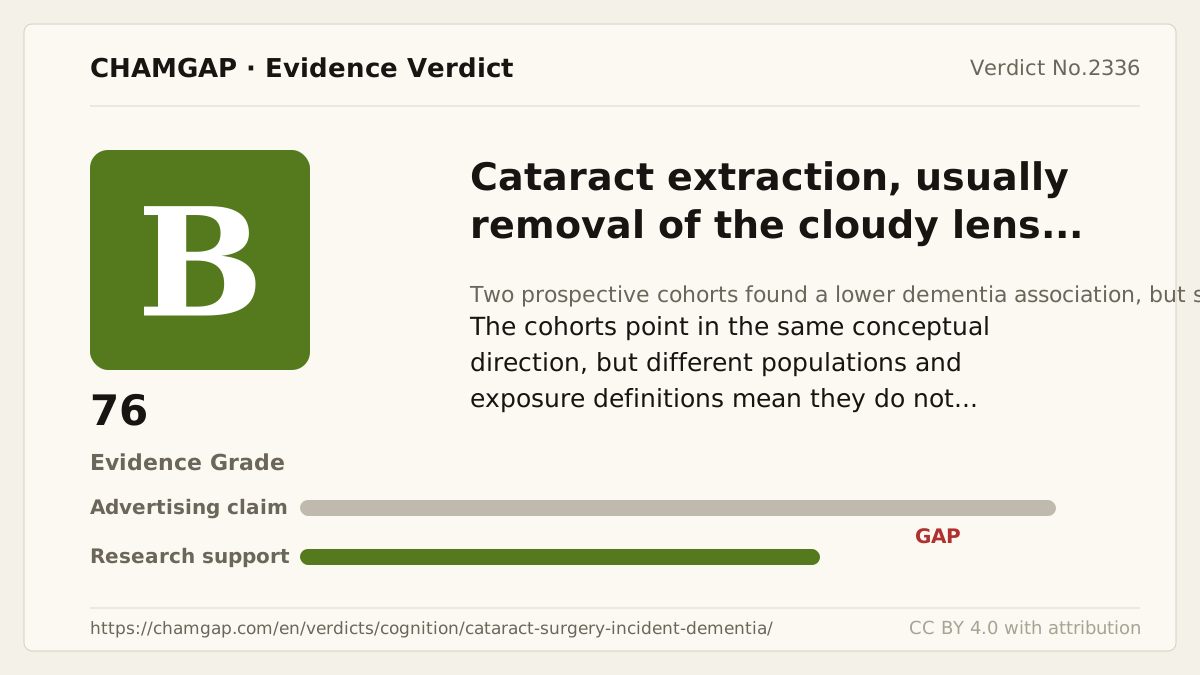
[Chamgap] Cataract surgery x reduced incident dementia — Evidence Grade B·76. 2 cited sources checked. Source: https://chamgap.com/en/verdicts/cognition/cataract-surgery-incident-dementia/ · CC BY 4.0CC BY 4.0 — free to use with attribution; do not distort grades, numbers, or verdict meaning.
What this document does and does not do
Chamgap is an information source. It reports what research has and has not confirmed; it does not tell readers what to take or buy. That decision belongs to readers and, when needed, medical or legal professionals. This verdict reflects literature available up to the search date and may change as new research appears. Nothing here is medical advice.