
Beetroot juice,
does it really help with Cognitive performance and cerebral blood flow in older adults?
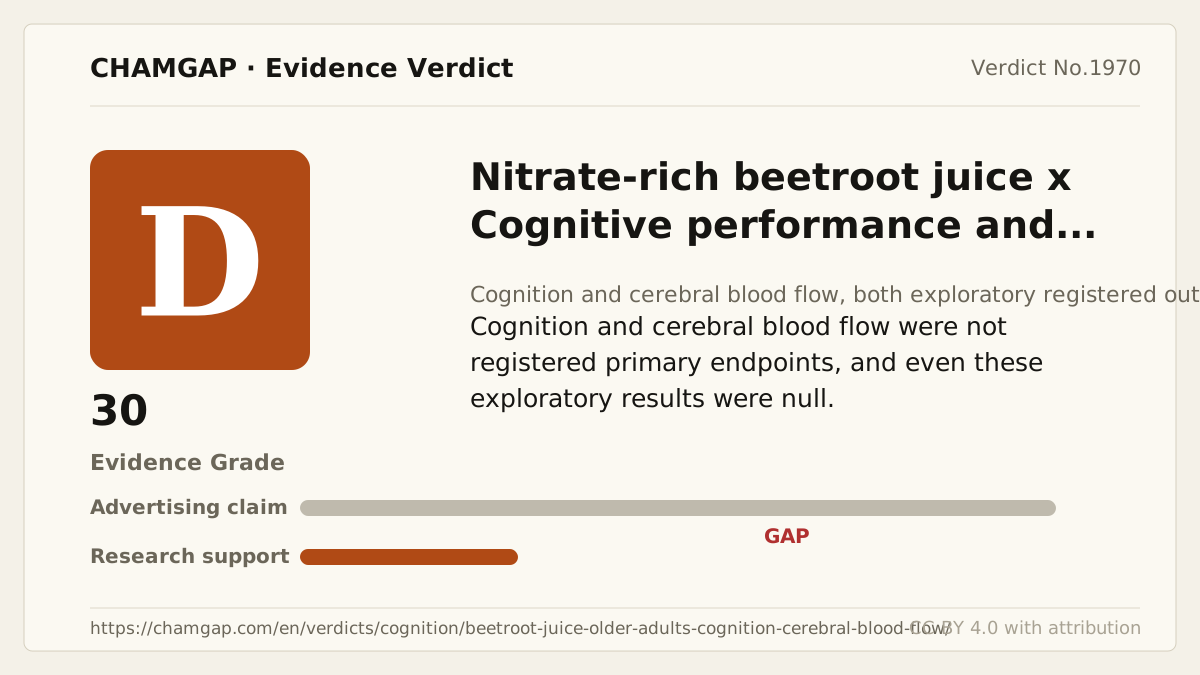
research showsThe grade is D with 30 points. In a 13-week trial that randomized 62 people, only 50 entered cognition analyses and 47 cerebral-blood-flow analyses, and neither outcome differed between groups. The registry's primary outcomes were feasibility measures such as adherence and acceptability; cognition and blood flow featured in the paper's title and abstract were secondary exploratory outcomes. Registration was retrospective, completed about six months after first enrolment.
ads claimNitrate's role in nitric-oxide physiology and results in other indications cannot substitute for cognition data in this older population. The trial directly measured cognition and blood flow and found no difference.
Useful facts when choosing a product
- The trial used commercial 70-mL James White Drinks beetroot-juice shots, but company funding, donation, or involvement in analysis was not identified. Dosing was twice daily, daily, or every other day depending on group.
- Ancient teutlon and beta were primarily leaf beets; the familiar edible root beet arose through early-modern European breeding. Culpeper wrote in 1653 that the red beet root was not used as food.
- Dioscorides, Book 2 chapter 149, wrote that the juice of both forms was bad because of nitrous properties. Treating this as ancient evidence for beetroot efficacy confuses plant part and historical form.
- Verdict 077 is B with 72 points for beet and blood pressure or exercise performance, while verdict 1507 is D with 38 points for nitrate-rich beetroot juice in COPD exercise tolerance and dyspnea. The present outcome is cognition and cerebral blood flow in older adults.
- Verdict 1958 is ungraded with no score for Swiss chard and iron-deficiency anemia. Ancient leaf beet and modern beetroot share a lineage but differ in edible part and claimed outcome.
Chamgap Semantic Classification Code
Candidate index · review held
F.nitrate-rich-beetroot-juice.food.cognitive-performance-and-cerebral-blood-flow.assess.placeboFoods and beverages > Nitrate-rich beetroot juice > Food consumption > Cognitive performance and cerebral blood flow > Association or change assessment > Placebo
An automated migration candidate, not an issued permanent code; exact claim scope remains under review. This machine-generated migration candidate helps retrieval but is not a permanent assignment. The original verdict ID and URL remain authoritative.
What the research actually shows
Sixty-two overweight or obese adults aged 60 to 75 were randomized to two nitrate-rich 70-mL shots daily, one shot daily, one shot every other day, or nitrate-depleted placebo every other day in a single-blind four-arm trial. At 13 weeks, only 50 entered cognitive analyses and 47 near-infrared cerebral-blood-flow analyses; neither cognition nor blood flow differed between groups. Main 95% confidence intervals were not reported. First enrolment was July 1, 2018, but registration was completed December 27, 2018, making it retrospective. The registry lists the Royal Embassy of Saudi Arabia Cultural Bureau as sponsor and funder, while the paper emphasizes Newcastle University's core research budget. Commercial James White Drinks juice was used, but company funding, donation, or involvement in analysis was not identified.
Why this is classified as D (30)
All exploratory cognition and blood-flow outcomes were null in one small trial, and only 50 and 47 of 62 randomized participants entered those analyses. Missing confidence intervals prevent exclusion of meaningful benefit, giving D with 30 points.
Counterpoint. Its feasibility purpose limits confirmatory power, but the most direct 13-week evidence currently shows no efficacy signal.
Rejudgment record. Cross-check applied — Secondary exploratory cognition and blood-flow outcomes were null in a feasibility trial with 19% to 24% analysis loss
| Endpoint | P | Symptom or function itself is the target - including patient reports and performance tests |
| Replication | R1 | Single confirmatory trial |
| Independence | I2 | Decisive evidence is publicly or non-profit funded |
| Effect size | E0 | Null |
| Precision | CX | No pooled confidence interval could be confirmed |
Stored derived and displayed grades match; this is not a current recalculation or validity check (D).
Sub-claim grades by effect
This ingredient is marketed for several effects. A single overall grade blends strong and weak claims together, so each effect is graded separately here. The overall grade reflects the strongest disconfirming or core claim.
| Effect (sub-claim) | Grade | Basis |
|---|---|---|
| Improved cognitive performance in older adults with beetroot juice | D | Registered secondary exploratory results were null. |
| Improved cerebral blood flow in older adults with beetroot juice | D | No between-group difference was found in the 47-person analysis. |
Cross-check — AI research and Codex final gate
Evidence Table
| Study | Design | Sample | Funding | Endpoint | Result | Weight |
|---|---|---|---|---|---|---|
| Babateen et al. 2022 | Four-arm single-blind randomized 13-week feasibility trial; registration completed after first enrolment | 62 randomized; 50 analyzed for cognition and 47 for cerebral blood flow | Registry: Royal Embassy of Saudi Arabia Cultural Bureau sponsor and funder; paper: Newcastle University core research budget | Cognitive testing and near-infrared cerebral blood flow | All between-group P values above 0.05; main 95% CIs not reported | Null secondary exploratory outcomes in a retrospectively registered trial |
Receipt — 2 References
All 2 cited sources were verified for existence at the original page (as of 2026-08-02).
Final verification and publication gate: Codex · Evidence date: 2026-08-02 · Corrections: none
Cite this verdict
[Chamgap] Beetroot juice x cognitive performance and cerebral blood flow in older adults — Evidence Grade D·30. 2 cited sources checked. Source: https://chamgap.com/en/verdicts/cognition/beetroot-juice-older-adults-cognition-cerebral-blood-flow/ · CC BY 4.0CC BY 4.0 — free to use with attribution; do not distort grades, numbers, or verdict meaning.
What this document does and does not do
Chamgap is an information source. It reports what research has and has not confirmed; it does not tell readers what to take or buy. That decision belongs to readers and, when needed, medical or legal professionals. This verdict reflects literature available up to the search date and may change as new research appears. Nothing here is medical advice.