
Atogepant,
does it really help with Reduction in monthly migraine days in adults with episodic or chronic migraine?
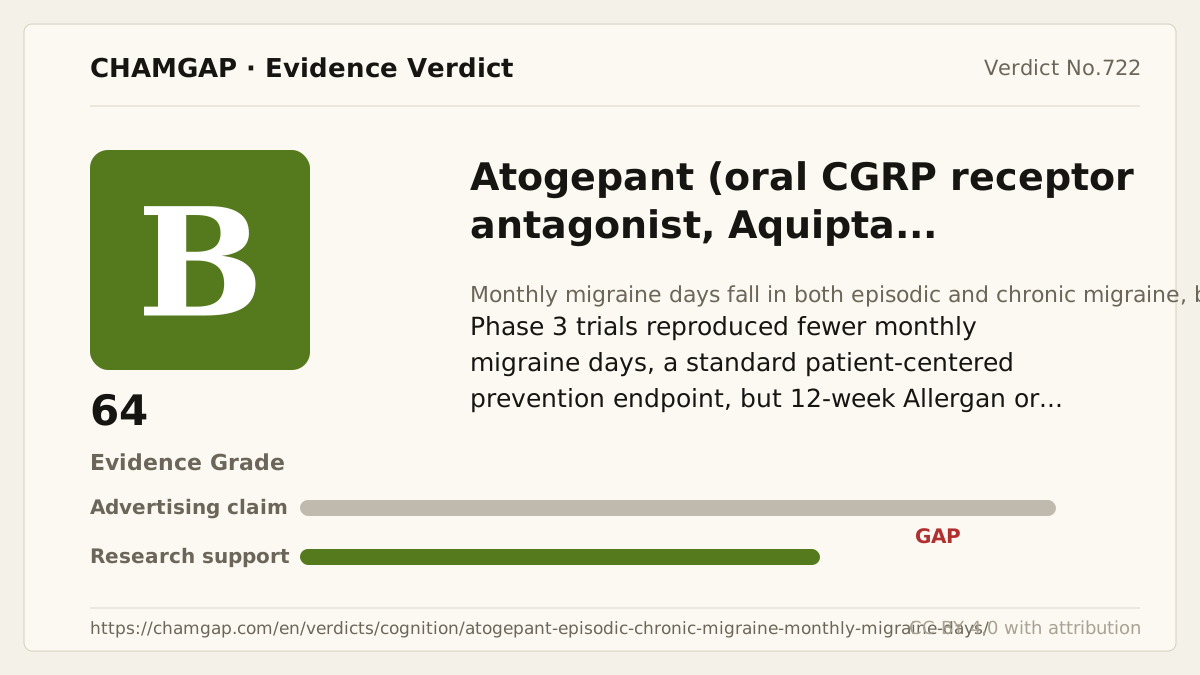
research showsAtogepant is rated B because it reduces monthly migraine days in adults with episodic and chronic migraine. In the phase 3 ADVANCE trial, 873 participants with episodic migraine were treated for 12 weeks and every dose reduced monthly migraine days more than placebo. The phase 3 PROGRESS trial likewise showed significant reductions with 30 mg twice daily and 60 mg once daily versus placebo among 755 participants with chronic migraine. Monthly migraine days are a standard patient-centered endpoint in migraine prevention, and the effect was reproduced across both populations. Both trials, however, lasted 12 weeks, were funded by Allergan or AbbVie with company authors, and lack an independent confirmatory randomized trial, supporting lower B with 64 points.
ads claimMarketing can broaden early benefit into elimination of migraine from day one or immediate treatment of an acute attack. The evidence concerns reduced average migraine days over 12 weeks with daily preventive use; being caffeine-free and nonsteroidal describes the compound but does not prove larger efficacy or absence of risk.
Useful facts when choosing a product
- Atogepant is an oral migraine preventive that blocks the CGRP receptor and is not a rescue medicine intended to terminate an attack already in progress.
- Approved dose and frequency for episodic or chronic migraine can vary by jurisdiction, indication, and concomitant medicines, so the prescription and product label should be followed.
- Strong CYP3A4 inhibitors or inducers and OATP inhibitors can alter exposure, and severe renal or hepatic impairment may require dose adjustment or avoidance.
- Constipation, nausea, and fatigue or somnolence are common adverse effects, and persistent constipation, abdominal symptoms, weight change, or hypersensitivity should be reported to a clinician.
Chamgap Semantic Classification Code
Candidate index · review held
M.atogepant.oral.monthly-migraine-days-with-episodic-or-chronic-migraine.reduce.placeboMedicinal interventions > Atogepant > Oral > monthly migraine days with episodic or chronic migraine > Reduction claim > Placebo
An automated migration candidate, not an issued permanent code; exact claim scope remains under review. This machine-generated migration candidate helps retrieval but is not a permanent assignment. The original verdict ID and URL remain authoritative.
What the research actually shows
The ADVANCE study by Ailani and colleagues randomized 910 adults with 4 to 14 migraine days per month and analyzed 873. Mean monthly migraine-day changes across 12 weeks were -3.7, -3.9, and -4.2 days with atogepant 10, 30, and 60 mg, respectively, versus -2.5 days with placebo. The PROGRESS study by Pozo-Rosich and colleagues randomized 778 adults with chronic migraine and analyzed 755; least-squares mean differences from placebo across 12 weeks were -2.4 days with 30 mg twice daily and -1.8 days with 60 mg once daily. Both evaluated prevention, not termination of an attack already underway.
Why this is classified as B (64)
Reductions in monthly migraine days, a standard patient-centered prevention endpoint, were reproduced in phase 3 analyses of 873 episodic-migraine and 755 chronic-migraine participants, supporting B. Both trials lasted 12 weeks, were funded by Allergan or AbbVie with company authors, and lack an independent confirmatory randomized trial, placing the verdict at lower B with 64 points. Constipation, nausea, and fatigue remain a separate safety axis.
Counterpoint. This verdict concerns the average effect of daily preventive use. It cannot be generalized without qualification to individual response, acute attack treatment, pregnancy or lactation, or people with severe chronic disease.
Rejudgment record. New verdict — Applied B because placebo-controlled phase 3 ADVANCE and PROGRESS trials reproduced reductions in monthly migraine days, a standard patient-centered endpoint in prevention, while both were limited to 12 weeks, funded by Allergan or AbbVie with company authors, and lacked an independent confirmatory randomized trial
Sub-claim grades by effect
This ingredient is marketed for several effects. A single overall grade blends strong and weak claims together, so each effect is graded separately here. The overall grade reflects the strongest disconfirming or core claim.
| Effect (sub-claim) | Grade | Basis |
|---|---|---|
| Reduction in monthly migraine days in adults with episodic migraine | B | The placebo-controlled ADVANCE phase 3 trial directly confirmed reductions at every tested dose. |
| Reduction in monthly migraine days in adults with chronic migraine | B | The placebo-controlled PROGRESS phase 3 trial directly confirmed reductions with both regimens. |
| Treatment of an acute migraine attack already in progress | ? | Pivotal atogepant trials evaluated prevention and cannot establish efficacy as acute rescue treatment. |
| Caffeine-free and nonsteroidal formulation | ? | This is a formulation characteristic, not a separate efficacy claim. |
Cross-check — AI research and Codex final gate
Evidence Table
| Study | Design | Sample | Funding | Endpoint | Result | Weight |
|---|---|---|---|---|---|---|
| Ailani J et al. 2021 ADVANCE | Multicenter randomized double-blind placebo-controlled phase 3 trial | 910 randomized and 873 analyzed participants with episodic migraine | Funded by Allergan or AbbVie with company employee coauthors | Change from baseline in mean monthly migraine days across 12 weeks | All doses were significantly superior, with changes of -3.7, -3.9, and -4.2 days for 10, 30, and 60 mg versus -2.5 days with placebo. | Pivotal direct phase 3 evidence in episodic migraine |
| Pozo-Rosich P et al. 2023 PROGRESS | Multinational randomized double-blind placebo-controlled phase 3 trial | 778 randomized and 755 analyzed participants with chronic migraine | Funded by AbbVie with employee coauthors | Change from baseline in mean monthly migraine days across 12 weeks | Differences versus placebo were -2.4 days with 30 mg twice daily and -1.8 days with 60 mg once daily, both significant. | Pivotal direct phase 3 evidence in chronic migraine |
Receipt — 2 References
All 2 cited sources were verified for existence at the original page (as of 2026-07-19).
Final verification and publication gate: Codex · Evidence date: 2026-07-19 · Corrections: none
Cite this verdict
[Chamgap] Atogepant x reduction in monthly migraine days in adults with episodic or chronic migraine — Evidence Grade B·64. 2 cited sources checked. Source: https://chamgap.com/en/verdicts/cognition/atogepant-episodic-chronic-migraine-monthly-migraine-days/ · CC BY 4.0CC BY 4.0 — free to use with attribution; do not distort grades, numbers, or verdict meaning.
What this document does and does not do
Chamgap is an information source. It reports what research has and has not confirmed; it does not tell readers what to take or buy. That decision belongs to readers and, when needed, medical or legal professionals. This verdict reflects literature available up to the search date and may change as new research appears. Nothing here is medical advice.