
Argentine tango or adapted-tango classes,
does it really help with Improved balance, gait, and daily activity participation in mild-to-moderate Parkinson's disease?
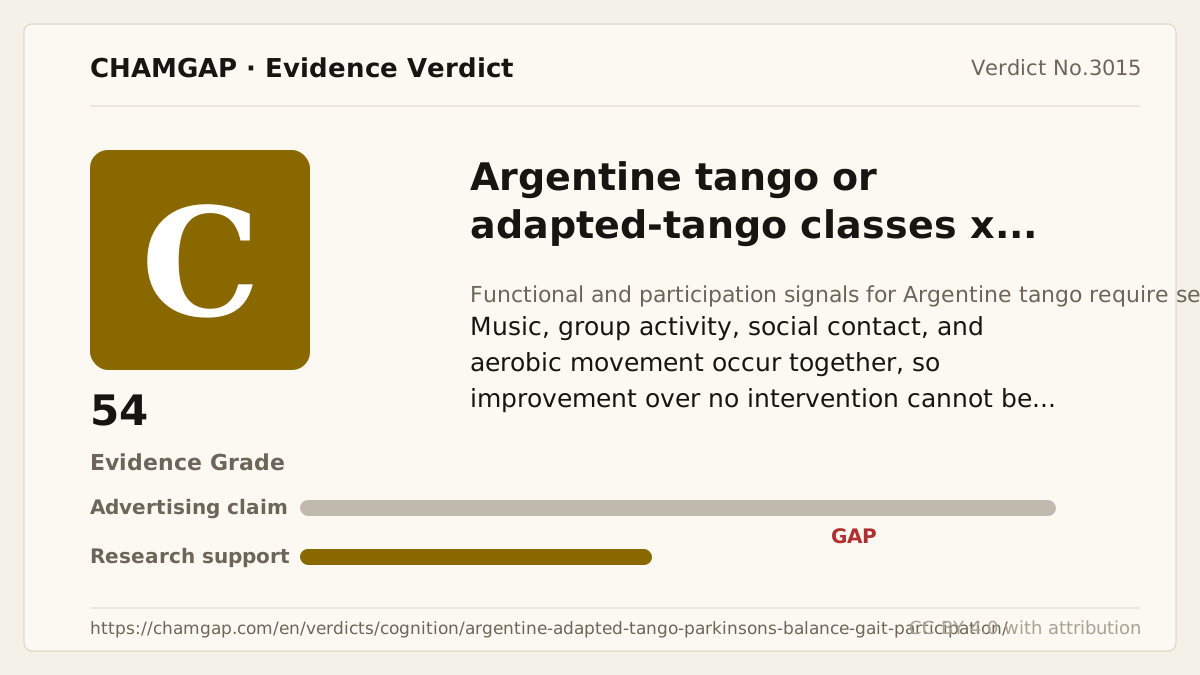
research showsGrade C with 54 points. In a 58-person three-arm trial, both tango and waltz/foxtrot improved balance, six-minute walk, and backward stride versus no intervention. A 62-person 12-month trial reported increased activity participation, but analyzed only 52 after excluding 10 who did not receive their allocation and emphasized within-group P values.
ads claimThe claim that tango restores Parkinson's disease converts general dance, exercise, and social-contact effects over no intervention into a tango-specific effect.
Useful facts when choosing a product
- Other ballroom dance also improved several functional outcomes.
- The 12-month trial randomized 62 and analyzed 52.
- Participation results were presented mainly as within-group changes.
Chamgap Semantic Classification Code
Permanent code issued
X.adapted-argentine-tango.behavioral.parkinson-balance.improve.no-interventionBehaviors, exposures and policies > Argentine tango or adapted-tango classes > Behavioral delivery > Improved balance, gait, and daily activity participation in mild-to-moderate Parkinson's disease > Improvement claim > No intervention
Codex retrospectively verified the principal intervention, delivery, population, endpoint, and comparator from the existing reviewed verdict and issued a permanent semantic code. Secondary outcomes on the page are not transferred as separate claims. The code identifies the intervention and claim; it never contains the evidence grade, score, or safety result.
Exact Claim Classification
These independent facets prevent evidence from different forms, routes, populations, effects, and comparators from being mixed.
| Intervention class | X · Behavior, exposure, or policy |
|---|---|
| Canonical ingredient or intervention | Argentine tango or adapted-tango classes |
| Source or part used | Plant source not applicable; specified behavior or training |
| Formulation or processing | Argentine tango or adapted-tango classes |
| Route | Behavioral delivery |
| Dose | Argentine tango or adapted-tango classes |
| Duration | 20 sessions over 13 weeks |
| Population | 58 participants over 20 classes and 13 weeks |
| Effect or condition | Improved balance, gait, and daily activity participation in mild-to-moderate Parkinson's disease |
| Primary endpoint | BBS, six-minute walk, backward stride, and UPDRS |
| Comparator | No intervention |
| Duplicate-detection key | adapted-argentine-tango|behavioral|58 participants over 20 classes and 13 weeks|parkinson-balance|20 sessions over 13 weeks |
What the research actually shows
Partnered or adapted tango classes, generally around twice weekly, were compared with waltz/foxtrot or no intervention. Balance, gait, and activity participation were treated as separate outcomes.
Why this is classified as C (54)
Patient-centered function and participation and comparative trials are strengths, but the same research network, no-intervention controls, lack of masking, post-randomization exclusion, and within-group analysis give C with 54 points.
Counterpoint. Tango-specific superiority over another dance or equal-intensity exercise remains inadequately established.
Rejudgment record. Cross-check applied — Separated tango versus no intervention from another dance and incorporated 62 randomized versus 52 analyzed, within-group P values, and the same research network
| Endpoint | P | Symptom or function itself is the target - including patient reports and performance tests |
| Replication | R1 | Single confirmatory trial |
| Independence | I2 | Decisive evidence is publicly or non-profit funded |
| Effect size | E+ | Meets the clinically important threshold |
| Precision | CX | No pooled confidence interval could be confirmed |
Stored derived and displayed grades match; this is not a current recalculation or validity check (C).
Sub-claim grades by effect
This ingredient is marketed for several effects. A single overall grade blends strong and weak claims together, so each effect is graded separately here. The overall grade reflects the strongest disconfirming or core claim.
| Effect (sub-claim) | Grade | Basis |
|---|---|---|
| Improved balance, gait, and participation versus no intervention | C | Signals are confounded by lack of masking and general group-activity effects. |
| Tango-specific superiority over other dance or exercise | D | Another ballroom dance also improved outcomes and no long active-control confirmation exists. |
Cross-check — AI research and Codex final gate
Evidence Table
| Study | Design | Sample | Funding | Endpoint | Result | Weight |
|---|---|---|---|---|---|---|
| Hackney ME and Earhart GM. 2009 | Three-arm randomized tango, waltz/foxtrot, and no-intervention trial | 58 participants over 20 classes and 13 weeks | NIH and academic support; no manufacturer involvement | BBS, six-minute walk, backward stride, and UPDRS | Both dances improved selected outcomes over no intervention; tango equal or superior on some measures | Key trial with another-dance active control |
| Foster ER et al. 2013 | Twelve-month randomized tango versus no-intervention trial | 62 randomized and 52 analyzed, 26 per group | NIH and academic support; overlapping research network | Activity Card Sort participation | Tango retention 77% to 90%, P=.006; control around 80%, P=.60; key between-group estimate not presented | Longer supporting trial |
Receipt — 2 References
All 2 cited sources were verified for existence at the original page (as of 2026-09-07).
Final verification and publication gate: Codex · Evidence date: 2026-09-07 · Corrections: none
Cite this verdict
[Chamgap] Argentine Tango for Parkinson's Disease—Better Than No Intervention, but Tango-Specific and Long-Term Effects Are Limited — Evidence Grade C·54. 2 cited sources checked. Source: https://chamgap.com/en/verdicts/cognition/argentine-adapted-tango-parkinsons-balance-gait-participation/ · CC BY 4.0CC BY 4.0 — free to use with attribution; do not distort grades, numbers, or verdict meaning.
What this document does and does not do
Chamgap is an information source. It reports what research has and has not confirmed; it does not tell readers what to take or buy. That decision belongs to readers and, when needed, medical or legal professionals. This verdict reflects literature available up to the search date and may change as new research appears. Nothing here is medical advice.