
Anterior temporal lobectomy,
does it really help with Sustained freedom from awareness-impairing and all seizures in drug-resistant temporal lobe epilepsy?
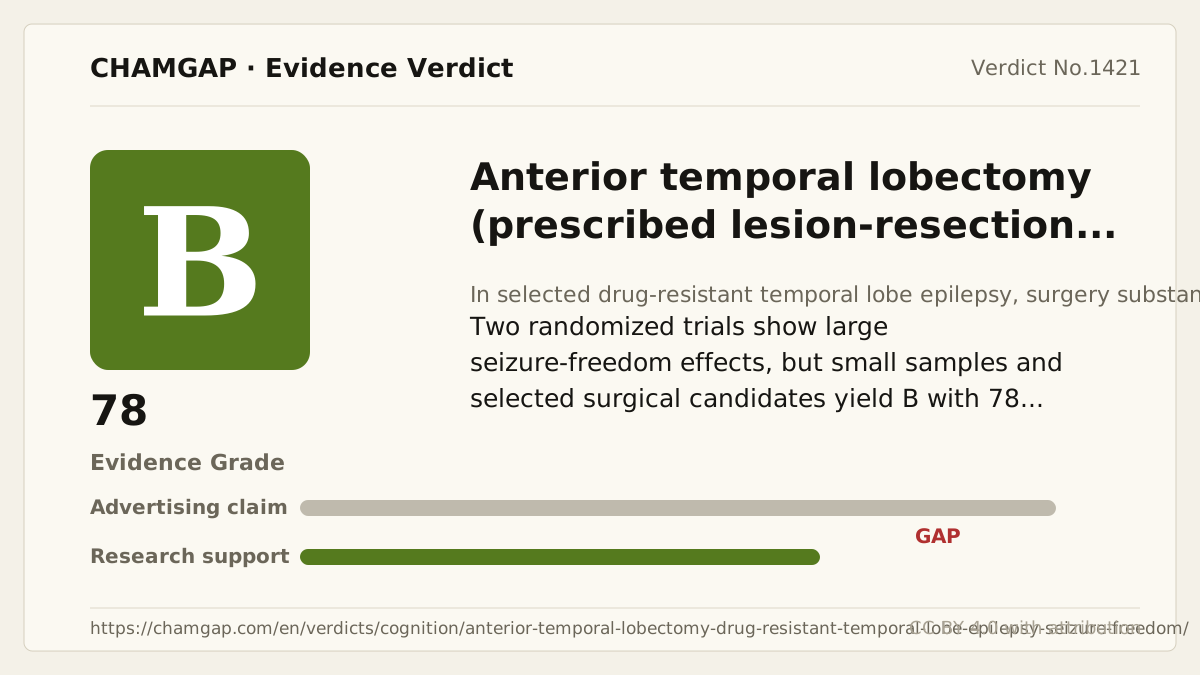
research showsAnterior temporal lobectomy is rated B because it markedly increases seizure freedom over continued medical therapy in appropriately selected drug-resistant temporal lobe epilepsy. In the 80-participant Wiebe 2001 randomized trial, one-year freedom from awareness-impairing seizures was 58% versus 8%, and freedom from all seizures was 38% versus 3%. ERSET also favored surgery, with freedom from disabling seizures during year two in 11 of 15 surgical participants versus 0 of 23 medical participants, but it was a small trial stopped for recruitment difficulty. The large replicated effect is limited to small, highly selected surgical cohorts and older resection evidence, imposing a B ceiling.
ads claimCalling surgery a universal cure would overstate the evidence. The results apply to patients with resectable drug-resistant temporal lobe epilepsy selected through comprehensive evaluation at specialist epilepsy centers.
Useful facts when choosing a product
- Anterior temporal lobectomy is prescribed for drug-resistant epilepsy when seizures are localized to one temporal lobe and the epileptogenic tissue can be resected acceptably.
- Preoperative workup includes prolonged video EEG, high-resolution MRI, neuropsychological testing, and assessment of language and memory dominance; antiseizure medication is not automatically stopped after surgery.
- Risks include memory or language decline, visual-field loss such as superior quadrantanopia, depression or other psychiatric effects, hemorrhage, infarction, infection, and general anesthesia complications.
- This is lesion-resection surgery rather than another antiseizure medication, and long-term specialist follow-up remains necessary because seizures can recur.
Chamgap Semantic Classification Code
Candidate index · review held
P.anterior-temporal-lobectomy.procedural.sustained-freedom-from-awareness-impairing-and-all-seizures-in-drug-resistant-temporal-lobe-epilepsy.assess.UNKProcedures, devices and tests > Anterior temporal lobectomy > Procedural > Sustained freedom from awareness-impairing and all seizures in drug-resistant temporal lobe epilepsy > Association or change assessment > Unknown
An automated migration candidate, not an issued permanent code; exact claim scope remains under review. This machine-generated migration candidate helps retrieval but is not a permanent assignment. The original verdict ID and URL remain authoritative.
What the research actually shows
Wiebe and colleagues assigned 80 participants to surgery or continued medical therapy for one year, with surgery superior for both awareness-impairing and all-seizure freedom. ERSET planned 200 participants but stopped after 38 were enrolled; disabling-seizure freedom during year two occurred in 11 of 15 surgical participants and 0 of 23 medical participants. These trials compare a resection strategy with continued medication, not one antiseizure drug with another.
Why this is classified as B (78)
Two direct randomized trials showed large improvements in seizure freedom, but they were small specialist-center studies of 80 and 38 selected participants, and ERSET stopped for recruitment difficulty. Strong effect and replication support B with 78 points, while sample size, age, and selected candidacy prevent A. Neurocognitive, visual, and operative harms are separate safety considerations.
Counterpoint. When seizures persist after two appropriate antiseizure medications, early evaluation at a comprehensive epilepsy center can be considered rather than assuming surgery is unavailable.
Rejudgment record. New verdict — Accepted direct seizure-freedom results from the Wiebe randomized trial and replication in ERSET, while applying the ceiling for small, older trials in highly selected surgical candidates
Sub-claim grades by effect
This ingredient is marketed for several effects. A single overall grade blends strong and weak claims together, so each effect is graded separately here. The overall grade reflects the strongest disconfirming or core claim.
| Effect (sub-claim) | Grade | Basis |
|---|---|---|
| Freedom from awareness-impairing seizures | B | The Wiebe trial found 58% versus 8% at one year. |
| Freedom from all seizures | B | The Wiebe trial found all-seizure freedom, including auras, in 38% versus 3%. |
| Sustained seizure freedom after early surgery | B | ERSET replicated disabling-seizure freedom during year two in 11 of 15 versus 0 of 23. |
Cross-check — AI research and Codex final gate
Evidence Table
| Study | Design | Sample | Funding | Endpoint | Result | Weight |
|---|---|---|---|---|---|---|
| Wiebe S et al. 2001 | Randomized controlled trial | 80 participants; 40 surgery and 40 medical therapy | Canadian public and academic support | One-year freedom from awareness-impairing and all seizures | Freedom from awareness-impairing seizures was 58% versus 8%; all-seizure freedom was 38% versus 3%. | Key direct randomized evidence |
| Engel J Jr et al. 2012 ERSET | Multicenter randomized controlled trial | 38 participants; 15 surgery and 23 medical therapy | United States NINDS public funding | Freedom from disabling seizures during year two | 11 of 15 surgical versus 0 of 23 medical participants; stopped before the planned 200 because of recruitment difficulty. | Replication with limited precision |
Receipt — 2 References
All 2 cited sources were verified for existence at the original page (as of 2026-07-23).
Final verification and publication gate: Codex · Evidence date: 2026-07-23 · Corrections: none
Cite this verdict
[Chamgap] Anterior temporal lobectomy x seizure freedom in drug-resistant temporal lobe epilepsy — Evidence Grade B·78. 2 cited sources checked. Source: https://chamgap.com/en/verdicts/cognition/anterior-temporal-lobectomy-drug-resistant-temporal-lobe-epilepsy-seizure-freedom/ · CC BY 4.0CC BY 4.0 — free to use with attribution; do not distort grades, numbers, or verdict meaning.
What this document does and does not do
Chamgap is an information source. It reports what research has and has not confirmed; it does not tell readers what to take or buy. That decision belongs to readers and, when needed, medical or legal professionals. This verdict reflects literature available up to the search date and may change as new research appears. Nothing here is medical advice.