
Aluminum cookware,
does it really help with Increased incidence of dementia or Alzheimer disease?
research showsThe grade is D with 30 points. In the French PAQUID prospective cohort, analysis of 1,586 respondents to a cookware question found essentially identical dementia hazard among users and nonusers, HR 1.04, P=0.86. Cookware use was self-reported, while food-specific migration and actual aluminum intake were not measured, and the confidence interval could not be verified. One null direct observational analysis gives D rather than F.
ads claimMigration of aluminum into food is a composition fact; dementia causation is a separate disease claim. Occupational dust exposure and high-dose exposure in dialysis patients were not combined with food-contact cookware exposure.
Useful facts when choosing a product
- A pan experiment measured aluminum in tomato sauce at 2.7 +/- 0.2 mg/100 g with added sugar and 4.9 +/- 0.2 mg/100 g without sugar; the plus-or-minus values were reported as standard deviations.
- Another normal cooking experiment measured 10 to 15 mg/kg in tomato sauce after 60 minutes. Migration varies with product, coating, acidity, salt, and time.
- The PAQUID cookware analysis asked only about use and did not measure migration or intake.
- Drinking water, occupational dust, antacids, and cookware are different aluminum exposure sources.
Chamgap Semantic Classification Code
Candidate index · review held
UNK.routine-use-of-aluminum-pots.UNK.incidence-of-dementia-or-alzheimer-disease.increase.UNKUnknown > Routine use of aluminum pots > Unknown > incidence of dementia or Alzheimer disease > Increase claim > Unknown
An automated migration candidate, not an issued permanent code; exact claim scope remains under review. This machine-generated migration candidate helps retrieval but is not a permanent assignment. The original verdict ID and URL remain authoritative.
What the research actually shows
PAQUID enrolled 3,777 community-dwelling older adults in southwestern France in 1988-1989 and used repeated neuropsychological screening plus neurologist assessment for dementia. The cookware analysis was limited to 1,586 people reporting whether they used aluminum cookware. It did not measure pot alloy, coating, cooked foods, acidity, duration, migration, or intake. The result was HR 1.04, P=0.86; a confidence interval was not found in the publicly checked material. PAQUID reports both public support and support from Aluminum Péchiney, so independence was treated as mixed.
Why this is classified as D (30)
The direct human analysis found no increased dementia, but exposure was not measured and precision was unavailable in one selected observational sample, giving D with 30 points.
Counterpoint. Selected drinking-water findings leave a broader aluminum question, but they do not support the cookware-specific claim.
Rejudgment record. Cross-check applied — The full cohort and cookware analysis counts, self-reported exposure, dementia ascertainment, HR and P value, and separation from drinking-water exposure were checked against the source
| Endpoint | H | Hard endpoint - actual events such as death |
| Replication | R1 | Single confirmatory trial |
| Independence | I1 | Mixed funding sources |
| Effect size | E0 | Null |
| Precision | CX | No pooled confidence interval could be confirmed |
Stored derived and displayed grades match; this is not a current recalculation or validity check (D).
Sub-claim grades by effect
This ingredient is marketed for several effects. A single overall grade blends strong and weak claims together, so each effect is graded separately here. The overall grade reflects the strongest disconfirming or core claim.
| Effect (sub-claim) | Grade | Basis |
|---|---|---|
| Aluminum cookware use increases dementia | D | The direct cohort analysis found HR 1.04, P=0.86, without an increase. |
Cross-check — AI research and Codex final gate
Evidence Table
| Study | Design | Sample | Funding | Endpoint | Result | Weight |
|---|---|---|---|---|---|---|
| Rondeau et al. 2000, PAQUID cookware analysis | Self-reported cookware subanalysis of a prospective population cohort | 3,777 enrolled and 1,586 included in the cookware analysis | Public institutions and Aluminum Péchiney support | Clinically ascertained incident dementia during follow-up | Aluminum cookware use HR 1.04, P=0.86; confidence interval not verified | Only direct human cookware analysis |
Receipt — 3 References
Of 3 cited sources, 1 had limited original-page access (blocked or summary-only) and were verified via index/summary, marked partial; the rest were verified at the original page. As of 2026-08-04.
Final verification and publication gate: Codex · Evidence date: 2026-08-04 · Corrections: none
Cite this verdict
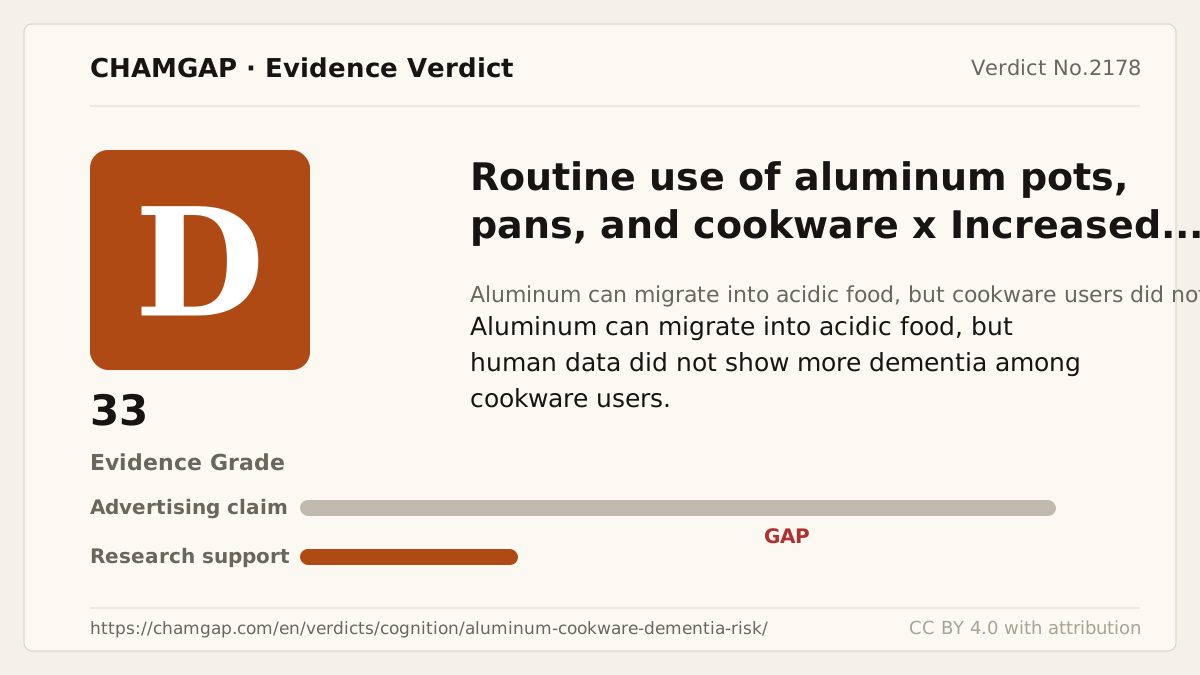
[Chamgap] Aluminum cookware x incident dementia — Evidence Grade D·30. 3 cited sources checked. Source: https://chamgap.com/en/verdicts/cognition/aluminum-cookware-dementia-risk/ · CC BY 4.0CC BY 4.0 — free to use with attribution; do not distort grades, numbers, or verdict meaning.
What this document does and does not do
Chamgap is an information source. It reports what research has and has not confirmed; it does not tell readers what to take or buy. That decision belongs to readers and, when needed, medical or legal professionals. This verdict reflects literature available up to the search date and may change as new research appears. Nothing here is medical advice.