
Adenotonsillectomy,
does it really help with Improved attention and executive function in children with sleep-disordered breathing?
research showsThe grade is D. Both PATS coprimary outcomes failed: BRIEF difference -0.96 (95% CI -2.66 to 0.74), P=0.27, and Go/No-Go d-prime difference 0.05 (-0.18 to 0.27), P=0.68. CHAT also missed its objective attention and executive-function primary endpoint. This verdict rejects only the objective cognition claim.
ads claimImproved snoring, sleep symptoms, or behavior should not be relabeled as improved objective attention or executive function. These are distinct outcomes.
Useful facts when choosing a product
- PATS studied mild sleep-disordered breathing with AHI below 3, whereas CHAT studied children with more definite obstructive sleep apnea.
- PATS assessors were masked and CHAT used standardized objective cognitive testing.
- Verdict 1722 is B with 68 points for adult recurrent-tonsillitis sore throat, and verdict 458 is D with 28 points for pharyngotonsillitis prevention; neither addresses pediatric cognition after sleep-disordered breathing treatment.
Chamgap Semantic Classification Code
Candidate index · review held
P.pediatric-adenotonsillectomy.procedural.attention-and-executive-function-with-sleep-disordered-breathing.improve.UNKProcedures, devices and tests > Pediatric adenotonsillectomy > Procedural > attention and executive function with sleep-disordered breathing > Improvement claim > Unknown
An automated migration candidate, not an issued permanent code; exact claim scope remains under review. This machine-generated migration candidate helps retrieval but is not a permanent assignment. The original verdict ID and URL remain authoritative.
What the research actually shows
PATS was supported by NHLBI. CHAT had NIH support and no commercial funding. Independent publicly funded trials repeatedly found null objective attention and executive-function primary outcomes; both PATS coprimary outcomes failed rather than splitting success.
Why this is classified as D (34)
Two independent large publicly funded trials failed primary attention and executive-function outcomes, but selected high-risk benefit remains possible, giving D with 34 points.
Counterpoint. D does not deny benefits for snoring, symptoms, behavior, or quality of life; it applies narrowly to attention and executive-function improvement.
Rejudgment record. Cross-check applied — Two large publicly funded RCTs in mild sleep-disordered breathing and obstructive sleep apnea repeatedly found null primary attention and executive-function outcomes, while selected high-risk groups remain underrepresented
| Endpoint | P | Symptom or function itself is the target - including patient reports and performance tests |
| Replication | RX | Repeatedly refuted in the same indication |
| Independence | I2 | Decisive evidence is publicly or non-profit funded |
| Effect size | E0 | Null |
| Precision | C0 | The confidence interval leaves room for benefit |
Stored derived and displayed grades match; this is not a current recalculation or validity check (D).
Sub-claim grades by effect
This ingredient is marketed for several effects. A single overall grade blends strong and weak claims together, so each effect is graded separately here. The overall grade reflects the strongest disconfirming or core claim.
| Effect (sub-claim) | Grade | Basis |
|---|---|---|
| Improved executive function | D | Key PATS BRIEF and CHAT NEPSY analyses were both nonsignificant. |
| Improved attention | D | The PATS Go/No-go difference was 0.05 points, P=0.68. |
| Improved sleep symptoms and behavior | B | Several secondary outcomes improved in both trials but are separate from this cognition verdict. |
Cross-check — AI research and Codex final gate
Evidence Table
| Study | Design | Sample | Funding | Endpoint | Result | Weight |
|---|---|---|---|---|---|---|
| Redline et al. 2023 PATS | Multicenter randomized single-blind watchful-waiting-controlled trial | 459 assigned; 458 in the primary mixed-model analysis; 394 completed the 12-month visit | Public funding from the U.S. NHLBI | 12-month BRIEF executive function and Go/No-go attention, the coprimary outcomes | Executive-function difference -0.96, 95% CI -2.66 to 0.74, P=0.27; attention difference 0.05, 95% CI -0.18 to 0.27, P=0.68. | Large publicly funded trial with both coprimary outcomes null |
| Marcus et al. 2013 CHAT | Multicenter randomized watchful-waiting-controlled trial | 464 randomized; 400 followed; 397 in the primary NEPSY analysis, 194 versus 203 | Public U.S. NIH funding; no commercial funding | Change in NEPSY attention and executive function, the primary endpoint | Improvement 7.1±13.9 versus 5.1±13.4 points, P=0.16. | Independent repeated null result in a different severity population |
Receipt — 2 References
All 2 cited sources were verified for existence at the original page (as of 2026-08-01).
Final verification and publication gate: Codex · Evidence date: 2026-08-01 · Corrections: none
Cite this verdict
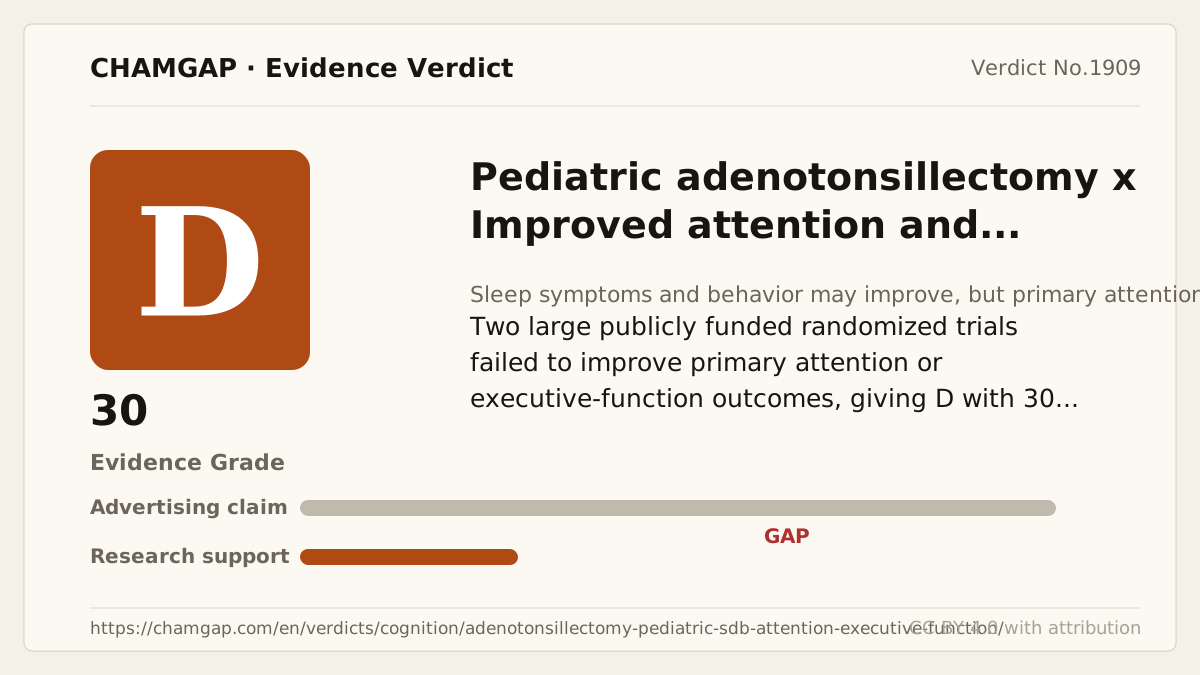
[Chamgap] Adenotonsillectomy x pediatric attention and executive function — Evidence Grade D·34. 2 cited sources checked. Source: https://chamgap.com/en/verdicts/cognition/adenotonsillectomy-pediatric-sdb-attention-executive-function/ · CC BY 4.0CC BY 4.0 — free to use with attribution; do not distort grades, numbers, or verdict meaning.
What this document does and does not do
Chamgap is an information source. It reports what research has and has not confirmed; it does not tell readers what to take or buy. That decision belongs to readers and, when needed, medical or legal professionals. This verdict reflects literature available up to the search date and may change as new research appears. Nothing here is medical advice.