
Physical activity,
does it really help with Lower incidence of dementia?
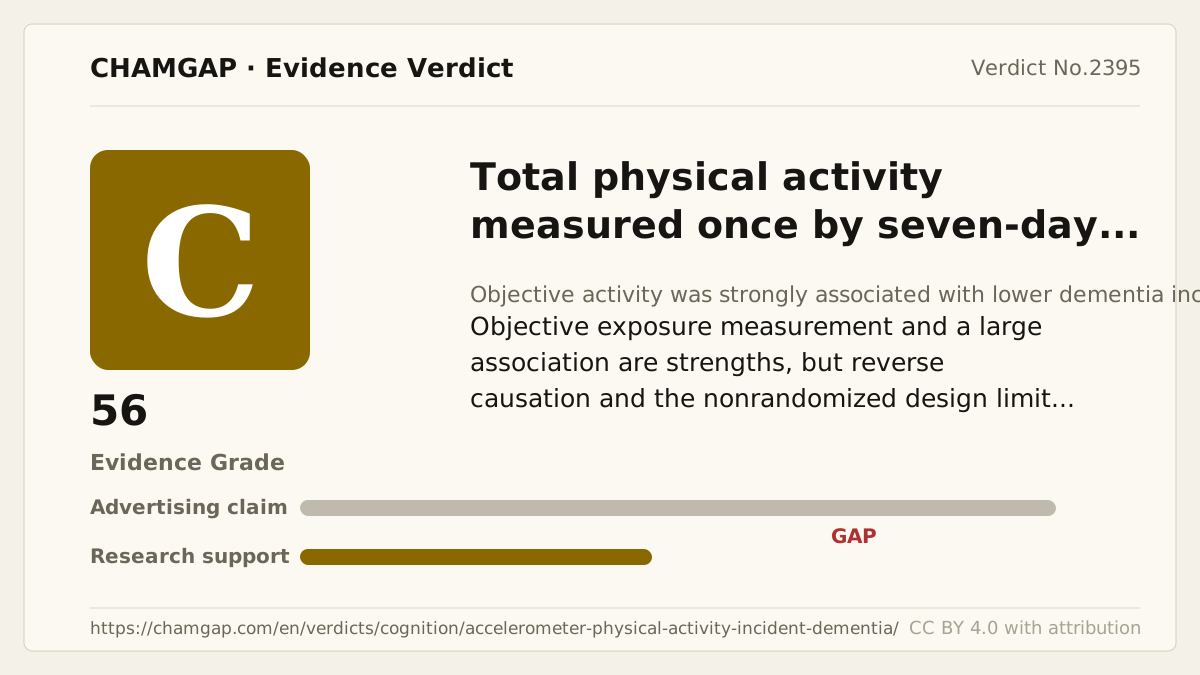
research showsThe grade is C. In a prospective UK Biobank cohort of 90,320 participants, 501 developed dementia over a median 6.9 years. Events were 132/45,140 (0.29%) above versus 369/45,180 (0.82%) below median activity, adjusted HR 0.58 (95% CI 0.47 to 0.71). A single seven-day measure and code-based observational outcome cannot establish prevention.
ads claimAn HR of 0.58 does not prove that moving more prevents 42% of dementia. It compares adjusted hazards in more- and less-active people and is not a randomized exercise-prescription result.
Useful facts when choosing a product
- Activity was device-measured rather than self-reported, but only once for seven days.
- Dementia was algorithmically identified from linked diagnosis and mortality data, not face-to-face adjudication.
- The primary analysis had no exclusion period; excluding cases within two years was a sensitivity analysis, and reverse-causation concern remains.
Chamgap Semantic Classification Code
Candidate index · review held
UNK.total-physical-activity-measured-once-by-wrist-accelerometry.UNK.incidence-of-dementia.reduce.UNKUnknown > Total physical activity measured once by wrist accelerometry > Unknown > incidence of dementia > Reduction claim > Unknown
An automated migration candidate, not an issued permanent code; exact claim scope remains under review. This machine-generated migration candidate helps retrieval but is not a permanent assignment. The original verdict ID and URL remain authoritative.
What the research actually shows
Exposure was not self-reported: participants wore a triaxial wrist accelerometer for up to seven days in 2013 to 2015. It was a single, not repeated, measurement. Dementia was not adjudicated in face-to-face clinical assessment; UK Biobank algorithmic outcomes used linked hospital and death-registry diagnostic information. This was a prospective cohort analysis, not a retrospective cohort. Funding was reported from the National Natural Science Foundation of China. Requested comparison verdict 1568 is D with 34 points for a hearing-aid intervention, verdict 1960 is D with 34 points for green leafy vegetables and cognitive decline, and verdict 2192 is C with 54 points for daytime napping and dementia prevention. None actually used exercise exposure, and their tests, cognitive endpoints, or lifestyle exposures were not pooled with accelerometer activity and coded dementia here.
Why this is classified as C (56)
Objective exposure and a large hard-outcome association are offset by single measurement, coded ascertainment, multiple activity analyses, and residual reverse causation, giving C with 56 points.
Counterpoint. Accelerometer participants were a selected, relatively healthy subset of UK Biobank, and the observed 0.55% absolute incidence should not be transferred directly to all older adults.
Rejudgment record. Cross-check applied — Direct cross-check of exposure measurement, two-year lag, code-based ascertainment, group event counts, incidence rates, hazard ratios, and verdicts 1568, 1960, and 2192
| Endpoint | H | Hard endpoint - actual events such as death |
| Replication | R1 | Single confirmatory trial |
| Independence | I2 | Decisive evidence is publicly or non-profit funded |
| Effect size | E+ | Meets the clinically important threshold |
Stored derived and displayed grades match; this is not a current recalculation or validity check (C).
Sub-claim grades by effect
This ingredient is marketed for several effects. A single overall grade blends strong and weak claims together, so each effect is graded separately here. The overall grade reflects the strongest disconfirming or core claim.
| Effect (sub-claim) | Grade | Basis |
|---|---|---|
| Association of higher accelerometer activity with lower dementia incidence | C | Rates were 0.29% versus 0.82%, adjusted HR 0.58. |
| Causal prevention of dementia by exercise | ? | This cohort cannot establish a causal intervention effect. |
Cross-check — AI research and Codex final gate
Evidence Table
| Study | Design | Sample | Funding | Endpoint | Result | Weight |
|---|---|---|---|---|---|---|
| Zhong et al. 2023 UK Biobank | Prospective cohort with accelerometer exposure | 90,320 participants; 501 dementia cases | National Natural Science Foundation of China | Algorithmically ascertained dementia over median 6.9 years | High activity 132/45,140 (0.29%) vs low activity 369/45,180 (0.82%); adjusted HR 0.58 (95% CI 0.47 to 0.71) | Decisive objective-exposure observational evidence |
Receipt — 1 References
All 1 cited sources were verified for existence at the original page (as of 2026-08-07).
Final verification and publication gate: Codex · Evidence date: 2026-08-07 · Corrections: none
Cite this verdict
[Chamgap] Physical activity x lower incidence of dementia — Evidence Grade C·56. 1 cited sources checked. Source: https://chamgap.com/en/verdicts/cognition/accelerometer-physical-activity-incident-dementia/ · CC BY 4.0CC BY 4.0 — free to use with attribution; do not distort grades, numbers, or verdict meaning.
What this document does and does not do
Chamgap is an information source. It reports what research has and has not confirmed; it does not tell readers what to take or buy. That decision belongs to readers and, when needed, medical or legal professionals. This verdict reflects literature available up to the search date and may change as new research appears. Nothing here is medical advice.