
Whole okra fruit powder,
does it really help with HbA1c reduction in type 2 diabetes?
research showsThe grade is C with 50 points. The pivotal trial randomized 120 patients but reviews counted 99 analyzed, using 4 g daily of whole okra fruit powder for eight weeks. A 2025 meta-analysis of five trials and 357 participants found a -0.42 percentage-point HbA1c difference, but it mixed whole powder, extract, and tea and therefore does not independently replicate that product claim. Its standardized magnitude was also below a conventional medium effect.
ads claimUsing the entire milled fruit rather than an extract is a product fact. Current evidence concerns a modest short-term laboratory change and does not establish prevention of diabetic complications.
Useful facts when choosing a product
- The pivotal intervention was not an extract: it used 1-g whole-okra fruit-powder capsules every six hours, totaling 4 g daily.
- Okra originated in Africa, and no classical source text was checked for this verdict.
- Verdict 295 is C with 58 points for okra extract and postprandial glucose or HbA1c. This verdict distinguishes non-extracted whole-fruit powder.
Chamgap Semantic Classification Code
Candidate index · review held
S.whole-okra-fruit-powder.UNK.hba1c-reduction-in-type-2-diabetes.reduce.placeboSupplements and nutraceuticals > Whole okra fruit powder > Unknown > HbA1c reduction in type 2 diabetes > Reduction claim > Placebo
An automated migration candidate, not an issued permanent code; exact claim scope remains under review. This machine-generated migration candidate helps retrieval but is not a permanent assignment. The original verdict ID and URL remain authoritative.
What the research actually shows
Saatchi and colleagues randomized 120 patients with type 2 diabetes, while reviews counted 99 in the analysis. Participants took 1-g capsules of whole okra fruit powder every six hours, totaling 4 g daily for eight weeks. No registration number appeared in the paper or abstract, so a prespecified primary endpoint could not be independently verified. The five-trial, 357-person meta-analysis mixed Saatchi 2022 whole powder, Moradi 2020, the Tabriz University-funded Nikpayam 2024 extract, about 3 g powder in Tavakolizadeh 2023, and tea from 20 g dried fruit in the Chinese Chen 2023 trial. This mixed pool was not counted as independent replication of 4 g daily whole powder.
Why this is classified as C (50)
The pooled result was statistically positive but remained a surrogate below a conventional medium effect, and trials mixed whole powder, extract, and tea rather than independently replicating 4 g daily whole powder. This yields C with 50 points.
Counterpoint. The pooled 95% confidence interval excluded no effect, so the evidence does not support saying there is no glycemic signal.
Rejudgment record. Cross-check applied — Modest surrogate HbA1c reduction, with whole powder, extract, and tea too heterogeneous to count as independent replication
| Endpoint | S | Surrogate marker - laboratory or imaging measures |
| Replication | R1 | Single confirmatory trial |
| Independence | I2 | Decisive evidence is publicly or non-profit funded |
| Effect size | E~ | Statistically positive but below the threshold |
Stored derived and displayed grades match; this is not a current recalculation or validity check (C).
Sub-claim grades by effect
This ingredient is marketed for several effects. A single overall grade blends strong and weak claims together, so each effect is graded separately here. The overall grade reflects the strongest disconfirming or core claim.
| Effect (sub-claim) | Grade | Basis |
|---|---|---|
| HbA1c reduction with whole okra fruit powder | C | Multiple trials showed a modest reduction limited to a surrogate. |
Cross-check — AI research and Codex final gate
Evidence Table
| Study | Design | Sample | Funding | Endpoint | Result | Weight |
|---|---|---|---|---|---|---|
| Saatchi et al. 2022 | Double-blind placebo-controlled eight-week randomized trial | 120 randomized; 99 analyzed according to reviews | Iranian university institutions; no identified industry funding | HbA1c and fasting glucose | Lower than placebo; between-group CI not reported | Prespecified primary endpoint not independently verifiable; small short trial |
| 2025 systematic review and meta-analysis | Meta-analysis of randomized trials | Five HbA1c trials with 357 participants | See review disclosures | HbA1c | -0.42 percentage points, 95% CI -0.64 to -0.19, I-squared 48% | Positive across trials but heterogeneous preparations, doses, and durations |
Receipt — 2 References
All 2 cited sources were verified for existence at the original page (as of 2026-08-02).
Final verification and publication gate: Codex · Evidence date: 2026-08-02 · Corrections: none
Cite this verdict
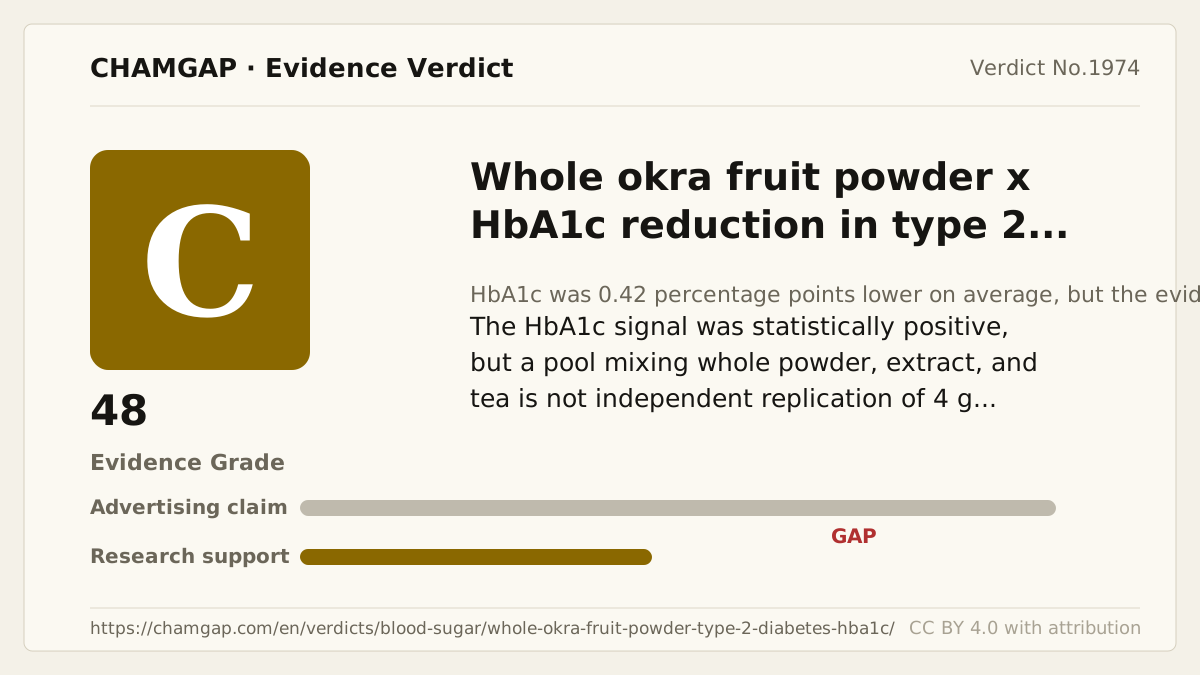
[Chamgap] Whole okra fruit powder x HbA1c reduction in type 2 diabetes — Evidence Grade C·50. 2 cited sources checked. Source: https://chamgap.com/en/verdicts/blood-sugar/whole-okra-fruit-powder-type-2-diabetes-hba1c/ · CC BY 4.0CC BY 4.0 — free to use with attribution; do not distort grades, numbers, or verdict meaning.
What this document does and does not do
Chamgap is an information source. It reports what research has and has not confirmed; it does not tell readers what to take or buy. That decision belongs to readers and, when needed, medical or legal professionals. This verdict reflects literature available up to the search date and may change as new research appears. Nothing here is medical advice.