
Whole bok choy,
does it really help with Prevention of incident type 2 diabetes?
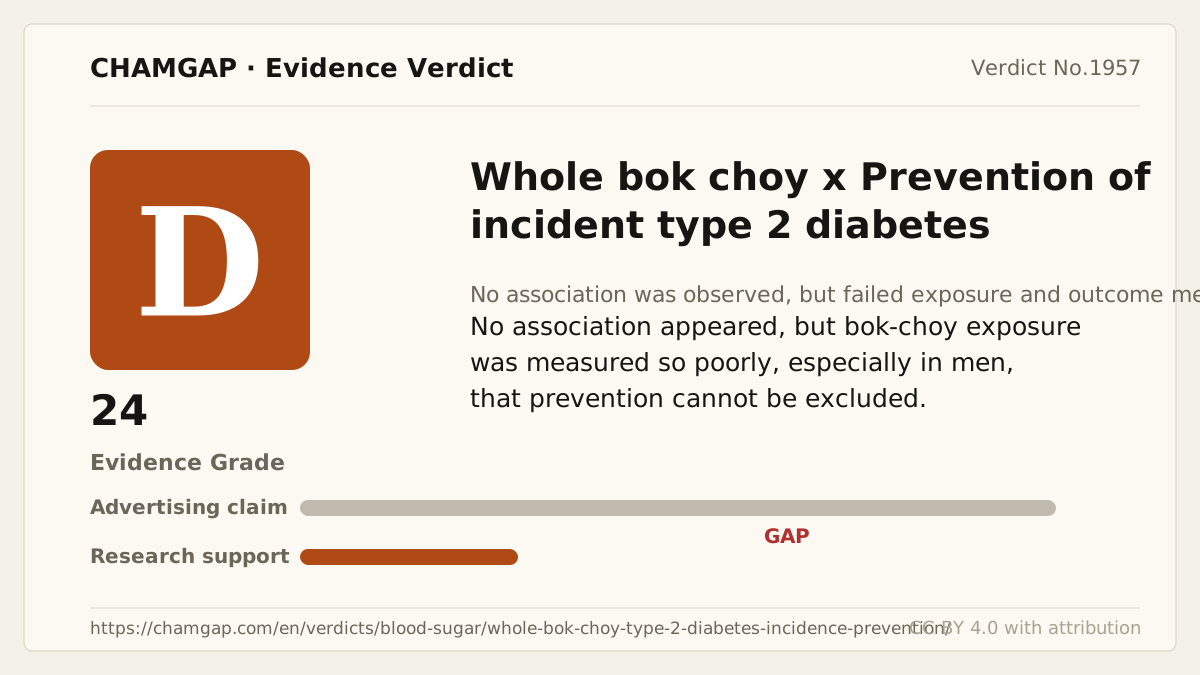
research showsThe grade is D with 34 points. In a 10,732-person observational cohort, bok-choy intake was not significantly associated with five-year type 2 diabetes incidence in either sex. The questionnaire's bok-choy validity coefficient was 0.02 in men, and incidence was self-reported. A separate JPHC validation in three areas confirmed about 94% of self-reported cases against medical records, but it did not recheck every case in this paper. Exposure and outcome limitations still prevent a firm conclusion of no preventive effect.
ads claimComparing people who eat more or less bok choy does not directly test what happens when people are assigned to eat it. In men, this study barely distinguished actual intake even for that observational comparison.
Useful facts when choosing a product
- The bok-choy-specific estimates were OR 1.15 (95% CI 0.71 to 1.86) in men and 0.88 (0.53 to 1.46) in women. They are not the paper's total Okinawan-vegetable estimates of 1.22 and 0.96.
- The 147-item FFQ validity coefficients for bok-choy intake appear in the Methods paragraph titled Validity and reproducibility of FFQ, not in a table: 0.02 in men and 0.60 in women. A value of 0.02 indicates virtually no relation between the questionnaire estimate and recorded intake in men.
- Incident diabetes was self-reported after five years without HbA1c or fasting-glucose confirmation. In a separate three-area JPHC validation, about 94% of self-reported cases were confirmed by medical records, but that study did not recheck every case in this paper.
- Funding came from Japan's National Cancer Center, Ministry of Health, Labour and Welfare, and Ministry of Agriculture, Forestry and Fisheries grant MAFF-CPS-2016-1-1; no conflict was declared.
- Classical song-cai or song entries could not be securely identified as the modern bok-choy cultivar. No verified classical record is included.
- Existing corpus entries on leafy vegetables concern extracts or other outcomes. Whole bok choy and diabetes incidence is a new combination.
Chamgap Semantic Classification Code
Candidate index · review held
F.whole-bok-choy.food.incident-type-2-diabetes.prevent.UNKFoods and beverages > Whole bok choy > Food consumption > incident type 2 diabetes > Occurrence-prevention claim > Unknown
An automated migration candidate, not an issued permanent code; exact claim scope remains under review. This machine-generated migration candidate helps retrieval but is not a permanent assignment. The original verdict ID and URL remain authoritative.
What the research actually shows
There is no randomized trial. The observational Okinawa JPHC cohort followed 10,732 adults aged 45 to 74, including 4,714 men and 6,018 women, for five years. Multivariable logistic regression analyzed 216 self-reported new type 2 diabetes cases, 123 in men and 93 in women. A separate JPHC validation in three areas by Kato and colleagues, Endocr J 2009;56:459-468, found that about 94% of self-reported cases were confirmed by medical records, but it did not recheck every case in this paper. For bok choy alone, highest versus lowest tertile ORs were 1.15 (95% CI 0.71 to 1.86; trend P=0.64) in men and 0.88 (0.53 to 1.46; P=0.53) in women. Median lowest and highest intakes were 0.0 and 15.0 g/day in men and 0.2 and 18.2 g/day in women. Of 28,315 eligible people, 17,583, or 62%, were excluded and 10,732 were analyzed. This verdict concerns the food itself, not an extract.
Why this is classified as D (34)
The outcome was observed in humans, so this is not ungraded, but severe exposure, outcome, and selection limitations plus wide intervals support D with 34 points.
Counterpoint. The null association is reported faithfully without expanding it into proof that preventive benefit is absent.
Rejudgment record. Cross-check applied — A single observational null association with poor exposure and outcome ascertainment and confidence intervals that do not exclude substantial benefit
| Endpoint | H | Hard endpoint - actual events such as death |
| Replication | R1 | Single confirmatory trial |
| Independence | I2 | Decisive evidence is publicly or non-profit funded |
| Effect size | E0 | Null |
| Precision | C0 | The confidence interval leaves room for benefit |
Stored derived and displayed grades match; this is not a current recalculation or validity check (D).
Sub-claim grades by effect
This ingredient is marketed for several effects. A single overall grade blends strong and weak claims together, so each effect is graded separately here. The overall grade reflects the strongest disconfirming or core claim.
| Effect (sub-claim) | Grade | Basis |
|---|---|---|
| Lower type 2 diabetes incidence in men with bok-choy intake | D | Null at OR 1.15, with intake validity of 0.02. |
| Lower type 2 diabetes incidence in women with bok-choy intake | D | OR 0.88 with a very wide 0.53-to-1.46 interval. |
| Randomized preventive effect of assigned bok-choy intake | ? | No randomized trial exists. |
Cross-check — AI research and Codex final gate
Evidence Table
| Study | Design | Sample | Funding | Endpoint | Result | Weight |
|---|---|---|---|---|---|---|
| Yamamoto J et al. 2020 | Prospective observational Okinawa JPHC cohort | 10,732 of 28,315 eligible analyzed; 4,714 men and 6,018 women; 216 diabetes cases | Public funding from Japan's National Cancer Center and health and agriculture ministries | Self-reported incident type 2 diabetes after five years | Bok choy, highest versus lowest: men OR 1.15 (0.71 to 1.86), women 0.88 (0.53 to 1.46) | Only direct observational study, with weak exposure and outcome measurement |
Receipt — 1 References
All 1 cited sources were verified for existence at the original page (as of 2026-08-02).
Final verification and publication gate: Codex · Evidence date: 2026-08-02 · Corrections: none
Cite this verdict
[Chamgap] Whole bok choy x prevention of type 2 diabetes — Evidence Grade D·34. 1 cited sources checked. Source: https://chamgap.com/en/verdicts/blood-sugar/whole-bok-choy-type-2-diabetes-incidence-prevention/ · CC BY 4.0CC BY 4.0 — free to use with attribution; do not distort grades, numbers, or verdict meaning.
What this document does and does not do
Chamgap is an information source. It reports what research has and has not confirmed; it does not tell readers what to take or buy. That decision belongs to readers and, when needed, medical or legal professionals. This verdict reflects literature available up to the search date and may change as new research appears. Nothing here is medical advice.