
Well-formulated ketogenic diet,
does it really help with Greater HbA1c reduction than a Mediterranean diet?
research showsThe grade is D. Among 33 participants with complete crossover data, 12-week HbA1c changed by -9% on ketogenic and -7% on Mediterranean-Plus; the registered primary comparison was null at P=.11 and remained null after weight-change adjustment at P=.45. Ketosis occurred, but HbA1c superiority did not, giving D with 30 points.
ads claimA measured rise in ketones is not the same as superior glycemic efficacy over a Mediterranean comparator.
Useful facts when choosing a product
- Actual carbohydrate intake was about 10±4.5% of energy on ketogenic and 34±8.8% on Mediterranean-Plus.
- Mean plasma beta-hydroxybutyrate reached 1.1 mmol/L at week 4 and 0.51 mmol/L at week 12.
- Food was provided for 4 weeks, followed by 8 weeks of self-procured ad libitum eating.
- Verdict 1504 is B with 75 points for total diet replacement and diabetes remission; this verdict compares food-choice ketogenic and Mediterranean patterns on HbA1c.
Chamgap Semantic Classification Code
Candidate index · review held
D.well-formulated-ketogenic-diet.dietary.greater-hba1c-reduction-than-a-mediterranean-diet.reduce.UNKDietary patterns and eating practices > Well-formulated ketogenic diet > Dietary regimen > Greater HbA1c reduction than a Mediterranean diet > Reduction claim > Unknown
An automated migration candidate, not an issued permanent code; exact claim scope remains under review. This machine-generated migration candidate helps retrieval but is not a permanent assignment. The original verdict ID and URL remain authoritative.
What the research actually shows
Forty participants enrolled, 36 completed the first phase, and 33 with complete blood data in both phases formed the primary analysis. Each diet lasted 12 weeks with no washout; food was provided only for the first 4 weeks and was then self-procured. Actual carbohydrate intake was about 10±4.5% of energy on ketogenic and 34±8.8% on Mediterranean-Plus. Mean plasma beta-hydroxybutyrate rose from 0.12 at baseline to 1.1 at week 4 and 0.51 mmol/L at week 12. Weight fell by about 8% and 7%, respectively. The registered HbA1c comparison had P=.11 and P=.45 after weight adjustment. Funding came from family and foundation gifts plus NHLBI and Stanford research infrastructure.
Why this is classified as D (30)
The registered surrogate primary endpoint was null in a small complete-data analysis, giving D with 30 points.
Counterpoint. HbA1c declined within both diet periods. D applies only to ketogenic superiority over Mediterranean-Plus.
Rejudgment record. Cross-check applied — Failure of ketogenic superiority on the registered Keto-Med HbA1c primary endpoint
| Endpoint | S | Surrogate marker - laboratory or imaging measures |
| Replication | R1 | Single confirmatory trial |
| Independence | I2 | Decisive evidence is publicly or non-profit funded |
| Effect size | E0 | Null |
| Precision | CX | No pooled confidence interval could be confirmed |
Stored derived and displayed grades match; this is not a current recalculation or validity check (D).
Sub-claim grades by effect
This ingredient is marketed for several effects. A single overall grade blends strong and weak claims together, so each effect is graded separately here. The overall grade reflects the strongest disconfirming or core claim.
| Effect (sub-claim) | Grade | Basis |
|---|---|---|
| Greater HbA1c reduction than Mediterranean diet | D | The registered primary comparison was null at P=.11. |
Cross-check — AI research and Codex final gate
Evidence Table
| Study | Design | Sample | Funding | Endpoint | Result | Weight |
|---|---|---|---|---|---|---|
| Gardner CD et al. 2022 Keto-Med | Randomized crossover diet trial without a washout | 40 enrolled, 33 in the complete-data primary analysis | Family and foundation gifts plus NHLBI and Stanford support | Primary endpoint of 12-week percentage HbA1c change | -9% versus -7%, between-diet P=.11; weight-adjusted P=.45 | Pivotal direct comparison |
| Landry MJ et al. Keto-Med adherence analysis | Dietary-adherence analysis of the randomized crossover trial | Keto-Med adherence cohort | Keto-Med study support | Food records and plasma beta-hydroxybutyrate | Confirmed diet separation in carbohydrate intake and increased ketones during the ketogenic phase | Confirms achieved dietary separation |
Receipt — 1 References
All 1 cited sources were verified for existence at the original page (as of 2026-08-04).
Final verification and publication gate: Codex · Evidence date: 2026-08-04 · Corrections: none
Cite this verdict
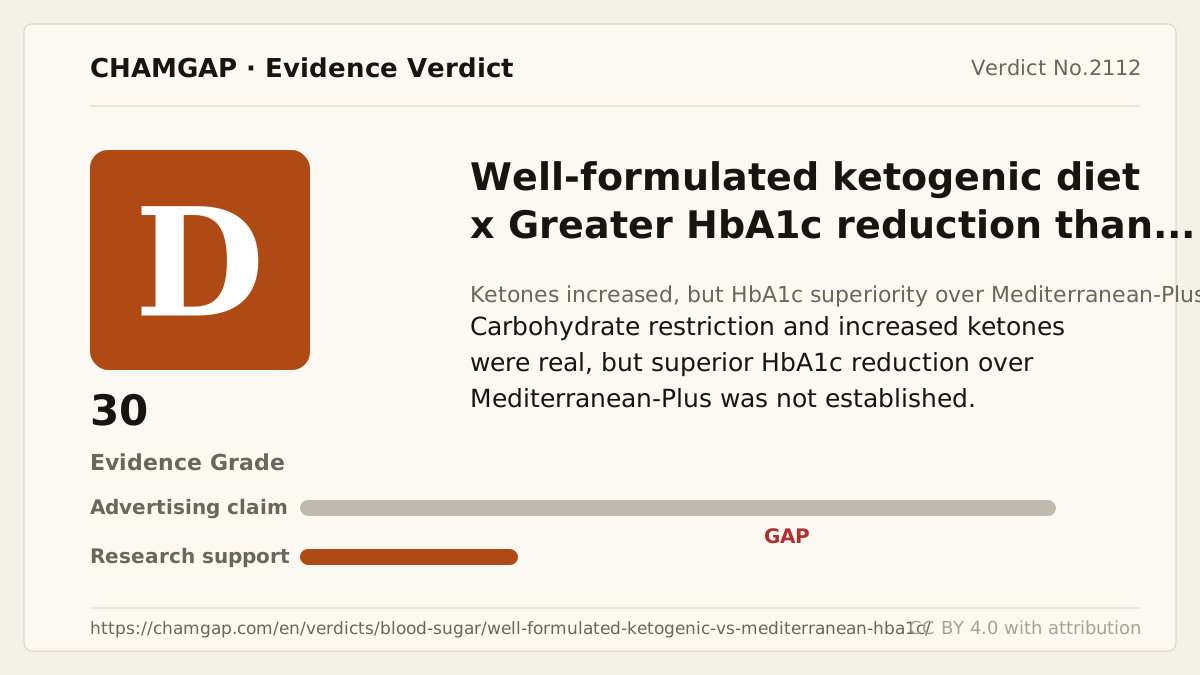
[Chamgap] Well-formulated ketogenic diet x greater HbA1c reduction than Mediterranean diet — Evidence Grade D·30. 1 cited sources checked. Source: https://chamgap.com/en/verdicts/blood-sugar/well-formulated-ketogenic-vs-mediterranean-hba1c/ · CC BY 4.0CC BY 4.0 — free to use with attribution; do not distort grades, numbers, or verdict meaning.
What this document does and does not do
Chamgap is an information source. It reports what research has and has not confirmed; it does not tell readers what to take or buy. That decision belongs to readers and, when needed, medical or legal professionals. This verdict reflects literature available up to the search date and may change as new research appears. Nothing here is medical advice.