
Vitamin D3,
does it really help with Prevention of progression from prediabetes to type 2 diabetes in adults?
research showsVitamin D3 is rated D with 38 points for preventing progression from prediabetes to type 2 diabetes. In D2d, the largest independent direct trial with 2,423 participants, vitamin D3 4,000 IU daily missed the prespecified primary endpoint: HR 0.88 (95% CI 0.75 to 1.04), P=0.12. A three-trial individual-participant-data meta-analysis reported an adjusted HR of 0.85 and a 3-year absolute risk reduction of 3.3%, but this pooled cholecalciferol with other vitamin D agents including eldecalcitol and cannot be assigned to vitamin D3 alone. Under boundary rule ②, that conflicting signal supports the upper end of D but does not restore C. Deficiency correction remains a separate clinical goal.
ads claimPromotion can convert the observational association between low vitamin D and diabetes into certain preventive efficacy for supplements. Randomized evidence is small and conflicting and does not replace weight loss, diet, exercise, or standard risk management.
Useful facts when choosing a product
- Vitamin D3 is a fat-soluble vitamin supplement, and doses used to correct deficiency should not be treated as equivalent to high-dose diabetes-prevention trials.
- D2d tested 4,000 IU daily, but this does not establish that dose as proven diabetes prevention for every adult with prediabetes.
- Usual recommended intakes are generally safe, but prolonged excess can cause hypercalcemia, hypercalciuria, and kidney stones.
- People with kidney disease, granulomatous disease, hypercalcemia risk, or concurrent calcium or thiazide use should seek clinical advice before high-dose use.
Chamgap Semantic Classification Code
Candidate index · review held
S.vitamin-d3.UNK.progression-from-prediabetes-to-type-2-diabetes.prevent.placeboSupplements and nutraceuticals > Vitamin D3 (cholecalciferol) > Unknown > progression from prediabetes to type 2 diabetes > Occurrence-prevention claim > Placebo
An automated migration candidate, not an issued permanent code; exact claim scope remains under review. This machine-generated migration candidate helps retrieval but is not a permanent assignment. The original verdict ID and URL remain authoritative.
What the research actually shows
D2d in 2019 enrolled 2,423 adults meeting at least two of three prediabetes criteria and assigned vitamin D3 4,000 IU daily or placebo regardless of baseline vitamin D. Over a median 2.5 years, diabetes occurred in 293 versus 323 participants, yielding HR 0.88 and P=0.12. Pittas and colleagues in 2023 pooled individual data from D2d cholecalciferol, Tromsø weekly 20,000-IU cholecalciferol, and DPVD eldecalcitol, reporting adjusted HR 0.85, a 3-year absolute risk reduction of 3.3%, and more regression to normal glucose regulation. A large effect in a post-randomization achieved-level analysis was not used as core grading evidence because randomization can be lost in that comparison.
Why this is classified as D (38)
The largest independent direct trial, D2d, missed its prespecified incident-diabetes primary endpoint with HR 0.88 (0.75 to 1.04), P=0.12. The three-trial individual-data meta-analysis reported adjusted HR 0.85 and a 3-year absolute difference of 3.3%, but it pooled cholecalciferol with other vitamin D agents including eldecalcitol and is not a vitamin D3-only effect. Boundary rule ② therefore keeps the verdict at the upper end of D, 38 points, rather than restoring C.
Counterpoint. Vitamin D deficiency can be corrected for established bone, muscle, or other clinical reasons. That need should not be equated with proven diabetes prevention in prediabetes, and lifestyle intervention remains the priority.
Rejudgment record. Cross-check revision — Cross-check: applied boundary rule ② because the D2d primary endpoint was null; the conflicting individual-data meta-analysis supports only the upper end of D. Its estimate pooled cholecalciferol with other vitamin D agents including eldecalcitol and was not attributed to vitamin D3 alone
Sub-claim grades by effect
This ingredient is marketed for several effects. A single overall grade blends strong and weak claims together, so each effect is graded separately here. The overall grade reflects the strongest disconfirming or core claim.
| Effect (sub-claim) | Grade | Basis |
|---|---|---|
| Prevention of diabetes progression in adults with prediabetes not selected for baseline deficiency | D | The prespecified D2d primary endpoint was null at HR 0.88 and P=0.12. |
| Reduced risk of diabetes progression in adults with prediabetes | D | The 15% relative reduction and 3-year absolute difference of 3.3% came from a mixed-agent vitamin D estimate and are not a vitamin D3-only effect. |
| Increased regression to normal glucose regulation in adults with prediabetes | C | The mixed-agent individual-data meta-analysis found an increase, but this secondary surrogate does not restore the overall D rating. |
Cross-check — AI research and Codex final gate
Evidence Table
| Study | Design | Sample | Funding | Endpoint | Result | Weight |
|---|---|---|---|---|---|---|
| Pittas AG et al.; D2d Research Group. 2019 | Multicenter randomized double-blind placebo-controlled trial | 2,423 adults with prediabetes | Public funding including the United States NIDDK | New-onset type 2 diabetes | Vitamin D3 4,000 IU daily produced HR 0.88 (95% CI 0.75 to 1.04), P=0.12, so the primary endpoint was not significant. | Key negative large primary endpoint |
| Pittas AG et al. 2023 | Systematic review and individual-participant-data meta-analysis of three randomized trials | 4,190 adults with prediabetes | No external funding for the meta-analysis; included trials had public or mixed support | New-onset diabetes, regression to normal glycemia, and adverse events | Pooling two cholecalciferol trials with one eldecalcitol trial produced adjusted HR 0.85 (0.75 to 0.96) and a 3-year absolute risk reduction of 3.3%. | Conflicting pooled small-effect evidence across multiple vitamin D agents |
Receipt — 2 References
All 2 cited sources were verified for existence at the original page (as of 2026-07-20).
Final verification and publication gate: Codex · Evidence date: 2026-07-20 · Corrections: none
Cite this verdict
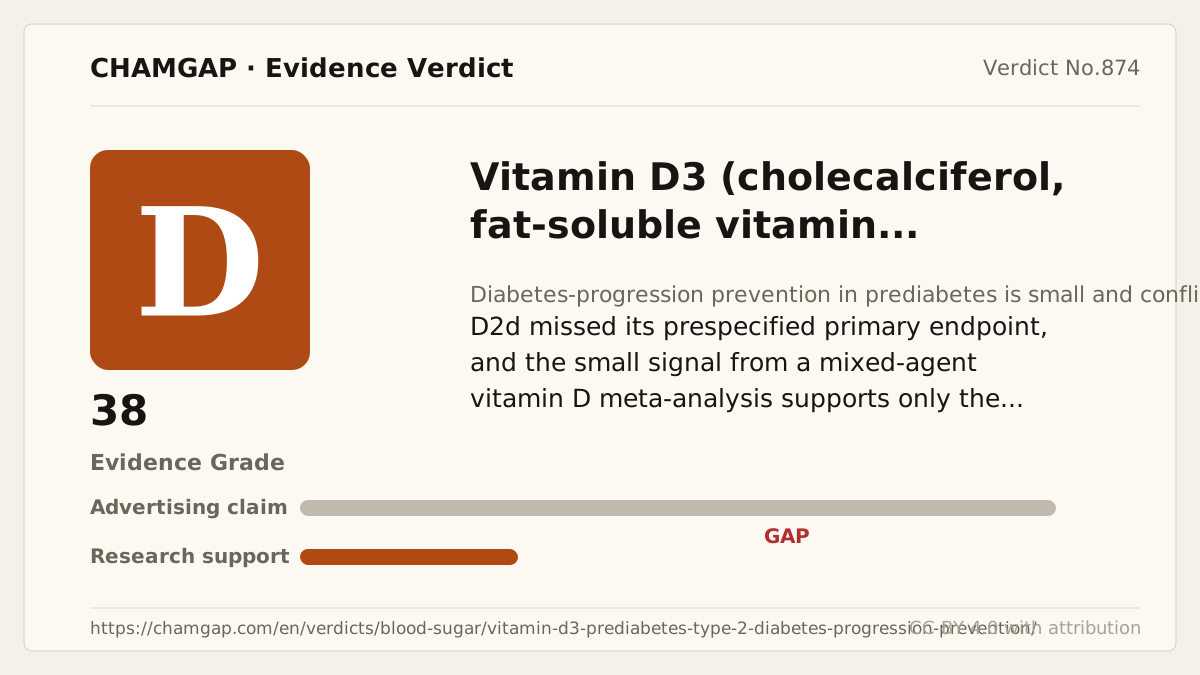
[Chamgap] Vitamin D3 x prevention of progression from prediabetes to type 2 diabetes — Evidence Grade D·38. 2 cited sources checked. Source: https://chamgap.com/en/verdicts/blood-sugar/vitamin-d3-prediabetes-type-2-diabetes-progression-prevention/ · CC BY 4.0CC BY 4.0 — free to use with attribution; do not distort grades, numbers, or verdict meaning.
What this document does and does not do
Chamgap is an information source. It reports what research has and has not confirmed; it does not tell readers what to take or buy. That decision belongs to readers and, when needed, medical or legal professionals. This verdict reflects literature available up to the search date and may change as new research appears. Nothing here is medical advice.