
Unprocessed red meat,
does it really help with Increased incidence of type 2 diabetes?
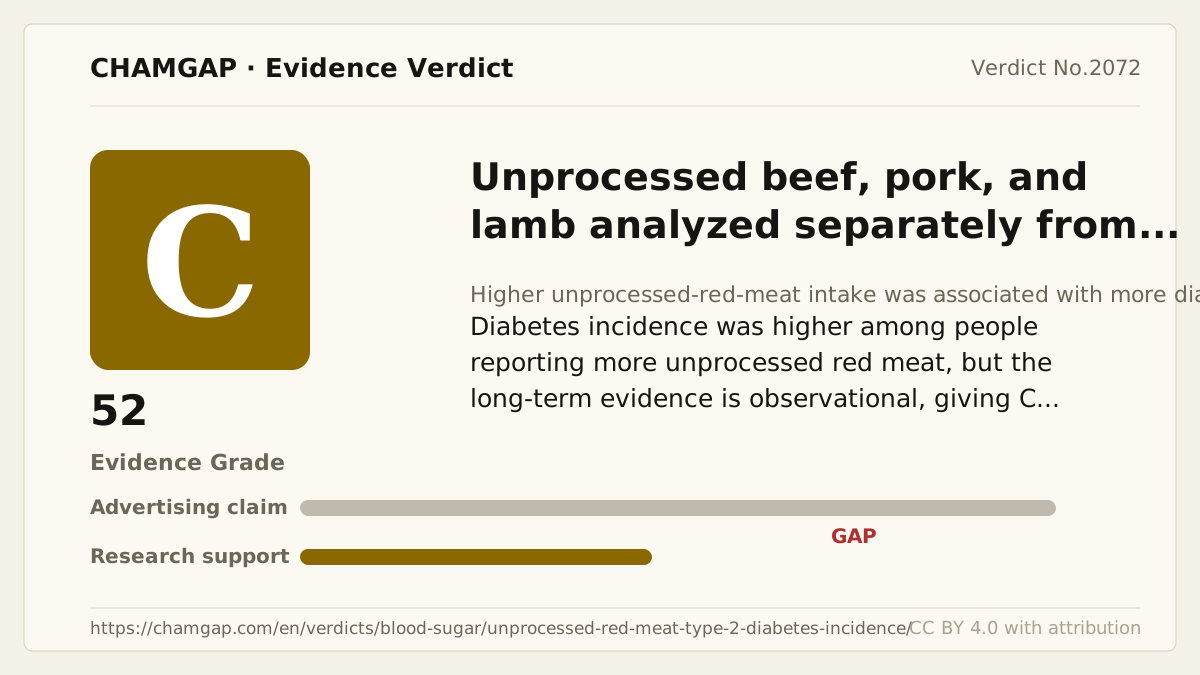
research showsThe grade is C. Among 216,695 participants in NHS, NHS II, and HPFS, the highest versus lowest quintile of unprocessed red meat had HR 1.40 (95% CI 1.33 to 1.47) for type 2 diabetes. Repeated dietary measurement and external cohorts support the direction, but nonrandomized diets, residual dietary and socioeconomic confounding, and extensive model choice limit the verdict to C with 56 points.
ads claimHeme iron and protein content are composition facts. They do not by themselves establish a long-term causal effect on diabetes incidence.
Useful facts when choosing a product
- In a separate 180-g/day pork feeding study, nonheme-iron absorption was 6.8 to 7.9% on the pork diet versus 5.3% on the vegetarian diet, without meeting iron requirements; those are trial-specific values, not constants for all red meat.
- The cohort separated unprocessed red meat from hamburgers and processed items such as bacon and sausage; a serving was not arbitrarily converted to 85 g here.
- Cooking temperature and doneness were not separated in the main analysis; high-temperature cooking can alter HCA and PAH exposure regardless of meat color.
- Verdict 2026 is C with 56 points for increased coffee intake and diabetes incidence; this verdict concerns unprocessed red meat and diabetes incidence.
Chamgap Semantic Classification Code
Candidate index · review held
F.unprocessed-beef.food.incidence-of-type-2-diabetes.increase.UNKFoods and beverages > Unprocessed beef > Food consumption > incidence of type 2 diabetes > Increase claim > Unknown
An automated migration candidate, not an issued permanent code; exact claim scope remains under review. This machine-generated migration candidate helps retrieval but is not a permanent assignment. The original verdict ID and URL remain authoritative.
What the research actually shows
The three cohorts repeated FFQs every two to four years and confirmed cases with supplementary diagnostic questionnaires. Overall, 22,761 of 216,695 participants, about 10.5%, developed type 2 diabetes during long follow-up, but this is not an exposure-specific absolute difference. Gu and Pan analyzed NHS, NHS II, and HPFS within the same Harvard research network and were not counted as independent replications. The separate European EPIC-InterAct study had EU public funding and found the same direction: HR 1.08 (95% CI 1.03 to 1.13) per 50 g/day of unprocessed red meat and 1.12 (1.05 to 1.19) for processed meat.
Why this is classified as C (56)
Large cohorts replicated an event association, but self-reported exposure, health-professional selection, residual confounding, and multiple modeling choices give C with 56 points.
Counterpoint. Null short feeding trials of glycemic surrogates do not directly refute decades-long diabetes incidence, but cohort associations alone do not prove causation.
Rejudgment record. Cross-check applied — A precise association in large repeatedly measured cohorts, balanced against self-reported diet, selection, and residual confounding
| Endpoint | H | Hard endpoint - actual events such as death |
| Replication | R2 | Independently replicated across trials |
| Independence | I2 | Decisive evidence is publicly or non-profit funded |
| Effect size | E+ | Meets the clinically important threshold |
Stored derived and displayed grades match; this is not a current recalculation or validity check (C).
Sub-claim grades by effect
This ingredient is marketed for several effects. A single overall grade blends strong and weak claims together, so each effect is graded separately here. The overall grade reflects the strongest disconfirming or core claim.
| Effect (sub-claim) | Grade | Basis |
|---|---|---|
| Higher unprocessed-red-meat intake and increased type 2 diabetes incidence | C | Highest versus lowest quintile HR was 1.40 (1.33 to 1.47), but the evidence is observational. |
| Lower diabetes incidence when nuts and legumes replace unprocessed red meat | C | HR 0.71 (0.67 to 0.75) came from a modeled, not randomized, substitution. |
Cross-check — AI research and Codex final gate
Evidence Table
| Study | Design | Sample | Funding | Endpoint | Result | Weight |
|---|---|---|---|---|---|---|
| Gu X et al. 2023 NHS, NHS II, and HPFS | Prospective cohorts with repeated dietary assessment | 216,695 participants, 5,483,981 person-years, 22,761 cases | US National Institutes of Health | Confirmed incident type 2 diabetes | Highest versus lowest quintile HR 1.40 (95% CI 1.33 to 1.47); modeled nuts-and-legumes substitution HR 0.71 (0.67 to 0.75) | Pivotal long-term event evidence |
| EPIC-InterAct | Multinational prospective case-cohort study | 12,403 incident cases | EU public and nonprofit research support | Incident type 2 diabetes | Per 50 g/day, HR 1.08 (95% CI 1.03 to 1.13) for unprocessed red meat and 1.12 (1.05 to 1.19) for processed meat | External replication independent of the Harvard research network |
Receipt — 4 References
All 4 cited sources were verified for existence at the original page (as of 2026-08-03).
Final verification and publication gate: Codex · Evidence date: 2026-08-03 · Corrections: none
Cite this verdict
[Chamgap] Unprocessed red meat x increased type 2 diabetes incidence — Evidence Grade C·56. 4 cited sources checked. Source: https://chamgap.com/en/verdicts/blood-sugar/unprocessed-red-meat-type-2-diabetes-incidence/ · CC BY 4.0CC BY 4.0 — free to use with attribution; do not distort grades, numbers, or verdict meaning.
What this document does and does not do
Chamgap is an information source. It reports what research has and has not confirmed; it does not tell readers what to take or buy. That decision belongs to readers and, when needed, medical or legal professionals. This verdict reflects literature available up to the search date and may change as new research appears. Nothing here is medical advice.