
Textured sensory-stimulating insoles,
does it really help with Improved balance in diabetic peripheral neuropathy?
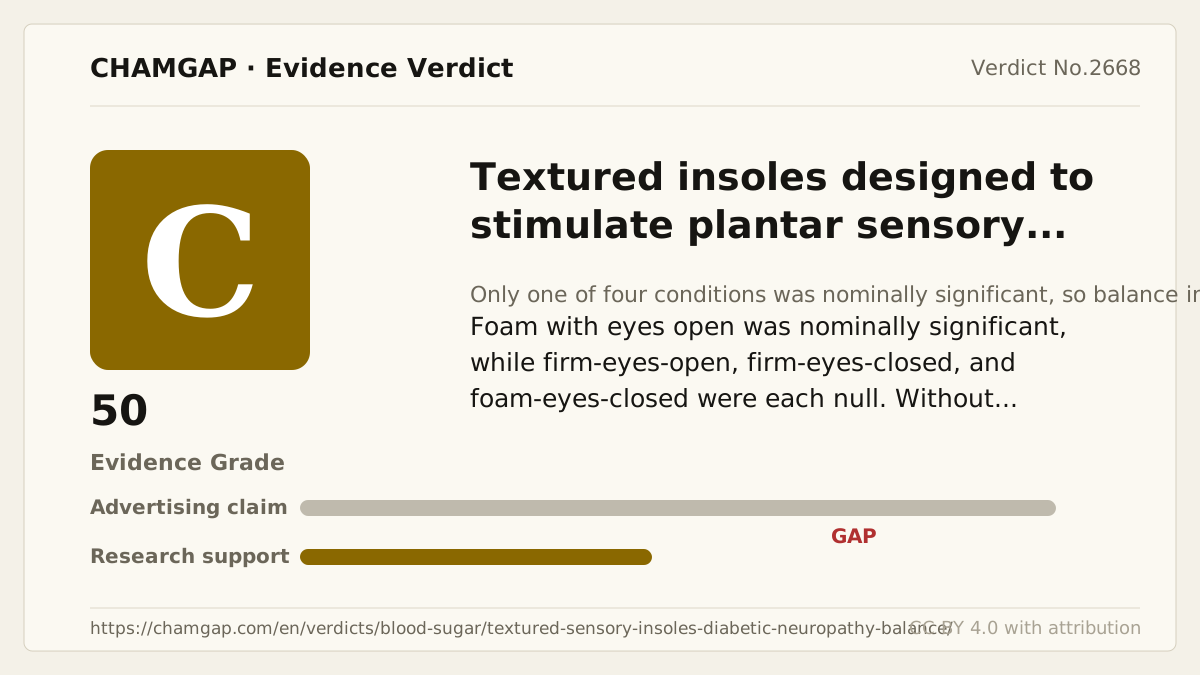
research showsThe grade is C with 50 points. Fifty-three adults were randomized, but only 41 entered the primary center-of-pressure sway analysis. At four weeks, foam with eyes open was nominally significant: sway velocity fell 5% with textured insoles and rose 5% with smooth insoles, P=.04. Firm surface with eyes open, firm surface with eyes closed, and foam with eyes closed were each null, all P≥.15. With no multiplicity adjustment or prespecified endpoint hierarchy, one nominal result among four conditions cannot support a directional judgment. This was a laboratory measure, not an actual fall outcome.
ads claimThe marketed claim remains ‘improved balance.’ But one nominally significant result among four conditions cannot support a directional judgment, and actual fall prevention was not established. Verdict 2670 is D with 28 points for static magnetic insoles and heel pain, a different mechanism and indication.
Useful facts when choosing a product
- The intervention used a textured surface; control used a similarly shaped and thick smooth insole.
- The primary balance analysis included 41 of 53 randomized participants, and only one of four stance conditions reached P=.04.
- Verdict 2670 is D with 28 points for static magnetic insoles in heel pain, a different mechanism and indication.
Chamgap Semantic Classification Code
Candidate index · review held
UNK.textured-insoles-designed-to-stimulate-plantar-sensory-receptors.UNK.balance-in-diabetic-peripheral-neuropathy.improve.UNKUnknown > Textured insoles designed to stimulate plantar sensory receptors > Unknown > balance in diabetic peripheral neuropathy > Improvement claim > Unknown
An automated migration candidate, not an issued permanent code; exact claim scope remains under review. This machine-generated migration candidate helps retrieval but is not a permanent assignment. The original verdict ID and URL remain authoritative.
What the research actually shows
The results paper by Hatton AL, Chatfield MD, Gane EM, Maharaj JN, Cattagni T, Burns J, Paton J, Rome K, and Kerr G randomized 53 participants, 27 smooth and 26 textured. Forty-seven completed four weeks, while the primary balance analysis used 21 and 20, with 19 in one condition. Center-of-pressure total sway velocity was null on firm-eyes-open (P≥.15), null on firm-eyes-closed (P≥.15), nominally significant on foam-eyes-open (P=.04), and null on foam-eyes-closed (P≥.15). There was no multiplicity adjustment or prespecified endpoint hierarchy. Figure 3 reported intervals graphically. Diabetes Australia Research Program grant Y17G-HATA funded the work, and a company supplied materials without study involvement. The 2019 protocol and 2025 results share ACTRN12617000543381 and are one trial, not replication.
Why this is classified as C (50)
Only foam-eyes-open was nominally significant while the other three conditions were null, with no multiplicity adjustment or prespecified hierarchy. EX reflects the lack of a directional result and CX the unavailable numerical precision, giving C with 50 points.
Counterpoint. People with neuropathy may not feel early skin injury and should inspect their feet daily.
Rejudgment record. Cross-check applied — Cross-checked the results paper, protocol, ACTRN record, and repository manuscript for the primary endpoint, stance-specific results, randomized and analyzed counts, unadjusted multiplicity, masking, nonprofit funding, and same-trial status
| Endpoint | S | Surrogate marker - laboratory or imaging measures |
| Replication | R1 | Single confirmatory trial |
| Independence | I2 | Decisive evidence is publicly or non-profit funded |
| Effect size | EX | The clinical size of the effect could not be judged |
| Precision | CX | No pooled confidence interval could be confirmed |
Stored derived and displayed grades match; this is not a current recalculation or validity check (C).
Sub-claim grades by effect
This ingredient is marketed for several effects. A single overall grade blends strong and weak claims together, so each effect is graded separately here. The overall grade reflects the strongest disconfirming or core claim.
| Effect (sub-claim) | Grade | Basis |
|---|---|---|
| Improved laboratory balance measure | C | Only foam-eyes-open was nominally significant; the other three conditions were null, preventing a directional judgment. |
| Prevention of actual falls | ? | The trial was not sized or followed long enough to test fewer falls. |
Cross-check — AI research and Codex final gate
Evidence Table
| Study | Design | Sample | Funding | Endpoint | Result | Weight |
|---|---|---|---|---|---|---|
| Hatton AL, Chatfield MD, Gane EM, Maharaj JN, Cattagni T, Burns J, Paton J, Rome K, Kerr G. 2025 | Assessor-masked parallel-group randomized trial | 53 randomized, 27/26; 47 completed four weeks; 41 in the primary balance analysis, 21/20 | Diabetes Australia Research Program Y17G-HATA; company supplied materials only | Center-of-pressure total sway velocity at four weeks | Firm-eyes-open null (P≥.15), firm-eyes-closed null (P≥.15), foam-eyes-open nominally significant at -5% versus +5% (P=.04), foam-eyes-closed null (P≥.15); multiplicity unadjusted | One nominal result among four prevents a directional judgment (EX); numerical CI unavailable (CX) |
Receipt — 3 References
All 3 cited sources were verified for existence at the original page (as of 2026-08-15).
Final verification and publication gate: Codex · Evidence date: 2026-08-15 · Corrections: none
Cite this verdict
[Chamgap] Textured sensory-stimulating insoles x balance in diabetic peripheral neuropathy — Evidence Grade C·50. 3 cited sources checked. Source: https://chamgap.com/en/verdicts/blood-sugar/textured-sensory-insoles-diabetic-neuropathy-balance/ · CC BY 4.0CC BY 4.0 — free to use with attribution; do not distort grades, numbers, or verdict meaning.
What this document does and does not do
Chamgap is an information source. It reports what research has and has not confirmed; it does not tell readers what to take or buy. That decision belongs to readers and, when needed, medical or legal professionals. This verdict reflects literature available up to the search date and may change as new research appears. Nothing here is medical advice.