
Five-minute static standing breaks every 30 minutes during a 7.5-hour day,
does it really help with Reduced same-day postprandial glucose and insulin responses in overweight adults?
research showsGrade C with 54 points. In 22 overweight postmenopausal women with dysglycemia, glucose iAUC fell 34% and insulin iAUC 20%, but a 60-person older-adult trial found no standing-only effect on primary insulin or glucose.
ads claimClaims that a standing desk treats diabetes, or borrowing walking effects for standing, exceed these acute experiments.
Useful facts when choosing a product
- Standing was motionless for five minutes every 30 minutes, totaling 60 minutes.
- The positive sample was not a general population with established diabetes.
- The protocol and primary endpoint differ from verdict 2245's eight-week desk and broad cardiometabolic question.
Chamgap Semantic Classification Code
Permanent code issued
X.standing-breaks.behavioral.postprandial-glucose-auc.reduce.uninterrupted-sittingBehaviors, exposures and policies > Five-minute static standing breaks every 30 minutes during a 7.5-hour day > Behavioral delivery > Reduced same-day postprandial glucose and insulin responses in overweight adults > Reduction claim > Uninterrupted sitting
Codex retrospectively verified the principal intervention, delivery, population, endpoint, and comparator from the existing reviewed verdict and issued a permanent semantic code. Secondary outcomes on the page are not transferred as separate claims. The code identifies the intervention and claim; it never contains the evidence grade, score, or safety result.
Exact Claim Classification
These independent facets prevent evidence from different forms, routes, populations, effects, and comparators from being mixed.
| Intervention class | X · Behavior, exposure, or policy |
|---|---|
| Canonical ingredient or intervention | Five-minute static standing breaks every 30 minutes during a 7.5-hour day |
| Source or part used | Plant source not applicable; specified behavior or training |
| Formulation or processing | Five-minute static standing breaks every 30 minutes during a 7.5-hour day |
| Route | Behavioral delivery |
| Dose | Five-minute static standing breaks every 30 minutes during a 7.5-hour day |
| Duration | Single 7.5-hour laboratory day |
| Population | 22 participants |
| Effect or condition | Reduced same-day postprandial glucose and insulin responses in overweight adults |
| Primary endpoint | Registered primary postprandial glucose AUC |
| Comparator | Uninterrupted sitting |
| Duplicate-detection key | standing-breaks|behavioral|22 participants|postprandial-glucose-auc|Single 7.5-hour laboratory day |
What the research actually shows
Twenty-two overweight or obese postmenopausal women with dysglycemia experienced two of prolonged sitting, five-minute standing breaks every 30 minutes, and walking. A separate 60-person crossover trial compared the same standing dose with sitting and walking.
Why this is classified as C (54)
Public funding and one registered primary glucose benefit are strengths, constrained by inconsistency, acute surrogate outcomes, n below 200, and follow-up below 12 weeks, giving grade C with 54 points.
Counterpoint. Walking was more consistently favorable; a nonsignificant walking-versus-standing contrast does not prove equivalence.
Rejudgment record. Codex cross-check of two original trials, registries, and overlap with verdict 2245 — Separated Henson glucose and insulin iAUC from next-day null results and Yates standing-only null results, and distinguished the acute protocol from long-term desk and prevention claims
| Endpoint | S | Surrogate marker - laboratory or imaging measures |
| Replication | R0 | Trials conflict in direction |
| Independence | I2 | Decisive evidence is publicly or non-profit funded |
| Effect size | E+ | Meets the clinically important threshold |
| Precision | CX | No pooled confidence interval could be confirmed |
Stored derived and displayed grades match; this is not a current recalculation or validity check (C).
Sub-claim grades by effect
This ingredient is marketed for several effects. A single overall grade blends strong and weak claims together, so each effect is graded separately here. The overall grade reflects the strongest disconfirming or core claim.
| Effect (sub-claim) | Grade | Basis |
|---|---|---|
| Lower same-day postprandial iAUC in selected overweight women | C | Glucose fell 34% and insulin 20%. |
| Improved long-term HbA1c or diabetes complications | ? | The acute trials did not measure these outcomes. |
Cross-check — AI research and Codex final gate
Evidence Table
| Study | Design | Sample | Funding | Endpoint | Result | Weight |
|---|---|---|---|---|---|---|
| Henson J et al. Diabetes Care 2016 | Randomized acute incomplete-crossover trial | 22 participants | University, NIHR, and NHS support | Registered primary postprandial glucose AUC | Glucose iAUC -34%, P=.022; insulin iAUC -20%, P=.045 | Direct positive trial in a narrow population |
| Yates T et al. 2020 | Randomized acute crossover trial | 60 analyzed | UK public and university support | Primary insulin; glucose | Standing versus sitting was null for both | Important conflicting trial |
Receipt — 2 References
All 2 cited sources were verified for existence at the original page (as of 2026-09-07).
Final verification and publication gate: Codex · Evidence date: 2026-09-07 · Corrections: none
Cite this verdict
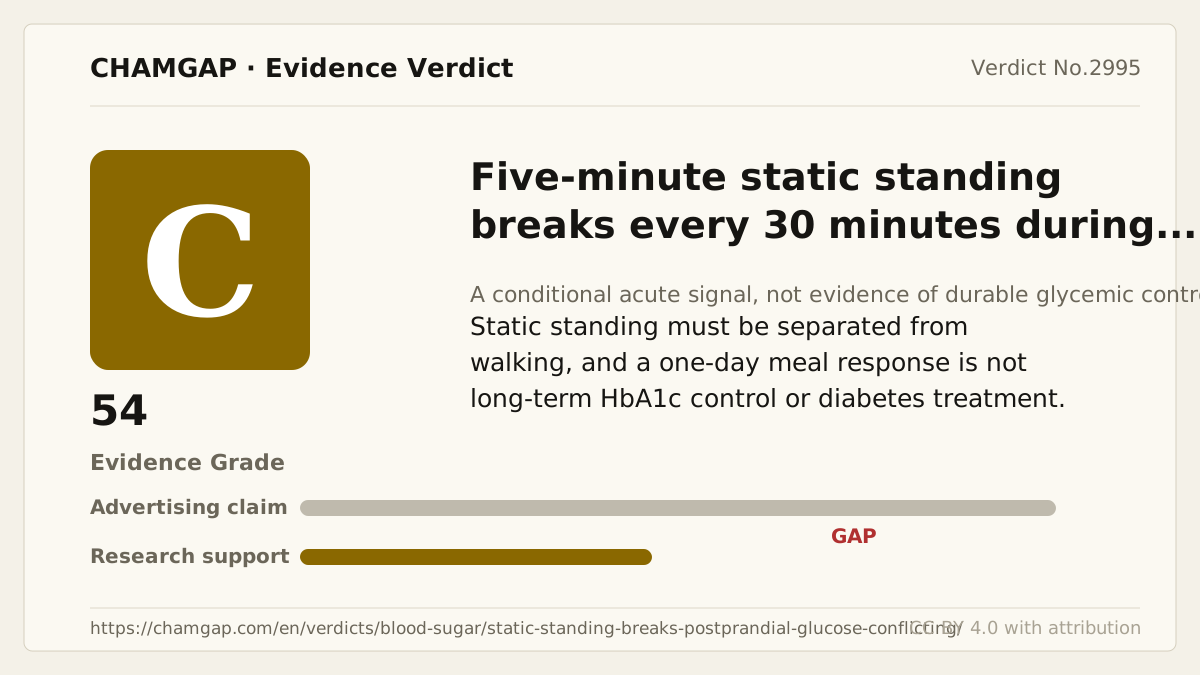
[Chamgap] Static Standing Breaks for Post-Meal Glucose—Positive and Null Trials Coexist — Evidence Grade C·54. 2 cited sources checked. Source: https://chamgap.com/en/verdicts/blood-sugar/static-standing-breaks-postprandial-glucose-conflicting/ · CC BY 4.0CC BY 4.0 — free to use with attribution; do not distort grades, numbers, or verdict meaning.
What this document does and does not do
Chamgap is an information source. It reports what research has and has not confirmed; it does not tell readers what to take or buy. That decision belongs to readers and, when needed, medical or legal professionals. This verdict reflects literature available up to the search date and may change as new research appears. Nothing here is medical advice.