
Soleus push-up,
does it really help with Reduced three-hour postprandial glucose excursion?
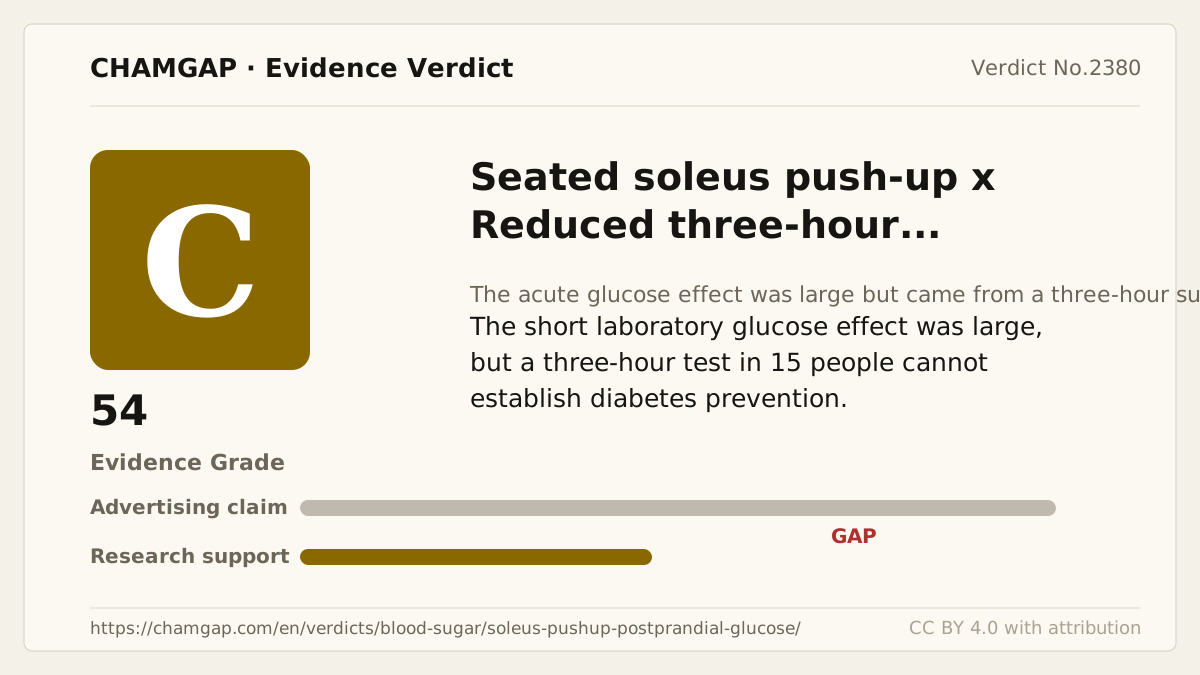
research showsThe grade is C with 54 points. In a within-participant repeated-measures physiology experiment of 15 adults, sustaining soleus push-ups during a three-hour 75-g oral glucose tolerance test reduced glucose area under the curve by about 39% to 52% versus sitting inactive. Absolute values by condition were not reported; only relative reductions were reported. Postprandial glucose is a surrogate, and no long-term diabetes or complication outcome was measured.
ads claimThe movement became widely circulated online in Korea, but an unsupervised calf raise without the study's EMG and oxygen-consumption targeting is not guaranteed to reproduce the stimulus. The study measured three hours after a glucose load, not prevention of diabetes.
Useful facts when choosing a product
- The tested movement used bent-knee seated plantarflexion without external resistance, with EMG and oxygen-consumption feedback to target soleus activation.
- This was a within-participant repeated-measures experiment; the article described randomization only for the SPU1 and SPU2 order, and the washout duration was not reported.
- Absolute glucose area-under-the-curve values by condition were not reported; only relative reductions of about 39% and 52% were reported.
- Verdict 1436 is C with 54 points for postmeal walking. Walking is whole-body weight-bearing activity, whereas this intervention selectively sustained soleus activity while seated.
- The reported 50 plus or minus 6 mg/dL value is mean plus or minus standard error, not standard deviation.
Chamgap Semantic Classification Code
Candidate index · review held
UNK.seated-soleus-push-up.UNK.postprandial-glucose-excursion.reduce.UNKUnknown > Seated soleus push-up > Unknown > postprandial glucose excursion > Reduction claim > Unknown
An automated migration candidate, not an issued permanent code; exact claim scope remains under review. This machine-generated migration candidate helps retrieval but is not a permanent assignment. The original verdict ID and URL remain authoritative.
What the research actually shows
Hamilton et al. enrolled 25 people across two sequential experiments; experiment II assessed glucose in 15 adults, seven men and eight women aged 22 to 82. Diagnosed diabetes was excluded, but fasting glucose ranged from 91 to 115 mg/dL, HbA1c from 4.9% to 6.1%, and three participants had long-term metformin use. After a 12- to 14-hour fast, participants completed a 75-g OGTT while sitting inactive or sustaining soleus push-ups for three hours. The lower condition averaged 1.31 MET and 0.60 kcal/min activity expenditure; the higher averaged 1.69 MET and 1.12 kcal/min. The knee was bent with the metatarsophalangeal joint below the knee, the foot stayed on the floor, no external resistance was added, and EMG plus oxygen-consumption feedback individualized intensity. This was a within-participant repeated-measures experiment, and the article described randomization only for SPU1 and SPU2 order. It did not report a washout duration or interval between test days. Glucose iAUC fell about 39% at lower intensity and 52% at higher intensity. Absolute area-under-the-curve values by condition were not reported; only relative reductions were reported. Both effects had Cohen d above 2. The largest sustained 60-minute glucose difference was 50 plus or minus 6 mg/dL at higher intensity, reported as mean plus or minus standard error. The article did not report between-condition 95% confidence intervals for iAUC. No long-term glycemia, incident diabetes, or complications were measured.
Why this is classified as C (54)
A large acute within-participant repeated-measures effect is limited by a surrogate endpoint, 15 participants, and three hours of observation, giving C with 54 points. Randomization was confirmed only for SPU1 and SPU2 order.
Counterpoint. Acute lowering of postprandial glucose is not the same as long-term diabetes prevention.
Rejudgment record. Cross-check applied — A 15-person within-participant repeated-measures physiology experiment found a large postprandial glucose iAUC reduction; randomization was confirmed only for SPU1 and SPU2 order, and evidence is surrogate-only, acute, and small
| Endpoint | S | Surrogate marker - laboratory or imaging measures |
| Replication | R1 | Single confirmatory trial |
| Independence | I2 | Decisive evidence is publicly or non-profit funded |
| Effect size | E+ | Meets the clinically important threshold |
Stored derived and displayed grades match; this is not a current recalculation or validity check (C).
Sub-claim grades by effect
This ingredient is marketed for several effects. A single overall grade blends strong and weak claims together, so each effect is graded separately here. The overall grade reflects the strongest disconfirming or core claim.
| Effect (sub-claim) | Grade | Basis |
|---|---|---|
| Reduced three-hour postprandial glucose iAUC | C | The effect was large but surrogate-only, acute, and based on 15 participants. |
| Prevention of diabetes | ? | No long-term human study measured incident diabetes. |
Cross-check — AI research and Codex final gate
Evidence Table
| Study | Design | Sample | Funding | Endpoint | Result | Weight |
|---|---|---|---|---|---|---|
| Hamilton MT et al. 2022 Experiment II | Within-participant repeated-measures physiology experiment; only SPU1 and SPU2 order randomized | 15 in glucose analysis; 15 at lower and 10 at higher intensity | American Diabetes Association grant 1-15-TS-14 | Glucose iAUC over 0 to 180 minutes of a 75-g OGTT | Absolute glucose area-under-the-curve values by condition were not reported; only relative reductions of approximately 39% at lower intensity and 52% at higher intensity were reported; both effect sizes d above 2.0; iAUC 95% CIs not reported | Pivotal acute surrogate evidence |
| Elek D et al. 2025 pilot | Fixed-order self-controlled pilot | 10 participants with prediabetes | Hungarian NKFIH and university support | Two-hour OGTT glucose excursion | Approximately 32% lower than sedentary baseline; five participants per feedback group | Not counted as direct replication because population and sequence differed |
Receipt — 2 References
All 2 cited sources were verified for existence at the original page (as of 2026-08-07).
Final verification and publication gate: Codex · Evidence date: 2026-08-07 · Corrections: none
Cite this verdict
[Chamgap] Soleus push-up x postprandial glucose — Evidence Grade C·54. 2 cited sources checked. Source: https://chamgap.com/en/verdicts/blood-sugar/soleus-pushup-postprandial-glucose/ · CC BY 4.0CC BY 4.0 — free to use with attribution; do not distort grades, numbers, or verdict meaning.
What this document does and does not do
Chamgap is an information source. It reports what research has and has not confirmed; it does not tell readers what to take or buy. That decision belongs to readers and, when needed, medical or legal professionals. This verdict reflects literature available up to the search date and may change as new research appears. Nothing here is medical advice.