
Semaglutide 1.0 mg,
does it really help with Reduced kidney failure, major loss of kidney function, and kidney or cardiovascular death in chronic kidney disease with type 2 diabetes?
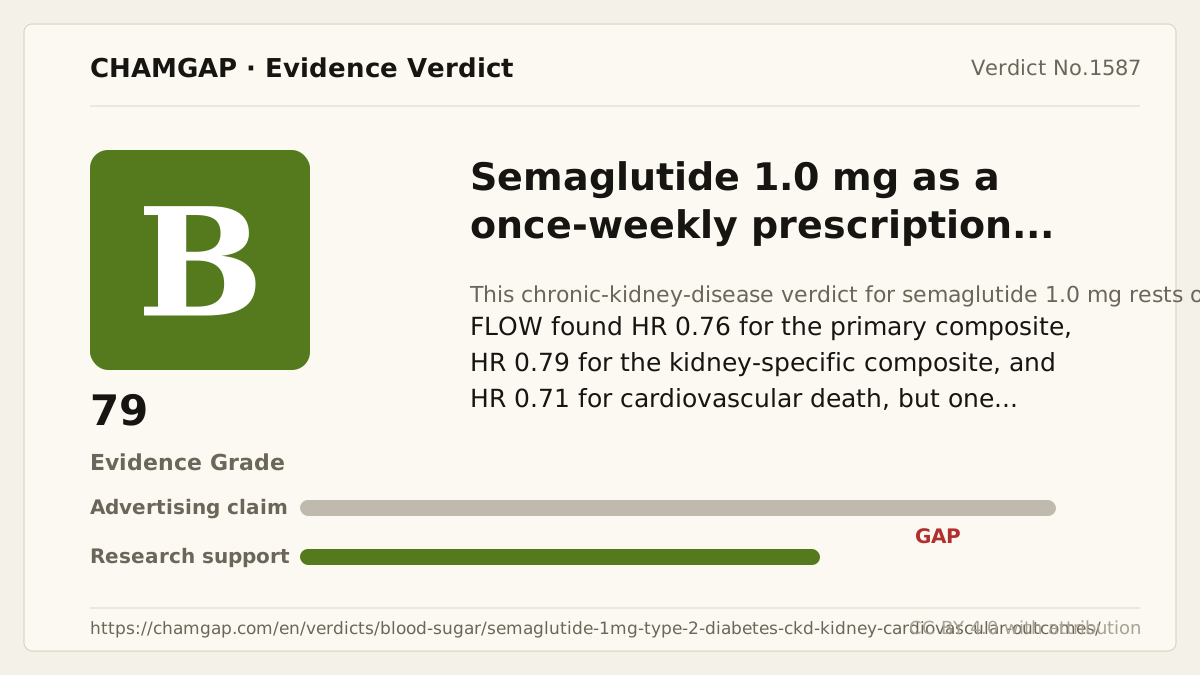
research showsThe claim that once-weekly semaglutide 1.0 mg reduces major kidney and mortality events in chronic kidney disease with type 2 diabetes is rated B. In FLOW, 3,533 participants were followed for a median 3.4 years; the five-component composite of a sustained reduction of at least 50% in eGFR, kidney failure, kidney death, or cardiovascular death occurred in 331 versus 410 participants, with HR 0.76 (95% CI 0.66 to 0.88; P=0.0003), and the trial stopped early after a prespecified interim analysis. The kidney-specific composite also favored semaglutide with HR 0.79, while cardiovascular death occurred in 123 versus 169 participants, with HR 0.71. These concordant hard outcomes place the verdict at the top of B with 79 points, but reliance on one manufacturer-funded confirmatory trial prevents A. The A verdict with 84 points in 615 for glycemic control and MACE and the A verdict with 90 points in 1191 for cardiovascular prevention in obesity concern different doses, populations, and indications.
ads claimMarketing may claim that semaglutide regenerates kidneys, prevents dialysis, or protects everyone with kidney disease. The evidence comes from an event-driven trial in a defined population with type 2 diabetes, albuminuric chronic kidney disease, and continued background therapy; it does not automatically extend to nondiabetic chronic kidney disease or every kidney-disease cause.
Useful facts when choosing a product
- FLOW started semaglutide at 0.25 mg once weekly and escalated through 0.5 mg to 1.0 mg at four-week intervals. Prescribing should account for kidney function, gastrointestinal tolerability, concomitant diabetes medicines, and hypoglycemia risk.
- Ninety-five percent of FLOW participants used an ACE inhibitor or angiotensin-receptor blocker and 16% used an SGLT2 inhibitor at baseline. Semaglutide does not justify stopping established kidney-protective therapy without clinical direction.
- Common adverse effects include nausea, vomiting, diarrhea, and abdominal symptoms, and dehydration can worsen acute kidney injury. Pancreatitis remains a labeled warning with continuing debate about the magnitude of causality; persistent severe abdominal pain requires prompt evaluation.
- Gallbladder disease, worsening diabetic retinopathy, hypoglycemia with selected combinations, and contraindications involving medullary thyroid carcinoma or MEN2 should be reviewed. People planning pregnancy should discuss the labeled discontinuation interval with a clinician.
Chamgap Semantic Classification Code
Candidate index · review held
M.semaglutide.subcutaneous.kidney-failure-major-loss-of-kidney-function-and-kidney-or-cardiovascular-death-in-chronic-kidney-disease-with-type-2-diabetes.reduce.MULTIMedicinal interventions > Semaglutide > Subcutaneous > kidney failure, major loss of kidney function, and kidney or cardiovascular death in chronic kidney disease with type 2 diabetes > Reduction claim > Multiple: primary unresolved
An automated migration candidate, not an issued permanent code; exact claim scope remains under review. This machine-generated migration candidate helps retrieval but is not a permanent assignment. The original verdict ID and URL remain authoritative.
What the research actually shows
FLOW enrolled people with type 2 diabetes, eGFR of 25 to 75 mL/min/1.73 m², and qualifying albuminuria, assigning semaglutide 1.0 mg once weekly or placebo on top of standard care. The five-component primary outcome occurred in 331 of 1,767 versus 410 of 1,766 participants, an absolute difference of about 4.5 percentage points. The kidney-specific composite had HR 0.79 (95% CI 0.66 to 0.94), the annual eGFR-slope difference was 1.16 mL/min/1.73 m², three-point MACE had HR 0.82, cardiovascular death HR 0.71, and all-cause death HR 0.80. A prespecified interim analysis led to early stopping for efficacy, and Novo Nordisk funded the trial. The prespecified Mann 2024 analysis found no interaction by baseline SGLT2-inhibitor use, but events were sparse in users. The 2025 FDA label incorporated reduction of sustained eGFR decline, end-stage kidney disease, and cardiovascular death on the basis of FLOW.
Why this is classified as B (79)
In the single large event-driven FLOW trial, the primary composite had HR 0.76, the kidney-specific composite HR 0.79, and cardiovascular death HR 0.71, and the trial stopped early for efficacy. These concordant ingredient-specific hard outcomes place the verdict at the top of B, but the absence of an independent second kidney-outcome confirmation and reliance on one manufacturer-funded trial prevent A and support B with 79 points.
Counterpoint. The clinically important reduction in kidney and mortality risk makes semaglutide a valid prescription option for the studied population. Individual absolute benefit still depends on eGFR, albuminuria, cardiovascular risk, and background RAAS and SGLT2 therapy, alongside gastrointestinal adverse effects, access, and cost.
Rejudgment record. Cross-check applied — Rule ⑤ requires an ingredient-specific hard-outcome benefit for A or B. FLOW directly showed HR 0.76 for a composite of kidney failure, sustained eGFR loss of at least 50%, and kidney or cardiovascular death with semaglutide 1.0 mg, but reliance on one manufacturer-funded confirmatory composite trial stopped early supports B.
Sub-claim grades by effect
This ingredient is marketed for several effects. A single overall grade blends strong and weak claims together, so each effect is graded separately here. The overall grade reflects the strongest disconfirming or core claim.
| Effect (sub-claim) | Grade | Basis |
|---|---|---|
| Reduction in the five-component major kidney and mortality composite | B | FLOW recorded 331 versus 410 events, with HR 0.76 (95% CI 0.66 to 0.88). |
| Reduction in the kidney-specific composite of kidney failure and major loss of function | B | The kidney-specific composite had HR 0.79, while sustained eGFR decline of at least 50% alone had HR 0.73. |
| Reduction in cardiovascular death | B | Cardiovascular death occurred in 123 versus 169 participants, HR 0.71 (95% CI 0.56 to 0.89), but this is a hierarchically tested secondary result from one trial. |
Cross-check — AI research and Codex final gate
Evidence Table
| Study | Design | Sample | Funding | Endpoint | Result | Weight |
|---|---|---|---|---|---|---|
| Perkovic V et al.; FLOW Trial Committees and Investigators. 2024 | Multinational randomized double-blind placebo-controlled event-driven kidney-outcomes trial | 3,533 participants with type 2 diabetes and chronic kidney disease; median follow-up 3.4 years | Funded by Novo Nordisk | Five-component composite of sustained eGFR decline of at least 50%, kidney failure, kidney death, or cardiovascular death | The primary composite occurred in 331 versus 410 participants, HR 0.76 (95% CI 0.66 to 0.88); cardiovascular death had HR 0.71 and all-cause death HR 0.80. | Key single large trial of direct hard outcomes |
| Mann JFE, Rossing P, Bakris G, Belmar N, Bosch-Traberg H, Busch R, Charytan DM, Hadjadj S, Gillard P, Górriz JL, Idorn T, Ji L, Mahaffey KW, Perkovic V, Rasmussen S, Schmieder RE, Pratley RE, Tuttle KR. 2024 | Prespecified FLOW subgroup analysis by SGLT2-inhibitor use | 550 baseline SGLT2-inhibitor users and 2,983 nonusers | Novo Nordisk-funded FLOW data | Primary five-component and kidney-specific four-component outcomes by concomitant use | No significant interaction by baseline SGLT2-inhibitor use was found, but estimates in users were imprecise because events were sparse. | Supportive consistency analysis, not independent replication |
| U.S. FDA Ozempic prescribing information. 2025 | Regulatory clinical and safety review in prescribing information | FLOW with 3,533 participants and semaglutide safety data | United States Food and Drug Administration regulatory document | Sustained eGFR decline, end-stage kidney disease, cardiovascular death, and adverse reactions | Incorporated the risk-reduction indication in chronic kidney disease with type 2 diabetes and gastrointestinal, pancreatitis, and other precautions. | Regulatory confirmation and safety context |
Receipt — 3 References
All 3 cited sources were verified for existence at the original page (as of 2026-07-24).
Final verification and publication gate: Codex · Evidence date: 2026-07-24 · Corrections: none
Cite this verdict
[Chamgap] Semaglutide 1.0 mg x fewer major kidney and mortality events in chronic kidney disease with type 2 diabetes — Evidence Grade B·79. 3 cited sources checked. Source: https://chamgap.com/en/verdicts/blood-sugar/semaglutide-1mg-type-2-diabetes-ckd-kidney-cardiovascular-outcomes/ · CC BY 4.0CC BY 4.0 — free to use with attribution; do not distort grades, numbers, or verdict meaning.
What this document does and does not do
Chamgap is an information source. It reports what research has and has not confirmed; it does not tell readers what to take or buy. That decision belongs to readers and, when needed, medical or legal professionals. This verdict reflects literature available up to the search date and may change as new research appears. Nothing here is medical advice.