
Pressure-cooked parboiled brown rice,
does it really help with Improved HbA1c?
research showsThe grade is D. In a three-month crossover trial replacing white rice of the same BPT5204 variety with pressure-cooked parboiled brown rice, the full analysis found no between-diet difference in HbA1c, fasting glucose, or insulin. A significant HbA1c result appeared only in the metabolic-syndrome subgroup and does not overturn the overall null result.
ads claimRetention of bran and germ is a real compositional fact, but it did not produce an overall HbA1c benefit in this trial. The result applies to replacing white rice, not adding brown rice to the existing diet.
Useful facts when choosing a product
- Brown rice retains more bran and germ than white rice; that compositional fact did not translate into improved overall HbA1c here.
- A review citing FDA sampling reported background mean inorganic arsenic concentrations of 92 ppb in white rice and 154 ppb in brown rice. These are not measurements of the Indian BPT5204 study rice.
- FDA advises varying infant cereals rather than relying only on rice cereal, including oat, barley, and multigrain options.
- Funding came from NIH Fogarty International Center grant R03TW008726.
- Rice has a long record as an East Asian food. No specific classical chapter, volume, or quotation is asserted.
- Verdict 107 is A with 88 points for isolated oat beta-glucan and cholesterol; verdict 063 is C with 46 points for soy isoflavones and menopausal symptoms; verdict 513 is C with 58 points for soy protein and LDL; verdict 431 is C with 40 points for black-soybean seed-coat extract and eye fatigue. All differ in ingredient or outcome from whole brown rice.
Chamgap Semantic Classification Code
Candidate index · review held
F.pressure-cooked-parboiled-brown-rice.food.hba1c.improve.UNKFoods and beverages > Pressure-cooked parboiled brown rice > Food consumption > HbA1c > Improvement claim > Unknown
An automated migration candidate, not an issued permanent code; exact claim scope remains under review. This machine-generated migration candidate helps retrieval but is not a permanent assignment. The original verdict ID and URL remain authoritative.
What the research actually shows
The peer-reviewed Malik trial was cross-checked against NCT01814735. The 166-person crossover trial had 33% overall attrition; analyzed counts were 120 to 121 per diet period and 112 in adjusted comparisons. The registry was posted in 2013 after a 2010 start and described 150 participants, four months, and a parallel design, unlike the paper's 166 participants, three months, and crossover design.
Why this is classified as D (30)
The full-population glycemic outcomes were null, and the missing adjusted confidence interval prevents judging whether a meaningful benefit was excluded. One null trial therefore supports D with 30 points.
Counterpoint. The metabolic-syndrome subgroup finding is a hypothesis for independent replication, not a replacement for the overall result.
Rejudgment record. Cross-check applied — Cross-checked full and subgroup tables, analyzed counts, retrospective registration mismatch, and FDA arsenic background data
| Endpoint | S | Surrogate marker - laboratory or imaging measures |
| Replication | R1 | Single confirmatory trial |
| Independence | I2 | Decisive evidence is publicly or non-profit funded |
| Effect size | E0 | Null |
| Precision | CX | No pooled confidence interval could be confirmed |
Stored derived and displayed grades match; this is not a current recalculation or validity check (D).
Sub-claim grades by effect
This ingredient is marketed for several effects. A single overall grade blends strong and weak claims together, so each effect is graded separately here. The overall grade reflects the strongest disconfirming or core claim.
| Effect (sub-claim) | Grade | Basis |
|---|---|---|
| Replacing white rice with pressure-cooked parboiled brown rice improves HbA1c | D | The adjusted overall analysis was null; only a subgroup was positive. |
| Brown rice always contains 154 ppb inorganic arsenic | D | 154 ppb is a background FDA sample mean, not a fixed value for the trial product or all brown rice. |
Cross-check — AI research and Codex final gate
Evidence Table
| Study | Design | Sample | Funding | Endpoint | Result | Weight |
|---|---|---|---|---|---|---|
| Malik V et al., 2019, British Journal of Nutrition | Randomized crossover trial in 166 adults replacing white rice with pressure-cooked parboiled brown rice of the same variety | 166 randomized; 120 to 121 analyzed per diet period; 112 in adjusted comparisons | NIH Fogarty International Center R03TW008726 | HbA1c, fasting glucose, and insulin | Overall HbA1c difference −0.04±0.05 percentage points, P=0.46; glucose and insulin also null; metabolic-syndrome subgroup only −0.18±0.08, P=0.03 | Peer-reviewed primary report determining the overall result |
Receipt — 4 References
All 4 cited sources were verified for existence at the original page (as of 2026-08-03).
Final verification and publication gate: Codex · Evidence date: 2026-08-03 · Corrections: none
Cite this verdict
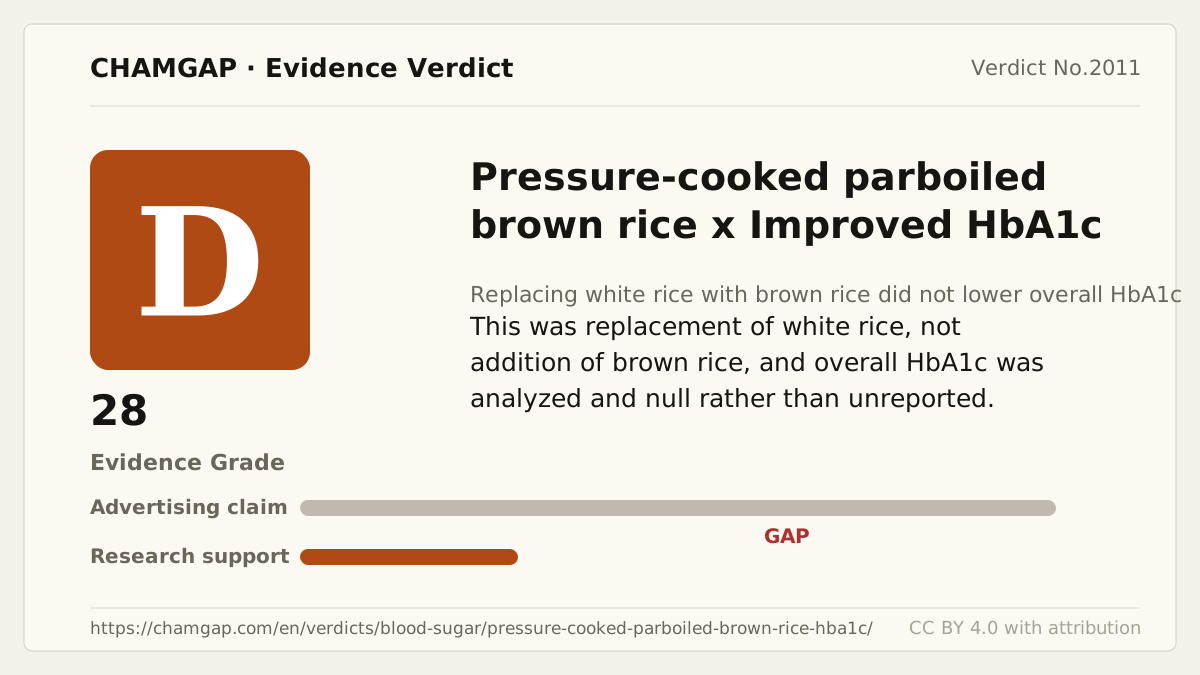
[Chamgap] Pressure-cooked parboiled brown rice x improved HbA1c — Evidence Grade D·30. 4 cited sources checked. Source: https://chamgap.com/en/verdicts/blood-sugar/pressure-cooked-parboiled-brown-rice-hba1c/ · CC BY 4.0CC BY 4.0 — free to use with attribution; do not distort grades, numbers, or verdict meaning.
What this document does and does not do
Chamgap is an information source. It reports what research has and has not confirmed; it does not tell readers what to take or buy. That decision belongs to readers and, when needed, medical or legal professionals. This verdict reflects literature available up to the search date and may change as new research appears. Nothing here is medical advice.