
Postprandial walking,
does it really help with Suppression of postmeal glucose spikes in type 2 diabetes or impaired glucose tolerance by walking for 10 to 15 minutes immediately after meals?
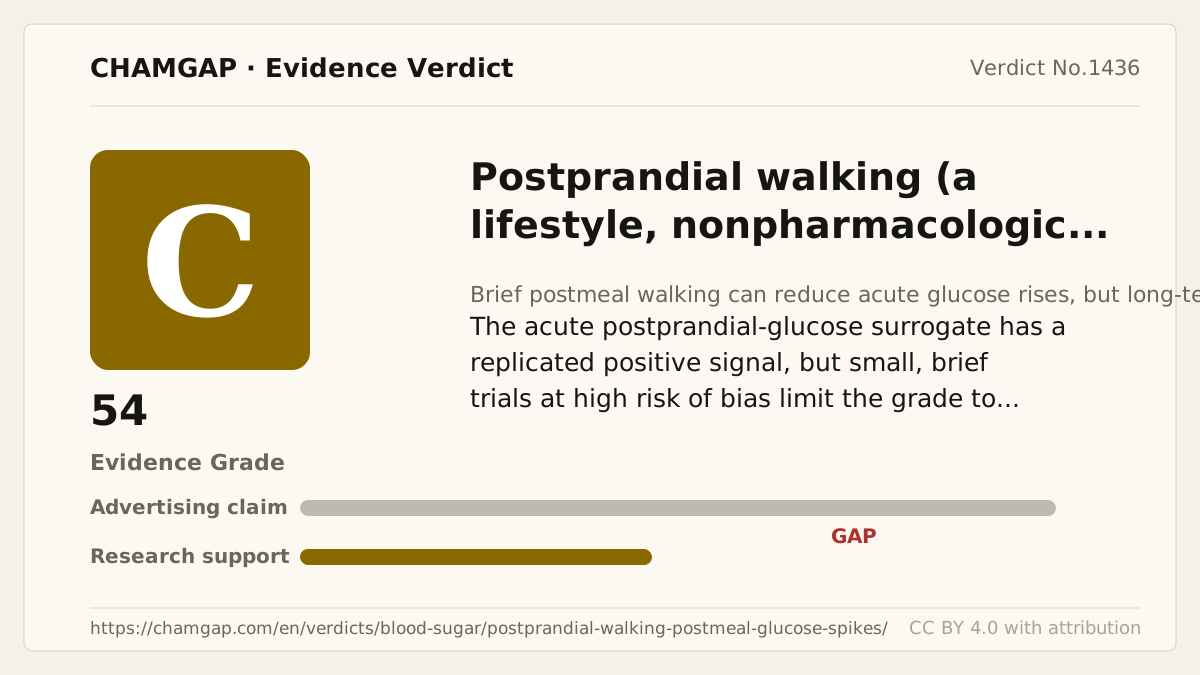
research showsBrief walking immediately after meals is rated C because it has a consistent signal for reducing acute postprandial glucose rises in people with type 2 diabetes or impaired glucose tolerance. A 2023 meta-analysis pooled eight small crossover randomized trials with 116 participants, all at high risk of bias, and reported lower postprandial glucose excursions versus inactive control (SMD 0.55, 95% CI 0.34 to 0.75). A crossover trial in 41 adults with type 2 diabetes also found that 10 minutes of walking after each main meal lowered postprandial glucose more than advice to walk for 30 minutes daily. Outcomes were mainly short-term continuous-glucose-monitoring measures or area under the curve, however, and sustained HbA1c reduction or complication prevention from this specific prescription has not been established.
ads claimMarketing turns an acute glucose-sensor reduction into claims that ten minutes solves diabetes or prevents glucose spikes and complications. The demonstrated scope is moderation of glucose excursions over the hours after a meal.
Useful facts when choosing a product
- Postprandial walking is not a drug or supplement; it is low-intensity activity performed immediately or as soon as practical after eating.
- Research prescriptions vary, including 10 or 15 minutes after each main meal, so a single minute-by-minute optimum has not been established.
- People using insulin or sulfonylureas may have altered hypoglycemia risk with exercise and should follow individualized glucose-monitoring and clinical advice.
- Walking should stop if dizziness, chest pain, marked breathlessness, a foot ulcer, or severe joint pain occurs, and a safer mode or intensity should be discussed.
Chamgap Semantic Classification Code
Candidate index · review held
X.postprandial-walking.behavioral.suppression-of-postmeal-glucose-spikes-in-type-2-diabetes-or-impaired-glucose-tolerance-by-walking-for-immediately-after-meals.assess.activeBehaviors, exposures and policies > Postprandial walking > Behavioral delivery > Suppression of postmeal glucose spikes in type 2 diabetes or impaired glucose tolerance by walking for immediately after meals > Association or change assessment > Active comparator
An automated migration candidate, not an issued permanent code; exact claim scope remains under review. This machine-generated migration candidate helps retrieval but is not a permanent assignment. The original verdict ID and URL remain authoritative.
What the research actually shows
Engeroff et al. 2023 synthesized 30 interventions from eight randomized crossover trials in 116 participants with and without type 2 diabetes. Postmeal exercise reduced postprandial glucose excursions versus inactive control (SMD 0.55) and exercise before eating, with earlier postmeal activity appearing more effective. The authors judged all included trials to be at high risk of bias. Reynolds et al. 2016 assigned 41 adults with type 2 diabetes in crossover fashion to two-week periods of 30 minutes of daily walking or 10 minutes after each main meal; the postmeal prescription produced lower postprandial glucose. DiPietro et al. 2013 also found improved 24-hour glucose with three 15-minute postmeal walks in 10 older adults at risk of impaired glucose tolerance, but it was a one-day, very small surrogate-outcome study.
Why this is classified as C (54)
The positive direction across a meta-analysis and small crossover trials supports a credible acute postprandial-glucose signal. The evidence still comprises only 116 participants in eight high-risk-of-bias trials, focuses on short-term surrogates, and does not establish durable HbA1c or complication benefits from this exact prescription, yielding C with 54 points.
Counterpoint. For someone who can walk safely, postmeal activity can be a practical part of a broader exercise plan. It does not replace medication adjustment, overall diet, weight management, or regular diabetes care.
Rejudgment record. New verdict — Accepted the acute postprandial-glucose reduction in a high-risk-of-bias meta-analysis of small crossover trials and a free-living crossover trial, but applied the rule ① ceiling of C because outcomes are short-term surrogates and sustained HbA1c or complication evidence for the specific prescription is absent
Sub-claim grades by effect
This ingredient is marketed for several effects. A single overall grade blends strong and weak claims together, so each effect is graded separately here. The overall grade reflects the strongest disconfirming or core claim.
| Effect (sub-claim) | Grade | Basis |
|---|---|---|
| Suppression of postmeal glucose spikes | C | A meta-analysis of small crossover randomized trials repeatedly found lower acute postprandial glucose versus inactivity, but the outcome is a short-term surrogate. |
| Improvement in postmeal insulin and metabolic markers | C | Some acute markers are favorable, but results are heterogeneous and do not substitute for clinical outcomes. |
| Durable reduction in HbA1c and diabetes complications | C | Unlike evidence for exercise in general, there is no direct evidence that the specific 10-to-15-minute postmeal prescription produces these long-term outcomes. |
Cross-check — AI research and Codex final gate
Evidence Table
| Study | Design | Sample | Funding | Endpoint | Result | Weight |
|---|---|---|---|---|---|---|
| Engeroff T et al. 2023 | Systematic review and meta-analysis of randomized crossover trials | Eight trials, 116 participants, and 30 interventions; 47 participants with type 2 diabetes | The authors reported no specific funding | Acute postprandial glucose excursions | Postmeal exercise reduced glucose excursions versus inactive control (SMD 0.55, 95% CI 0.34 to 0.75). All included trials were at high risk of bias. | Key synthesis with an acute surrogate endpoint |
| Reynolds AN et al. 2016 | Randomized free-living crossover trial | 41 adults with type 2 diabetes | University of Otago research funding in New Zealand | Continuous-glucose-monitoring postprandial glucose | Ten minutes of walking after each main meal lowered postprandial glucose more than advice to walk for 30 minutes at any time of day. | Direct short-term pragmatic evidence |
| DiPietro L et al. 2013 | Randomized crossover trial | 10 older adults at risk of impaired glucose tolerance | United States NIH support | Twenty-four-hour continuous glucose | Three 15-minute postmeal walks improved glucose control, particularly after dinner, versus the control day and a single 45-minute walk. | Very small mechanistic surrogate support |
Receipt — 3 References
All 3 cited sources were verified for existence at the original page (as of 2026-07-23).
Final verification and publication gate: Codex · Evidence date: 2026-07-23 · Corrections: none
Cite this verdict
[Chamgap] Postprandial walking x suppression of postmeal glucose spikes in type 2 diabetes or impaired glucose tolerance — Evidence Grade C·54. 3 cited sources checked. Source: https://chamgap.com/en/verdicts/blood-sugar/postprandial-walking-postmeal-glucose-spikes/ · CC BY 4.0CC BY 4.0 — free to use with attribution; do not distort grades, numbers, or verdict meaning.
What this document does and does not do
Chamgap is an information source. It reports what research has and has not confirmed; it does not tell readers what to take or buy. That decision belongs to readers and, when needed, medical or legal professionals. This verdict reflects literature available up to the search date and may change as new research appears. Nothing here is medical advice.