
Pioglitazone,
does it really help with Prevention of recurrent stroke and myocardial infarction after ischemic stroke or transient ischemic attack in insulin-resistant adults without diabetes?
research showsPioglitazone is rated B because it reduced the composite risk of stroke or myocardial infarction in insulin-resistant adults without diabetes who had a recent ischemic stroke or TIA. In the 3,876-participant randomized double-blind IRIS trial, the primary composite occurred in 9.0% versus 11.8% over a median of 4.8 years, with a hazard ratio of 0.76 (95% CI 0.62 to 0.93; P=0.007). This is a direct hard endpoint, but the evidence is concentrated in one large trial and cannot automatically be extended to definitive reductions in each stroke and myocardial-infarction component or all-cause death. Weight gain exceeding 4.5 kg, edema, and serious fractures increased, so efficacy and safety must be judged separately.
ads claimThe phrase 'a glucose drug prevents another stroke' omits both selection and the composite endpoint. The evidence concerns adults with measured insulin resistance, no diabetes, and a recent ischemic stroke or TIA, and supports a lower combined risk of stroke or myocardial infarction rather than established prevention of every individual event or death in all stroke survivors.
Useful facts when choosing a product
- Pioglitazone is a prescription thiazolidinedione insulin sensitizer; IRIS started at 15 mg daily and titrated toward 45 mg daily as tolerated.
- Secondary prevention after stroke or TIA in adults without diabetes is a distinct evidence scope from routine glucose-lowering authorization, so local labeling, guidelines, and individual cardiovascular and fracture risks must be checked.
- Weight gain and peripheral edema may require dose reduction or discontinuation, and fluid retention warrants particular caution in anyone with a history or symptoms of heart failure.
- Fracture risk, warnings related to active or previous bladder cancer, and possible macular edema should be reviewed and monitored separately from vascular efficacy.
Chamgap Semantic Classification Code
Candidate index · review held
M.pioglitazone.UNK.recurrent-stroke-and-myocardial-infarction-after-ischemic-stroke-or-transient-ischemic-attack-in-insulin-resistant-adults-without-diabetes.prevent.placeboMedicinal interventions > Pioglitazone > Unknown > recurrent stroke and myocardial infarction after ischemic stroke or transient ischemic attack in insulin-resistant adults without diabetes > Occurrence-prevention claim > Placebo
An automated migration candidate, not an issued permanent code; exact claim scope remains under review. This machine-generated migration candidate helps retrieval but is not a permanent assignment. The original verdict ID and URL remain authoritative.
What the research actually shows
Kernan and the IRIS Trial Investigators randomized 3,876 participants under double masking to pioglitazone, titrated to a target of 45 mg daily, or placebo. Fatal or nonfatal stroke or myocardial infarction occurred in 175 of 1,939 participants (9.0%) versus 228 of 1,937 (11.8%), for a hazard ratio of 0.76. New diabetes fell from 7.7% to 3.8%, while all-cause mortality was not significant at a hazard ratio of 0.93. Weight gain exceeding 4.5 kg occurred in 52.2% versus 33.7%, edema in 35.6% versus 24.9%, and fractures requiring hospitalization or surgery in 5.1% versus 3.2%. A subsequent fracture analysis found a 4.9-percentage-point absolute increase in any fracture at five years and serious low-energy nonpathological fractures in 4.7% versus 3.1%, with a hazard ratio of 1.47.
Why this is classified as B (78)
IRIS provided a direct hard-endpoint reduction in 3,876 participants, with stroke or myocardial infarction occurring in 9.0% versus 11.8% and a hazard ratio of 0.76. Its high directness is balanced by a 2.8-percentage-point absolute benefit, reliance on one pivotal trial, uncertainty for individual components and all-cause death, and increased weight gain, edema, and fracture, yielding B with 78 points. The harms do not negate efficacy; they are separate safety factors that restrict patient selection and net benefit.
Counterpoint. Pioglitazone may be considered when heart-failure and fracture risks are low and weight and edema can be closely monitored, after discussing absolute vascular risk and patient preferences. It does not replace antiplatelet therapy, statins, blood-pressure control, smoking cessation, or other standard secondary prevention.
Rejudgment record. New verdict — Accepted the direct hard-endpoint benefit in the 3,876-participant randomized double-blind IRIS trial, with fatal or nonfatal stroke or myocardial infarction at 9.0% versus 11.8% and a hazard ratio of 0.76, while separately incorporating the 2.8-percentage-point absolute difference, reliance on one pivotal trial, uncertainty for individual components and all-cause death, and increased weight gain, edema, and fracture to assign B
Sub-claim grades by effect
This ingredient is marketed for several effects. A single overall grade blends strong and weak claims together, so each effect is graded separately here. The overall grade reflects the strongest disconfirming or core claim.
| Effect (sub-claim) | Grade | Basis |
|---|---|---|
| Prevention of fatal or nonfatal stroke or myocardial infarction after stroke or TIA in insulin-resistant adults without diabetes | B | IRIS showed a direct hard-composite benefit of 9.0% versus 11.8%, HR 0.76, but it remains one pivotal trial. |
| Prevention of new diabetes in the same population | B | The prespecified secondary aim was positive at 3.8% versus 7.7%, HR 0.48, but it is separate from the vascular-event claim. |
| Reduction in all-cause mortality in the same population | D | All-cause mortality was not significant, HR 0.93 (95% CI 0.73 to 1.17), so the evidence cannot be extended to longer survival. |
Cross-check — AI research and Codex final gate
Evidence Table
| Study | Design | Sample | Funding | Endpoint | Result | Weight |
|---|---|---|---|---|---|---|
| Kernan et al. and the IRIS Trial Investigators 2016 | Multinational randomized double-blind placebo-controlled trial | 3,876 adults with a recent ischemic stroke or TIA, HOMA-IR above 3.0, and no diabetes | Public funding from the United States NINDS; Takeda supplied study drug and placebo | First fatal or nonfatal stroke or myocardial infarction | At a median of 4.8 years, the primary endpoint was 9.0% versus 11.8%, HR 0.76 (95% CI 0.62 to 0.93; P=0.007); new diabetes was 3.8% versus 7.7%, HR 0.48. | Pivotal direct hard-endpoint evidence |
| Viscoli et al. and the IRIS Trial Investigators 2017 | Prespecified safety surveillance analysis of the randomized IRIS trial | 3,876 IRIS participants | Public funding from the United States NINDS | Any fracture and serious low-energy nonpathological fracture | The five-year absolute risk of any fracture increased by 4.9 percentage points; serious low-energy nonpathological fractures were 4.7% versus 3.1%, HR 1.47 (95% CI 1.03 to 2.09). | Direct safety evidence limiting net benefit |
Receipt — 2 References
All 2 cited sources were verified for existence at the original page (as of 2026-07-22).
Final verification and publication gate: Codex · Evidence date: 2026-07-22 · Corrections: none
Cite this verdict
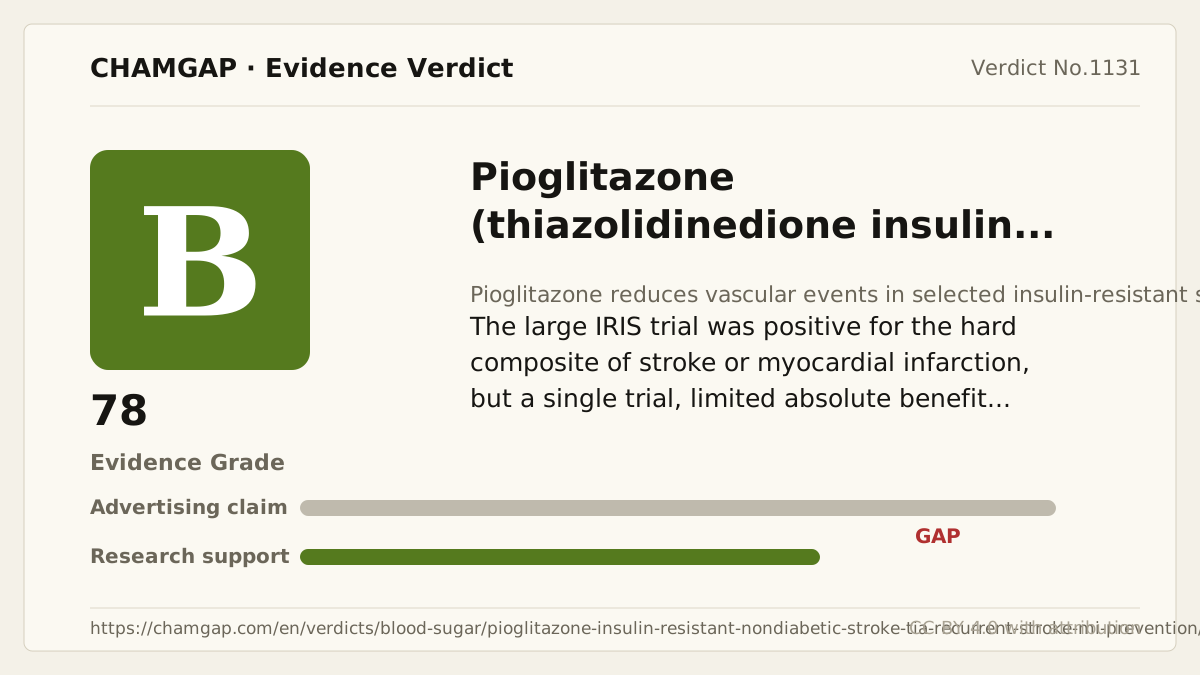
[Chamgap] Pioglitazone x prevention of recurrent stroke and myocardial infarction after stroke or TIA in insulin-resistant adults without diabetes — Evidence Grade B·78. 2 cited sources checked. Source: https://chamgap.com/en/verdicts/blood-sugar/pioglitazone-insulin-resistant-nondiabetic-stroke-tia-recurrent-stroke-mi-prevention/ · CC BY 4.0CC BY 4.0 — free to use with attribution; do not distort grades, numbers, or verdict meaning.
What this document does and does not do
Chamgap is an information source. It reports what research has and has not confirmed; it does not tell readers what to take or buy. That decision belongs to readers and, when needed, medical or legal professionals. This verdict reflects literature available up to the search date and may change as new research appears. Nothing here is medical advice.