
Ordinary thiamine,
does it really help with HbA1c reduction in type 2 diabetes with CKD stage 3?
research showsA small trial reported a signal of greater HbA1c reduction, but the material verified so far does not establish a clinically meaningful glycemic benefit. C·46 describes limited evidence in the CKD stage 3 population under the studied oral regimen. It is neither a finding of no effect nor evidence that thiamine can replace diabetes medication.
ads claimAdvertising and mechanistic claims were not used as grade bonuses or direct clinical evidence.
Four separate assessment dimensions
| Effect direction and size | A small trial reported a signal of greater HbA1c reduction, but the material verified so far does not establish a clinically meaningful glycemic benefit. C·46 describes limited evidence in the CKD stage 3 population under the studied oral regimen. It is neither a finding of no effect nor evidence that thiamine can replace diabetes medication. |
|---|---|
| Evidence certainty | HbA1c is a surrogate endpoint (S). The decisive trial is R1. Funding was not verified, giving I1 under rubric precedent 29. Clinical magnitude and interval verification are limited (EX, CX); the small trial gives B1. A failed renal primary endpoint with a positive HbA1c secondary endpoint is flagged. The calculator gives C; 0 strength axes map to the fixed score of 46. |
| Applicability | Adults with type 2 diabetes and CKD stage 3; not all adults with diabetes |
| Safety | The abstract’s statement about no reported serious adverse events is not treated as a general safety guarantee. Specific event counts, denominators and long-term exposure data remain unconfirmed. The research dose is not an instruction to change treatment or self-medicate. |
Not official GRADE or treatment-success probability; ? has no score.
Useful facts when choosing a product
- This is a question about ordinary thiamine in an oral capsule. Benfotiamine, injectable products and populations with different renal states are not automatically combined. Baseline nutritional status, total dietary thiamine and the exact capsule salt remain unconfirmed.
Chamgap Semantic Classification Code
Permanent code issued
S.thiamine.oral.type-2-diabetes-ckd3-hba1c.reduce.placeboSupplements > Ordinary thiamine > Oral > HbA1c in type 2 diabetes with CKD stage 3 > Reduction claim > Placebo
Technically bound to the current-value claim boundary fixed by ChatGPT. Unconfirmed dose, duration, study details, and evidence grade remain in verdict fields and revision history rather than the permanent semantic code. The code identifies the intervention and claim; it never contains the evidence grade, score, or safety result.
Exact Claim Classification
These independent facets prevent evidence from different forms, routes, populations, effects, and comparators from being mixed.
| Intervention class | S · Supplement or nutraceutical |
|---|---|
| Canonical ingredient or intervention | Ordinary thiamine (vitamin B1) |
| Source or part used | Synthetic/fermentation/other production origin unconfirmed; plant-part classification not applicable |
| Formulation or processing | Single-ingredient oral thiamine capsule; salt, release profile and manufacturer unconfirmed |
| Route | Oral (page question; see observed_evidence for study-route verification) |
| Dose | 300 mg/day, 150 mg/capsule; research regimen, not dosing advice |
| Duration | 24 weeks of treatment; persistence thereafter unconfirmed |
| Population | Adults with type 2 diabetes and CKD stage 3; not all adults with diabetes |
| Effect or condition | HbA1c reduction in type 2 diabetes with CKD stage 3 |
| Primary endpoint | Between-group difference in median HbA1c change at 24 weeks; a secondary trial endpoint |
| Comparator | Placebo; exact composition and arm-level background diabetes care unconfirmed |
| Duplicate-detection key | thiamine|oral-capsule|300mg-day|24weeks|type2-diabetes-ckd3|hba1c-median-change|placebo |
What the research actually shows
The principal direct evidence is the Phrawong trial. HbA1c was secondary in a trial primarily studying kidney function. The reported median-change difference of −1.35 and P<0.01 are retained, but an unspecified unit is not filled in as percentage points and no interval is invented. Enrollment is not substituted for the HbA1c analysis denominator.
Why this is classified as C (46)
HbA1c is a surrogate endpoint (S). The decisive trial is R1. Funding was not verified, giving I1 under rubric precedent 29. Clinical magnitude and interval verification are limited (EX, CX); the small trial gives B1. A failed renal primary endpoint with a positive HbA1c secondary endpoint is flagged. The calculator gives C; 0 strength axes map to the fixed score of 46.
Counterpoint. The earlier microalbuminuria trial did not report glycemic benefit. Treatment-end and off-treatment values in a later paper with the same registry identifier were kept separate. Differences in renal status, duration and analysis preclude declaring contradiction or pooling solely from significance labels.
Rejudgment record. A small trial reported a signal of greater HbA1c reduction, but the material verified so far does not establish a clinically meaningful glycemic benefit. C·46 describes limited evidence in the CKD stage 3 population under the studied oral regimen. It is neither a finding of no effect nor evidence that thiamine can replace diabetes medication. — HbA1c is a surrogate endpoint (S). The decisive trial is R1. Funding was not verified, giving I1 under rubric precedent 29. Clinical magnitude and interval verification are limited (EX, CX); the small trial gives B1. A failed renal primary endpoint with a positive HbA1c secondary endpoint is flagged. The calculator gives C; 0 strength axes map to the fixed score of 46.
| Endpoint | S | Surrogate marker - laboratory or imaging measures Case application: S: laboratory surrogate, not diabetic complications |
| Replication | R1 | Single confirmatory trial Case application: R1: one decisive CKD stage 3 trial; other renal populations not pooled |
| Independence | I1 | Mixed funding sources Case application: I1: funding statement not obtained; rubric precedent 29, not an assertion of actual mixed funding |
| Effect size | EX | The clinical size of the effect could not be judged Case application: EX: accessible evidence insufficient to verify clinical magnitude; no claim that the unavailable full paper omits it |
| Precision | CX | No pooled confidence interval could be confirmed Case application: CX: HbA1c treatment-contrast CI not verified |
Stored derived and displayed grades match; this is not a current recalculation or validity check (C).
Review performed and remaining limitations
Exact salt and release profile unconfirmed Unit of −1.35 absent from the accessed abstract Treatment-contrast interval and analyzed denominator unconfirmed Funding of the decisive trial unconfirmed Paid full text not obtained Native databases worldwide were not exhaustively searched; the current judgment is published with that limitation.
Search scope and limitations. tasks/R01-001/search_log.json
Evidence Table
| Study | Design | Sample | Funding | Endpoint | Result | Weight |
|---|---|---|---|---|---|---|
| Phrawong et al. — thiamine in T2D with CKD stage 3 (online 2025; issue 2026) | Randomized placebo-controlled trial; kidney function is primary | 35 enrolled (18 thiamine, 17 placebo); HbA1c analysis denominator unconfirmed | Unconfirmed or not used in this page grade | Kidney-function primary endpoint; HbA1c change is secondary | HbA1c median-change contrast −1.35, P<0.01; unit and interval absent from the abstract | Decisive included result |
| Rabbani et al. — thiamine and early diabetic nephropathy (2009) | Indirect contextual evidence | Only verified denominators are recorded in numeric_evidence.json; assignment totals are not substituted for unknown endpoint analysis counts. | Unconfirmed or not used in this page grade | Albuminuria primary endpoint; glycemic control reported separately | The earlier microalbuminuria trial abstract reports no effect on glycemic control. It is not pooled as the same question as the CKD stage 3, 24-week trial. | Indirect contextual evidence |
| Alam et al. — high-dose thiamine and T2D risk factors (2012) | Same-trial contextual report; not independent replication | Only verified denominators are recorded in numeric_evidence.json; assignment totals are not substituted for unknown endpoint analysis counts. | Unconfirmed or not used in this page grade | HbA1c and other risk factors in a report with the same trial registration; treatment and off-treatment time points separated | Table 2 reports HbA1c means of 9.2→9.0→7.8% for thiamine and 8.8→8.5→8.4% for placebo: baseline, after 3 months of treatment, and after 2 months off treatment. | Same-trial contextual report; not independent replication |
Receipt — 3 References
Evidence access cutoff: 2026-09-15. Each citation states its actual access level (full-text transcription, abstract, index, or other) and remaining limitations. Bibliographic checking does not certify the study results or treatment efficacy.
Technical integration by: Codex · Evidence date: 2026-09-15 · Corrections: 2
Correction log — 2
Corrections applied to this verdict, in chronological order. Changes are logged, not erased.
- 2026-09-15 · current_value_initial_publication — The previously inaccessible recent trial was updated to publisher-abstract access; the unit of −1.35 was not guessed.
- 2026-09-15 · current_value_initial_publication — Off-treatment change in the older cohort was not recast as on-treatment benefit, and reports from the same trial were not counted as replication.
Cite this verdict
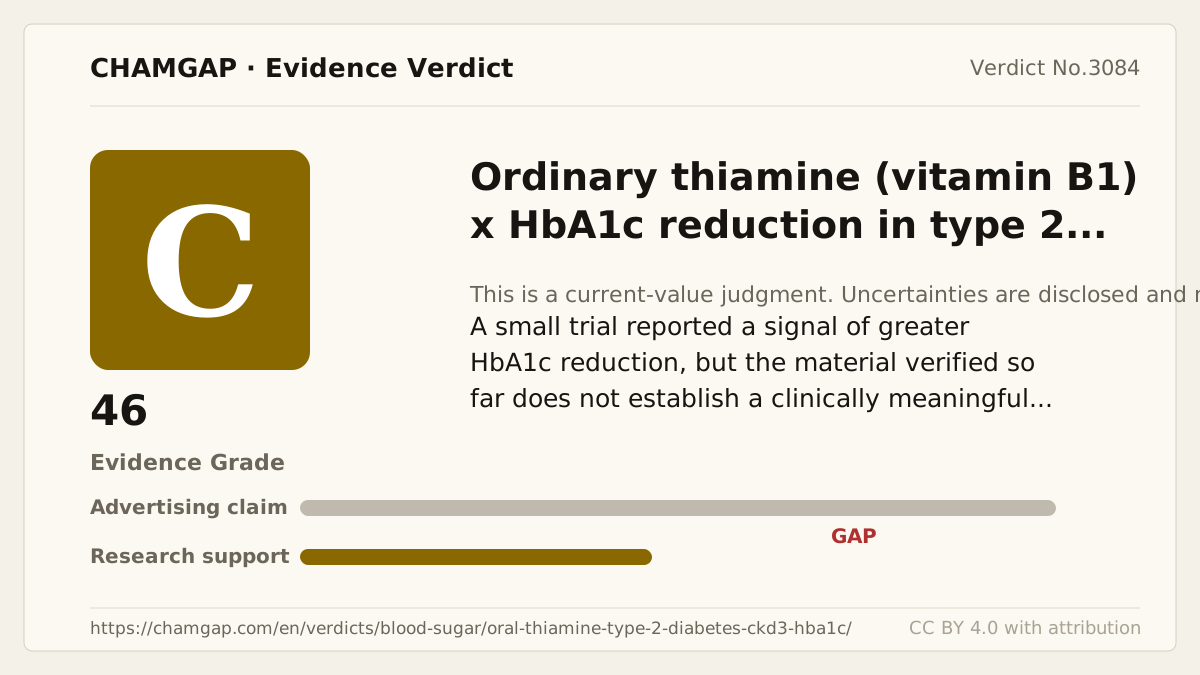
[Chamgap] Ordinary thiamine (vitamin B1) × HbA1c reduction in type 2 diabetes with CKD stage 3 — Evidence Grade C·46. 3 cited sources checked. Source: https://chamgap.com/en/verdicts/blood-sugar/oral-thiamine-type-2-diabetes-ckd3-hba1c/ · CC BY 4.0CC BY 4.0 — free to use with attribution; do not distort grades, numbers, or verdict meaning.
What this document does and does not do
Chamgap is an information source. It reports what research has and has not confirmed; it does not tell readers what to take or buy. That decision belongs to readers and, when needed, medical or legal professionals. This verdict reflects literature available up to the search date and may change as new research appears. Nothing here is medical advice.