
Oral single-active biotin and pain in painful diabetic peripheral neuropathy
research showsWithin the accessed scope, the between-group mean pain NRS effect of oral sole-active biotin in adults with painful diabetic peripheral neuropathy is unverified. A 1990 report of clinical and laboratory improvement in three diabetic neuropathy patients exists, but its abstract does not establish actual route, sole-active composition, painful diagnosis, instrument or comparison. This is not zero effect, equivalence, universal absence of human evidence or confirmed safety.
ads claimNo specific advertisement was verified. Deficiency, glycemic, conduction or combination-product findings do not establish sole-biotin pain relief or replacement of standard care.
Four separate assessment dimensions
| Effect direction and size | Within the accessed scope, the between-group mean pain NRS effect of oral sole-active biotin in adults with painful diabetic peripheral neuropathy is unverified. A 1990 report of clinical and laboratory improvement in three diabetic neuropathy patients exists, but its abstract does not establish actual route, sole-active composition, painful diagnosis, instrument or comparison. This is not zero effect, equivalence, universal absence of human evidence or confirmed safety. |
|---|---|
| Evidence certainty | Methods, precision and independent replication of a direct pain comparison are unverified. No separate formal GRADE certainty rating was invented. |
| Applicability | Painful/non-painful phenotype, diabetic/other causes, adults/children, deficiency/repletion, sole-active/mixture, route and endpoint remain separate. |
| Safety | Adverse-event and withdrawal risks and long-term, high-dose or special-population safety for this pain treatment remain unverified. Biotin can interfere with certain susceptible assays, producing falsely high or low results, but this is not generalized to every test. No established UL is not a safety guarantee. No individual interruption interval, medication change or treatment replacement is directed, and the existing 3106 assessment is unchanged. |
The original calculator was run with axes derived for this evidence. Its raw C has two required-axis errors for replication and bias, so neither C nor its score anchor was accepted. ?/null explicitly records the support gap under the supplied current contract; it is not zero points, a new rating system, the no-human-study gate or a clinical hold.
Useful facts when choosing a product
- This page addresses a pain-comparison question for oral biotin as the sole additional active ingredient.
- The S01 abstract reports biotin administration in three diabetic neuropathy patients.
- Actual route, molecular form, exact dose, sole-active composition and total intake in S01 remain unverified.
- S02 and S03 change multiple active ingredients together.
Chamgap Semantic Classification Code
Permanent code issued
S.biotin-sole-added-active-dpn.oral.adult-painful-diabetic-neuropathy.defined-time-mean-pain-comparison.oral-biotin-dpn-actual-comparator-unverifiedSupplements and nutraceuticals > Biotin as the sole additional active ingredient: question boundary > Adults with painful diabetic peripheral neuropathy; diabetes type, painful/non-painful phenotype, adult details and deficiency status are separated. Actual painful diagnostic eligibility in S01 is unverified. > Mean pain NRS is preferred; actual instrument, direction, window and registered primary endpoint are separated by study. > Placebo, usual care and active treatment are candidates. S01 actual comparator, common treatment, rescue medication and placebo additives are unverified. > Oral is the question, not an established route or route sequence in the S01 abstract.
Original declared policy gap, ?/null, submitted axes, human report existence, Caution and whole bilingual reports preserved. The code identifies the intervention and claim; it never contains the evidence grade, score, or safety result.
Exact Claim Classification
These independent facets prevent evidence from different forms, routes, populations, effects, and comparators from being mixed.
| Intervention class | S · Supplement or nutraceutical |
|---|---|
| Canonical ingredient or intervention | Biotin as the sole additional active ingredient: question boundary |
| Source or part used | Unverified manufacturing source, ingredient and molecular form in an eligible product; separate from food or dietary exposure. |
| Formulation or processing | A proposed sole-active oral formulation; actual sole-active composition, dosage form and excipients in S01 are unverified. |
| Route | Oral is the question, not an established route or route sequence in the S01 abstract. |
| Dose | Eligible active dose, frequency and dietary/supplement total intake are unverified; doses from other studies are not substituted. |
| Duration | S01 describes 1–2 years of administration and improvement at 4–8 weeks, but a direct quantitative pain time point and actual oral-exposure duration remain unverified. |
| Population | Adults with painful diabetic peripheral neuropathy; diabetes type, painful/non-painful phenotype, adult details and deficiency status are separated. Actual painful diagnostic eligibility in S01 is unverified. |
| Effect or condition | Between-group pain difference at a defined time |
| Primary endpoint | Mean pain NRS is preferred; actual instrument, direction, window and registered primary endpoint are separated by study. |
| Comparator | Placebo, usual care and active treatment are candidates. S01 actual comparator, common treatment, rescue medication and placebo additives are unverified. |
| Duplicate-detection key | biotin|sole-added-active-oral|adult-painful-diabetic-peripheral-neuropathy|defined-time-mean-pain|actual-comparator-unverified |
What the research actually shows
# Oral single-active biotin and pain in painful diabetic peripheral neuropathy
**TASK-1038 · R01-078 | Research and content self-review: 2026-09-17** Input snapshot: **2026-09-17T14:50:38+09:00**. This snapshot is not assumed identical to the current website. This document submits research for item 78; it is not a record of site publication or deployment.
## 1. Thirty-second answer
**Within the searches and materials accessed, no directly eligible quantitative result established how oral biotin as the sole active ingredient changes mean pain NRS relative to a comparator in adults with painful diabetic peripheral neuropathy.** A 1990 human report describing clinical and laboratory improvement in three patients with diabetic peripheral neuropathy does exist. The accessed abstract, however, does not establish the actual administration route, sole-active composition, painful diagnostic phenotype, pain instrument or between-group comparison.[S01]
This does **not** establish zero effect, equivalence to placebo, universal absence of human studies or confirmed safety. The current efficacy value is **`? / null`—explicitly unscored, not zero points**. The original calculator's raw C was separated from its required-axis validation errors; neither that invalid output nor a score anchor was accepted. Content is complete as `completed_with_uncertainty` / `ready_with_uncertainty`.
## 2. Fixed question and duplicate boundary
The proposed question concerns **oral biotin as the sole additional active ingredient, adults, painful diabetic peripheral neuropathy and a defined-time pain comparison**. Mean numerical rating scale (NRS) pain is preferred, but an actual study's different instrument, direction or reporting window must remain distinct. Placebo, usual care and an appropriate active comparator are candidate comparisons, not established trial facts. Diabetes type, neuropathy diagnosis, deficiency status and common treatment require study-level verification.
The entire **3,153-record index** was read and searched using Korean/English biotin names, molecular/vitamin aliases and neuropathy/pain terminology. The **eight complete candidate originals** were read and separated as follows.
| Existing ID | Completed scope | Difference and reuse | |---|---|---| | 009 | Hair growth or loss | Hair outcomes are not neuropathic pain. Entity and source boundaries were reused. | | 866 | Brittle nails | Nail thickness or strength is separate from a pain comparison. | | 1639 | Function/disability in multiple sclerosis | Central nervous system disease and function are not diabetic peripheral neuropathic pain. | | 3103 | Hair density in adult androgenetic alopecia | Different diagnosis and endpoint. | | 3104 | Recurrent brittle-nail breakage | Different population and endpoint. | | 3105 | HbA1c in type 2 diabetes | Glycemia and HbA1c changes are not pain NRS effects. Existing search/extraction boundaries were reused. | | 3106 | Falsely low TSH in particular assays | Only the relevant assay-interference safety map was reused; the existing assessment was not changed. | | 3153 | Atopic dermatitis severity | Different disease and endpoint. Its earlier unscored state does not automatically determine this assessment. |
**Decision: `operation=new`.** No exactly matching completed claim was identified in the supplied scope. Candidate presence or absence alone did not determine the decision. Additional index entries were not represented as fully read originals when their files were absent. Comparisons and index hits are recorded in `boundary_review.json`; original `what_research` strings are preserved exactly in `what_research_original.json`. Other completed efficacy or safety pages were not researched, regraded or translated again. A potential inherited mismatch between a design label and narrative in 009 was not propagated into this assessment, and that original was not modified.
## 3. Search scope and access level
On 2026-09-17, **38 searches** combined biotin, D-biotin and vitamin B7/H with diabetic or painful neuropathy, pain instruments, trials, registries, negative or terminated findings, corrections and retractions. Korean searches and exact-title/identifier searches were included. `search_log.json` retains the expressions, access routes and failures. Search-engine discovery, official bibliographic records, primary publishers and registries were distinguished. No exhaustive subscription-database search or complete registry export is claimed.
There are **six main accessed sources** and **four clinical-study records with 76 extraction fields each**. S01 and S02 were accessed as official abstracts/bibliography; S03 as publisher full HTML and an author-uploaded copy of the same article; S04 as publisher full HTML, parsed PDF and page 1/3 screenshots; S05 and S06 as official safety information. Copies with the same DOI/PMID and the two language reports do not count as independent studies.
The full articles for S01 and S02 were not obtained. Some publisher routes returned 403 or tool errors. Registry details/APIs returned only shells or errors, so original registered primary outcomes, histories and submitted results were not verified. Failure to access S03's PDF was not confused with failure to access its full HTML. S04 PDF pages were viewed, but no local original PDF binary was downloaded; no original-PDF SHA was invented. L01, a related rat study, was inaccessible beyond discovery; L02, concerning uremic neurologic disorders, was retained only as a bibliographic search lead.
No correction, retraction or new eligible negative comparison for this exact question was identified within the reviewed scope. This is not a worldwide absence guarantee. Search non-identification, inaccessible full text, information not reported in an accessed source and inapplicability are separate states.
## 4. Study-level evidence table
| Record | Verified population, design and exposure | Verified result and role in this question | |---|---|---| | **S01 Koutsikos et al., 1990** | Three diabetic patients with severe peripheral neuropathy. The abstract describes high-dose biotin for 1–2 years but does not establish exact dose, route or sole-active composition. | Favorable qualitative human signal: clinical/laboratory improvement at 4–8 weeks. Quantitative pain instrumentation, arm denominators and between-group effects were not verified; no mean NRS effect is accepted. | | **S02 Farvid et al., 2011** | Type 2 diabetes; randomized, double-blind, three groups; 75 randomized, 67 completed; four months. Biotin 200 μg/day varies together with other vitamins/minerals. | MNSI questionnaire scores improved in both supplement groups, while between-group examination scores and electrophysiological measures did not show significant differences. MNSI is not standalone mean pain NRS, and this is not an isolated biotin contrast. | | **S03 Maladkar et al., 2014** | Five-centre open-label non-comparative study in adult peripheral neuropathy; 497 evaluated; six-active oral capsule for 12 weeks, including biotin 5 mg/day. | Within-group improvement was described using 0–10 pain anchors. The diabetic painful-neuropathy stratum, averaging window and comparator were not established. The uncontrolled product result was not decomposed into a biotin effect. | | **S04 Créange et al., 2023** | CIDP, anti-MAG and CMT1a/1b, five each; 15 total; open-label uncontrolled oral MD1003, a 100 mg capsule three times daily, for up to 52 weeks. | The electrophysiological composite primary objective was not met; some secondary signals were reported. Different-etiology neuropathy is neither direct pain evidence nor repeated refutation in this indication. |
Study doses in this table are **exposure-identification facts**, not personal dosing or standard-treatment-change instructions. Different diagnoses, background treatments, instruments and time windows were not pooled.[S01–S04]
## 5. The nearest human report: known and unknown
S01 is a real 1990 report, PMID 2085665 and DOI 10.1016/0753-3322(90)90171-5. Its favorable clinical and laboratory description was retained. However, severe neuropathy does not automatically establish painful neuropathy with verified baseline pain. Adult/Middle Aged/Aged indexing does not substitute for individual ages, precise adult eligibility criteria or diabetes type.[S01]
The abstract does not verify actual neuropathy criteria, diabetes type/duration/control, baseline pain, analgesics or rescue medication, a biotin-deficiency test or baseline concentration, diet/total intake, kidney function or comorbidity, manufacturing source, molecular form, purity, sole-active status, dosage form, route or route changes, exact active dose/frequency or adherence. The authors' proposed deficiency, inactivity or unavailability explanation is a **hypothesis**, not a confirmed deficiency diagnosis in these three people.
Three is the number reported in the abstract. It is not automatically a randomized, completed, intention-to-treat or pain-analysis denominator. Comparator existence/type, actual placebo ingredients, attrition/missingness, analysis methods, pain collection window/instrument/direction/unit and baseline/final means, SD, SE or CI are unverified. The **4–8-week response description and 1–2-year administration description were not merged into a fixed pain-assessment time point**. Inability to read the full article was not restated as proof that these data are absent from it.
Accordingly, the existence of related human reporting is stored as `true`, while verification of a directly eligible quantitative between-group pain result is `false` within this search scope. `no_human_study=false`, and the effect magnitude remains `null`.
## 6. Why mixtures and other neuropathies remain separate
### S02: MNSI is not an isolated biotin pain contrast
The MV group received daily zinc 20 mg, magnesium 250 mg, vitamin C 200 mg and vitamin E 100 mg. MVB added B1, B2 and B6 at 10 mg each, biotin 200 μg, B12 10 μg and folic acid 1 mg/day. MVB versus placebo is therefore a combination-product contrast, while MVB versus MV also changes several vitamins together. Neither isolates biotin. The accessed abstract does not adequately establish route, actual product/excipients, arm denominators or analgesic management; these gaps were not filled with presumed oral administration or matched background therapy.[S02]
Questionnaire improvement and non-significant examination/electrophysiological findings were both retained. A significant neuropathy questionnaire result is not proof of mean pain NRS benefit, a particular MCID or analgesic-sparing effects. The 75 randomized and 67 completed totals were retained without inventing valid pain-risk denominators from unverified arm-specific attrition, missing-data handling or ITT status. NCT01173315 was linked, but the registered primary endpoint and change history were not claimed as reviewed.
### S03: A pain result does not make the product single-active
The actual oral capsule combined methylcobalamin 1,500 μg, alpha-lipoic acid 200 mg, folic acid 5 mg, biotin 5 mg, benfotiamine 50 mg and vitamin B6 5 mg. The paper calls the instrument a “10-point” scale while describing 0–10 anchors. That wording discrepancy was retained rather than declared equivalent to a verified mean-NRS collection method. The Results section's baseline mean of 5.50 and 78.0% reduction at week 12 are a **within-group relative reduction for the combination product**. They were not converted into a percentage-point change, comparator-adjusted effect, isolated biotin contribution or verified MCID.[S03]
Age of at least 18 years is an eligibility criterion, while the actual diagnostic denominator for the diabetic painful subgroup is not separated. Without a comparison group, natural course, regression to the mean, common management, other active ingredients and expectation effects cannot be disentangled. Authors were affiliated with Aristo Pharmaceuticals; separate funding/product-provision details remain unverified. The statement that no serious adverse events were reported was not transformed into zero overall events or established long-term safety. Numerical figure digitization or reconstruction of a valid SD/CI was not performed.
### S04: Different causes and a different primary endpoint
MD1003 is an oral formulation containing biotin and excipients; it does not establish the formulation missing from S01. S04 enrolled chronic inflammatory demyelinating polyneuropathy, anti-MAG neuropathy and hereditary CMT rather than the present diabetic painful-neuropathy population. Clinical and electrophysiological visit schedules were separated. The publication's primary objective concerned specified improvement in two of four electrophysiological parameters, not pain NRS.[S04]
The failed primary objective and selected secondary findings were both recorded. NCT02967679 was linked, but verification of its original registry history remains separate and incomplete. Maintained background disease/symptom treatment, including immunoglobulin in the CIDP group, does not establish biotin as a replacement monotherapy. Medday funding was disclosed. This study was not counted as `RX` or repeated pain-treatment refutation in the present indication.
## 7. Pain, numerical and design assessment
The target is pain experienced by the patient. Nerve conduction, sensory/motor examination, composite MNSI scores, quality of life, HbA1c and glycemia are separate outcomes. No conversion was made without establishing whether the actual measure was NRS, VAS or another questionnaire; whether higher scores mean worse symptoms; whether it describes a 24-hour or weekly average, worst pain or another construct; and when it was measured. Common responder thresholds or MCIDs from other literature were not imposed on these data.
A directly eligible study's baseline/final means, within-group change, between-group difference, adjusted effect, SD/SE/CI, analysis population, missingness and common treatment were insufficiently verified. Accordingly, no pooling, standardized mean difference, inversion of p values or precision estimate was performed. Randomized, clustered, crossover, paired structures and within-person correlations were not invented. **ARR, RR, NNT, NNH and MCID remain `null`**, because an eligible design and matched-period arm denominators/events or direct pain data are unverified. Unknown information was not filled with zero.
Unverified registered primary/secondary outcomes, post hoc analyses and multiplicity plans were not labelled prospectively registered or multiplicity-adjusted. Publication claims were distinguished from actual access to registry history. Publisher and author-uploaded copies are one S03 study; PubMed and publisher manifestations are one S01/S02 study, not extra independent replications.
## 8. Safety and laboratory interference
The safety label is **Caution**. It is not a calculated adverse-event rate for this treatment or a claim that every high-dose exposure is harmful. S01's event/withdrawal collection and exposure denominators are unverified in the abstract. Safety findings from mixtures or other neuropathies were not directly transferred to this sole-active treatment question.
S04 reported **42 adverse events**, including **three of severe intensity**. These are not 42 people, and severe intensity is not synonymous with a serious adverse event (SAE). Its flow diagram identifies one intervention discontinuation associated with an SAE. Investigator attribution and occurrence are also separate. These uncontrolled observations in another population were not used to calculate comparative harm in diabetes.[S04]
The existing 3106 assay-interference map was reused, with only relevant official context checked. NIH describes the absence of an established tolerable upper intake level (UL), but that is not proof of unlimited safety or safety across kidney function, long-term high-dose exposure or co-medication. Certain biotin-dependent assay systems can give falsely high or low results according to exposure, sampling and assay design; FDA discusses falsely low results in some susceptible troponin assays. This was **not generalized to all laboratory tests**. Effects of some anticonvulsants on biotin status were not extended to all neuropathy medications.[S05,S06]
Safety for this treatment in pregnancy/lactation, children, liver/kidney disease, long-term high doses and specific diabetes/analgesic combinations remains unverified. No personal pre-test interruption period, instruction to start/stop biotin, analgesic/diabetes-drug change or replacement of standard treatment is provided.
## 9. Current original rubric and calculator
The complete 820-line supplied rubric and the original calculator were read and executed without modification. Their immutable source identifiers are `참고자료/채점표.md` and `참고자료/등급도출.py`. `grading_input.json` and `grading_calculator_result.json` preserve the actual input, original hashes, outputs, errors and exit code. The prior 3153 outcome was not copied to determine this grade.
| Axis | Current input | Basis and boundary | |---|---|---| | Claim | `B` | This is a clinical-efficacy question, not a physical property. | | Endpoint | `P` | Patient pain is itself a treatment goal. Nerve-conduction outcomes elsewhere do not turn this question into `S`. | | Replication | `null` | R1 means a single confirmatory trial (rubric lines 48–56); R0 requires genuinely conflicting comparable evidence; RX requires repeated refutation in the same indication; RE requires strict life-saving replacement gates. None was fabricated for the related three-person report and unverified direct pain comparison. | | Independence | `I1` | This follows precedent 29, lines 167–176, for unverified funding. It is not an empirical claim that mixed manufacturer/independent funding or actual independence was established. | | Effect | `EX` | Direct pain magnitude, MCID and reconstructable means/variances/test statistics were not verified. The reconstruction checks in lines 209–212 and 252–257 were applied without claiming that inaccessible full text contains no such data. | | Precision | `CX` | A direct pain CI was not verified. This is not C1 exclusion of meaningful benefit or E0 ineffectiveness. | | Bias | `null` | A defensible count of avoidable flaws in decisive directly eligible pain evidence cannot be established. B0/B2 were not invented for convenience, consistent with precedents 40 and 44. | | No-human-study gate | `false` | Related human reporting exists. Unverified direct quantitative comparison was not converted into universal absence. |
The original `derive_grade` function does not validate required axes before applying its caps, and returned **raw C** through the EX cap. However, `validate_axes` and `check_verdict` returned **two errors: `replication=None` and `bias=None`**. The actual command-line exit code was **1**. This is not a receipt showing successful valid scoring by the original calculator. **Neither raw C nor its score anchor was accepted. The final value is `? / null`, with `grading_status=not_scored_policy_gap`.**
This is the explicitly unscored representation allowed by section 5 and the current-value clause of the supplied task contract. It is not a new efficacy system, invented score, zero conversion or clinical hold. Completed content is separated from technical mapping of unsupported/missing-axis states in the existing engine. A formal supported-rule change or directly eligible evidence is a revision condition.
## 10. Classification, interpretation and publication state
`kind=S` classifies the oral sole-active supplement question; it does not assert regulatory approval of S01's actual product. `category=blood-sugar` retains the supplied diabetes-related navigation category. **The measured endpoint remains pain, not a glycemic efficacy assessment.** Unknown molecular form, formulation, total intake and comparator are stated in the 12 facets. R01, TASK and NEUROPAIN are workflow keys, not official medical codes or newly assigned permanent codes.
No particular product advertisement was verified. Correction of deficiency, glycemic or nerve-conduction changes and combination-product findings do not establish that sole-active biotin treats diabetic neuropathic pain or replaces standard care. Factual sentences and advertising-interpretation boundaries occupy separate fields.
The result is `completed_with_uncertainty`, content readiness is `ready_with_uncertainty`, and content verification is `completed_with_declared_scope`. Technical display mapping for the unscored state is `needs_format_mapping`; site identity is `needs_id_assignment`. Site ID, slug, URL, first-publication timestamp and permanent/semantic codes remain **unreserved null**. The full bilingual reports and verdict JSON are submitted, with no clinical re-search, regrading or translation-review TODO assigned to Codex.
## 11. Self-review, limitations and revision conditions
Document quality is **A: a self-assessment of traceability, boundary handling, uncertainty, bilingual completeness and format within the requested scope**. It is separate from efficacy grade and is not formal GRADE, independent external review, journal certification or a guarantee of no errors. One author's rereading, calculation comparison, language comparison and technical restoration do not constitute independent studies or independent clinical audit.
Principal limitations are inaccessible S01 full text and unverified actual route/composition, painful diagnosis, adult details, deficiency/diet/kidney function, concomitant/rescue drugs, comparison, pain denominators/instrument/window/effect/CI, funding and safety. S02 full text, registry histories and additional search access also remain limited. Neither S03's open observation nor S04's different disease outcomes resolve these gaps. Reasons are linked to source-specific status fields in `study_extraction.json`.
Directly eligible full text, individual or group pain data, actual formulation/route/comparator/denominators/time, new comparative trials or registry results, corrections/retractions, boundary changes or formal grading-support changes would trigger revision. These are future revision conditions for a completed initial evidence baseline, not unfinished clinical tasks. Initial `corrections=[]` is separate from the pre-submission audit.
## 12. History and technical-restoration scope
Identity was checked for the input ZIP's 57 members, the input manifest's 56 non-self files and the manifest's externally recorded own hash. Prior 73–77 original manifests, resumes, sources, verification reports, full bilingual reports and five stored six-route deployment receipts were read. `previous_conversation_completed` denotes the preceding five items; the current chat's previously completed items are 74–77, four items. For 76/77, transmitted `research_report.md` was matched to the original `research_report_ko.md` using the documented exact alias, not treated as a new translation. Historical unreserved/pre-deployment manifest values were preserved.
The current ZIP and transport distinguish inherited input text from new content. The frozen completed ZIP is `source_archive`; exact restoration checks ZIP byte identity, while separate recompression checks logical member equality and compressed-byte differences independently. Raw headers, compressed regions, CRC/SHA, member order and actual ZIP fields are separated from runtime labels. Technical results are external execution receipts, not clinical certification. No server access, site deployment or next-item 79 work was performed.
## Sources
- **[S01]** Koutsikos D, Agroyannis B, Tzanatos-Exarchou H. *Biotin for diabetic peripheral neuropathy.* Biomed Pharmacother. 1990;44(10):511–514. PMID 2085665. DOI 10.1016/0753-3322(90)90171-5. [Official abstract and bibliography](https://pubmed.ncbi.nlm.nih.gov/2085665/). - **[S02]** Farvid MS, Homayouni F, Amiri Z, Adelmanesh F. *Improving neuropathy scores in type 2 diabetic patients using micronutrients supplementation.* Diabetes Res Clin Pract. 2011;93(1):86–94. PMID 21496936. DOI 10.1016/j.diabres.2011.03.016. [Official abstract and bibliography](https://pubmed.ncbi.nlm.nih.gov/21496936/). Linked registration: NCT01173315; details/history unverified. - **[S03]** Maladkar M, Tekchandani C, Dave U. *Post-Marketing Surveillance of Fixed Dose Combination of Methylcobalamin, Alpha Lipoic Acid, Folic Acid, Biotin, Benfotiamine & Vitamin B6-Nutripathy for the Management of Peripheral Neuropathy.* J Diabetes Mellitus. 2014;4:124–132. DOI 10.4236/jdm.2014.42019. [Publisher full HTML](https://file.scirp.org/Html/6-4300215_46105.htm). - **[S04]** Créange A, et al. *High-dose pharmaceutical-grade biotin in patients with demyelinating neuropathies: a phase 2b open label, uncontrolled, pilot study.* BMC Neurol. 2023;23:389. DOI 10.1186/s12883-023-03440-y. [Publisher full text](https://link.springer.com/article/10.1186/s12883-023-03440-y). Linked registration: NCT02967679; registry details/history unverified. - **[S05]** NIH Office of Dietary Supplements. *Biotin—Health Professional Fact Sheet.* Page updated 2022-01-10; accessed 2026-09-17. [Official safety information](https://ods.od.nih.gov/factsheets/Biotin-HealthProfessional/). - **[S06]** U.S. FDA. *Biotin Interference with Troponin Lab Tests—Assays Subject to Biotin Interference.* Accessed 2026-09-17. [Official assay-interference information](https://www.fda.gov/medical-devices/in-vitro-diagnostics/biotin-interference-troponin-lab-tests-assays-subject-biotin-interference).
L01 (rat nerve injury) and L02 (uremic neurologic disorders) have separate access/exclusion records in `sources.json`; they are not presented as fully verified eligible trials. Original input filenames remain unchanged as source identifiers.
Why this is classified as ?
The original calculator was run with axes derived for this evidence. Its raw C has two required-axis errors for replication and bias, so neither C nor its score anchor was accepted. ?/null explicitly records the support gap under the supplied current contract; it is not zero points, a new rating system, the no-human-study gate or a clinical hold.
Counterpoint. The favorable three-person human report is retained without expanding it into a quantitative comparative pain effect.
Rejudgment record. The original calculator was run with axes derived for this evidence. Its raw C has two required-axis errors for replication and bias, so neither C nor its score anchor was accepted. ?/null explicitly records the support gap under the supplied current contract; it is not zero points, a new rating system, the no-human-study gate or a clinical hold.
| Endpoint | P | Symptom or function itself is the target - including patient reports and performance tests |
| Independence | I1 | Mixed funding sources |
| Effect size | EX | The clinical size of the effect could not be judged |
| Precision | CX | No pooled confidence interval could be confirmed |
Review performed and remaining limitations
S01 full text and its actual route, composition, painful diagnosis, adult details, deficiency, diet, kidney function, total intake, concomitant/rescue medication, comparator, pain denominators/instrument/time/effect/CI, funding and safety remain unverified. S02 full text, registry histories and some additional sources were inaccessible; mixtures and different diseases were not used to fill those gaps.
Evidence Table
| Study | Design | Sample | Funding | Endpoint | Result | Weight |
|---|---|---|---|---|---|---|
| Koutsikos et al., 1990; PMID 2085665 | Three-person descriptive treatment report; control, randomization and actual route are unverified in the abstract. | Three people in the abstract; not assumed randomized, completed, ITT or pain-analysis denominators. | Funding, product provision and conflicts are unverified in the accessed abstract. | Clinical/laboratory change; actual pain instrument and comparative time point are unverified. | Administration for 1–2 years and improvement at 4–8 weeks are described; no quantitative pain effect or CI was extractable. | Related human signal, not a verified directly eligible oral sole-active pain comparison. |
| Farvid et al., 2011; PMID 21496936 | Randomized double-blind three-arm placebo-controlled micronutrient study over four months. | 75 randomized and 67 completed; arm-specific pain-analysis denominators are unverified. | Non-U.S. government research-support indexing was verified; exact funder and product provision remain unverified. | MNSI questionnaire/examination and electrophysiology, not converted to mean pain NRS. | Questionnaire improvement and non-significant examination/electrophysiological comparisons were both retained. | Excluded from isolated biotin effects because multiple ingredients change together. |
| Maladkar et al., 2014; DOI 10.4236/jdm.2014.42019 | Five-centre open-label non-comparative oral combination-product observation over 12 weeks. | 497 evaluated; not assumed a diabetic painful subgroup or comparative-arm denominator. | Authors affiliated with Aristo Pharmaceuticals; separate funding/product-provision details are unverified. | 0–10 pain anchors, called 10-point by the paper; recall/averaging method is unverified. | Baseline 5.50 and 78.0% reduction at week 12 describe a within-group relative change for the mixture, not a between-group NRS effect. | Excluded from sole-biotin efficacy because of six active ingredients, no control and an incompletely specified etiologic population. |
| Créange et al., 2023; DOI 10.1186/s12883-023-03440-y | Open-label uncontrolled oral MD1003 study in different-etiology demyelinating neuropathies. | Five each with CIDP, anti-MAG and CMT, 15 total. | Medday Pharmaceuticals funding was verified. | Electrophysiological composite primary objective, not diabetic pain NRS. | The unmet primary objective and some secondary signals were separated. Forty-two AE events and three severe-intensity events are not person counts or SAE counts. | Different indication and endpoint; not used as direct efficacy or repeated refutation for this question. |
| NIH ODS biotin professional fact sheet | Official safety information, not a comparative pain trial. | Not applicable: not a comparative-trial patient denominator. | Institutional authorship is separate from funding of individual trials. | UL, susceptible-assay interference and medication safety context. | No established UL is not a safety guarantee; interference in susceptible assays was not generalized to all tests. | Relevant safety context through reuse of the existing map, not independent efficacy replication. |
| FDA biotin–troponin assay-interference information | Official laboratory-test safety information. | Not applicable: not a diabetic-neuropathy risk denominator. | Agency information, not a product-provided clinical trial. | Falsely low results in certain susceptible troponin assays. | Assay specificity was retained; no personal pre-test interruption interval was specified. | Safety context, not an efficacy grading study for this pain question. |
Receipt — 6 References
Evidence access cutoff: 2026-09-17. Each citation states its actual access level (full-text transcription, abstract, index, or other) and remaining limitations. Bibliographic checking does not certify the study results or treatment efficacy.
Technical integration by: Codex · Evidence date: 2026-09-17 · Corrections: none
Cite this verdict
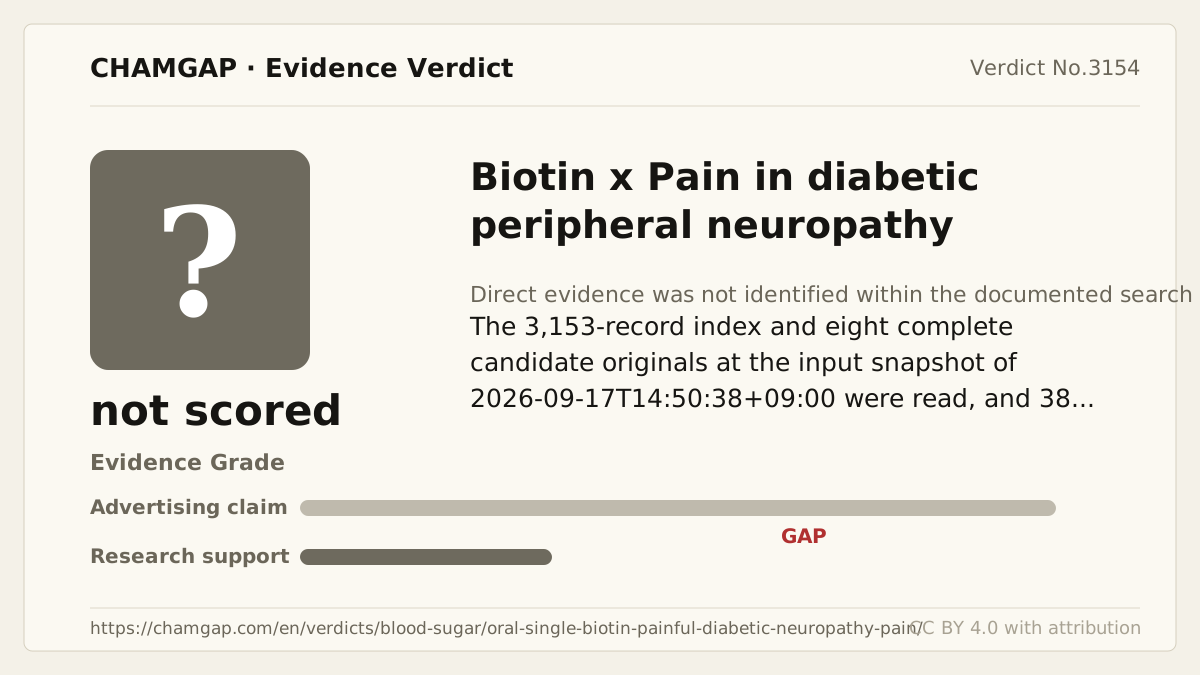
[Chamgap] Oral single-active biotin and pain in painful diabetic peripheral neuropathy — Evidence Grade ?. 6 cited sources checked. Source: https://chamgap.com/en/verdicts/blood-sugar/oral-single-biotin-painful-diabetic-neuropathy-pain/ · CC BY 4.0CC BY 4.0 — free to use with attribution; do not distort grades, numbers, or verdict meaning.
What this document does and does not do
Chamgap is an information source. It reports what research has and has not confirmed; it does not tell readers what to take or buy. That decision belongs to readers and, when needed, medical or legal professionals. This verdict reflects literature available up to the search date and may change as new research appears. Nothing here is medical advice.