
Oral NIASPAN extended-release nicotinic acid — added to usual diabetes care,
does it really help with HbA1c increase in adults with stable type 2 diabetes and dyslipidemia?
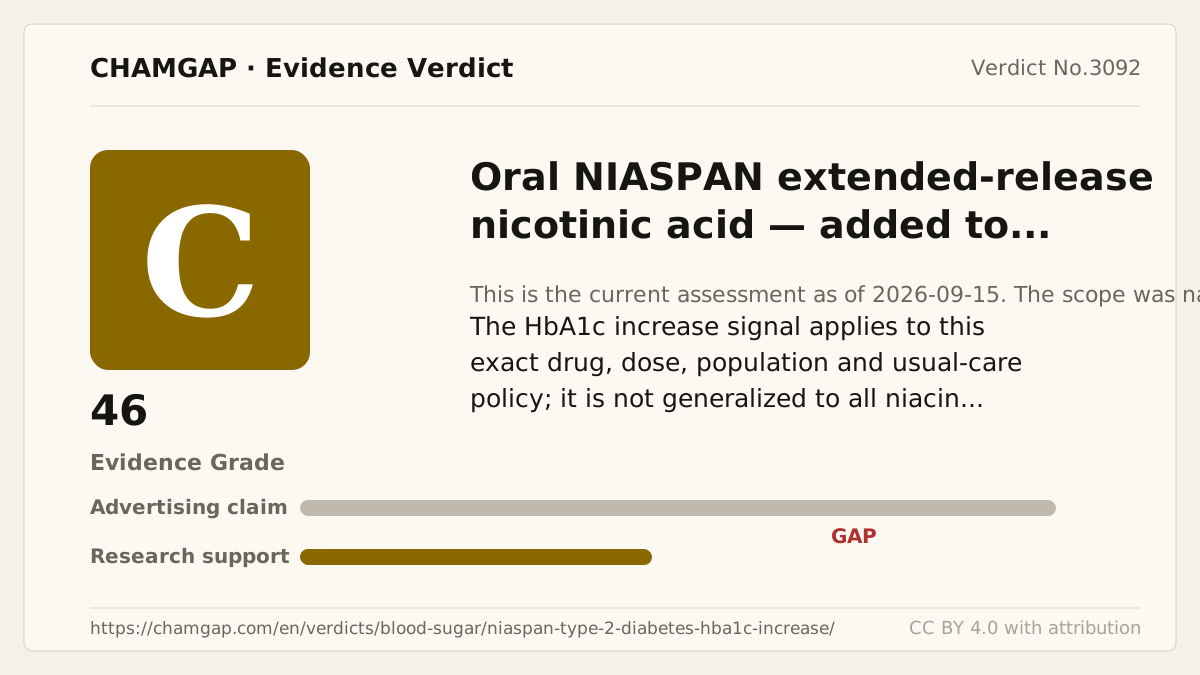
research showsA 16-week trial adding NIASPAN extended-release nicotinic acid, titrated to 1500 mg/day, to usual diabetes care found a signal of greater HbA1c increase than placebo. Simple subtraction of the reported arm mean changes gives +0.31 percentage points, with a reported between-group P=0.048. The current evidence grade is C, score 46. This does not establish the size of clinically important deterioration or long-term harm. [S01]
ads claimThese results do not support claims that a vitamin is necessarily safe for glycemia or that improved lipids imply improved diabetes. This page does not claim glycemic improvement; the observed HbA1c increase does not by itself establish long-term complications or a cardiovascular-event difference. [S01]
Four separate assessment dimensions
| Effect direction and size | HbA1c increase signal in the specific comparison; clinical risk magnitude remains uncertain. |
|---|---|
| Evidence certainty | Limited by a surrogate endpoint, one direct family, manufacturer dependence, attrition and small size. |
| Applicability | Only the locked NIASPAN contrast; not other vitamin forms/doses, deficiency correction or long-term events. |
| Safety | Caution |
C, 46 expresses the evidence tier for the increase claim, not risk severity, success probability or document quality.
Useful facts when choosing a product
- The intervention was prescription NIASPAN extended-release nicotinic acid (niacin) tablets from Kos Pharmaceuticals. Nicotinamide, NR, NMN, no-flush, immediate-release and sustained-release products are not treated as the same intervention. Manufacturing origin, batch and exact excipients are unconfirmed. [S01][S06]
- The trial bedtime daily doses were 375 mg in week 1, 500 mg in week 2, 750 mg in week 3, 1000 mg in week 4, and 1500 mg during weeks 5–16. The total 16 weeks included 4 weeks of titration. These are study observations, not personal dosing instructions. [S01]
- Participants were adults aged at least 21 with stable type 2 diabetes and dyslipidemia. Entry required HbA1c ≤9% and fasting glucose ≤200 mg/dL on 2 measurements. Baseline niacin deficiency and total dietary niacin are unconfirmed. [S01]
- The placebo arm followed the same dietary and diabetes-care policy, but exact placebo composition is unconfirmed. Diabetes drugs could be increased or added, and only existing statin users continued statins. Aspirin for flushing was permitted rather than compulsory common treatment. [S01]
- Central-laboratory HbA1c was assessed at baseline and weeks 4, 8, 12 and 16. The exact assay, instrument, interference evaluation, endpoint denominators, missing-data handling and specific contrast adjustment are unconfirmed. [S01]
Chamgap Semantic Classification Code
Permanent code issued
M.niaspan-er-nicotinic-acid.oral-addon.type-2-diabetes-dyslipidemia-hba1c.increase.placeboMedicines > NIASPAN extended-release nicotinic acid > Oral add-on > HbA1c change in type 2 diabetes with dyslipidemia > Increase claim > Matching placebo under adjustable usual care
Technically bound to the ChatGPT-fixed current-value boundary of NIASPAN titrated to 1500 mg/day over 16 total weeks in stable type 2 diabetes with dyslipidemia, compared with matching placebo under adjustable usual care, for increased HbA1c change. The analysis denominator, formal CI and other unknowns remain in multidimensional fields and revision history. The code identifies the intervention and claim; it never contains the evidence grade, score, or safety result.
Exact Claim Classification
These independent facets prevent evidence from different forms, routes, populations, effects, and comparators from being mixed.
| Intervention class | M · Medicine |
|---|---|
| Canonical ingredient or intervention | Nicotinic acid (niacin), not nicotinamide |
| Source or part used | Prescription chemical ingredient; manufacturing origin unconfirmed, botanical part not applicable |
| Formulation or processing | NIASPAN (Kos) single-ingredient ER oral tablets; separate salt specification, batch and excipients unconfirmed |
| Route | Oral |
| Dose | Target 1500 mg/day at bedtime; escalation 375→500→750→1000 mg/day then 1500 mg/day |
| Duration | Total 16 weeks including 4 titration weeks; target dose in weeks 5–16 |
| Population | Age ≥21, stable type 2 diabetes/dyslipidemia; HbA1c ≤9%, fasting glucose ≤200 mg/dL; deficiency status unconfirmed |
| Effect or condition | HbA1c increase |
| Primary endpoint | Between-group difference in HbA1c change from baseline to week 16 (percentage points); trial primary (1st) safety endpoint |
| Comparator | Added matching placebo; common dietary/adjustable diabetes-care policy; continuation of prior statins, not universal statin treatment |
| Duplicate-detection key | niaspan-er-nicotinic-acid|oral-addon-titrated-to-1500mg-day|16weeks-including-4week-titration|stable-type-2-diabetes-and-dyslipidemia|hba1c-change-baseline-to-week16-increase|matching-placebo-under-adjustable-usual-diabetes-care |
What the research actually shows
ADVENT randomized 148 participants overall; the authors called the 146 exposed participants the ITT population. The selected active-arm count of 52 and placebo count of 49 are not endpoint-specific analysis denominators. Baseline-to-week-16 HbA1c was the primary (1st) safety endpoint. Reported changes were +0.29 versus −0.02 percentage points, giving a +0.31-percentage-point arithmetic difference. This is not a formal adjusted model estimate or confidence interval; matched change SD, SE, CI and the HbA1c analysis denominators are unconfirmed. [S01]
Why this is classified as C (46)
The axes are B / S / R1 / I0 / EX / B2 / CX. They reflect a surrogate HbA1c endpoint, one direct trial family, manufacturer dependence, unjudgeable clinical magnitude, small size and substantial attrition. EX does not mean no numerical observation; it means the clinical importance of that difference cannot be judged. The fixed anchor for 0 strengths yields C, score 46. Under precedents 32 and 39, a harm claim is graded for its supporting evidence; harm itself is not a reason to assign F.
Counterpoint. In ADMIT, using a different immediate-release formulation, HbA1c was maintained within the niacin arm while it declined in the placebo arm. Within-arm stability therefore does not mean a null between-group effect. A low-dose niacin-plus-sitagliptin study reported improvement, but its exact chemical form/product is unclear and it differs from this extended-release drug comparison. These differently directed findings were retained, not pooled. [S02][S04]
Rejudgment record. Limited evidence supporting the locked HbA1c increase claim; not a grade for risk severity or benefit. — Supplied original rubric/calculator and fixed score table. Precedents 32 and 39, the EX cap, bias criteria and C anchor are applied.
| Endpoint | S | Surrogate marker - laboratory or imaging measures Case application: HbA1c is the trial primary (1st) safety endpoint and a surrogate rather than a complication event. |
| Replication | R1 | Single confirmatory trial Case application: There is one direct family for the exact product/dose/duration/population/care-policy contrast. Other doses, abstracts and regulatory summaries from the same trial are not replication. |
| Independence | I0 | Evidence comes only from manufacturer studies Case application: Kos funding and author-manufacturer ties; no independent exact replication. Classified manufacturer-only, without recounting funding as a bias defect. |
| Effect size | EX | The clinical size of the effect could not be judged Case application: An increase signal exists, but no verified clinical-importance threshold, matched change variance or formal interval permits a clinical magnitude judgment. Unknown is not converted into subthreshold or no effect. |
| Precision | CX | No pooled confidence interval could be confirmed Case application: The matched between-group change CI is unconfirmed; not reconstructed from rounded P or endpoint SE. |
Review performed and remaining limitations
Endpoint denominators, change interval, assay, missingness handling and prospective registration remain explicitly unconfirmed.
Preliminary RoB 2-informed review — not a complete formal assessment
| Randomization | Randomized/double-blind reported; sequence and concealment details unconfirmed. |
|---|---|
| Deviations from assigned interventions | Permitted diabetes-drug changes and actual concomitant differences are part of the care-policy contrast. |
| Missing outcome data | Attrition confirmed; endpoint missingness and handling unconfirmed. |
| Outcome measurement | Central laboratory; exact HbA1c assay unconfirmed. |
| Selection of the reported result | Primary safety endpoint verified; registration/multiplicity details and internal inconsistencies disclosed. |
Reasons for the certainty judgment — not formal GRADE
| Risk of bias | Small size and substantial attrition. |
|---|---|
| Inconsistency | Too little exact replication to estimate inconsistency. |
| Indirectness | Dose, formulation, co-care and population boundaries locked. |
| Imprecision | Formal change-contrast interval unconfirmed. |
| Publication bias | One exact trial and inaccessible materials prevent quantitative assessment. |
Search scope and limitations. search_log.json; selection_log.json; sources.json
Evidence Table
| Study | Design | Sample | Funding | Endpoint | Result | Weight |
|---|---|---|---|---|---|---|
| ADVENT | Randomized double-blind matching-placebo parallel trial | 148 randomized/146 exposed overall; selected arms 52/49; endpoint-specific HbA1c denominators unconfirmed. | Kos funding, manufacturer-affiliated author and disclosed speaker/stock relationships. | Baseline-to-week-16 HbA1c change: primary (1st) safety endpoint. | +0.29 versus −0.02 percentage points; arithmetic difference +0.31 percentage points; reported P=0.048; formal change interval unconfirmed. | Only direct exact-comparison family; other doses/duplicate reports not counted. |
Receipt — 13 References
Evidence access cutoff: 2026-09-15. Each citation states its actual access level (full-text transcription, abstract, index, or other) and remaining limitations. Bibliographic checking does not certify the study results or treatment efficacy.
Technical integration by: Codex · Evidence date: 2026-09-15 · Corrections: none
Cite this verdict
[Chamgap] Can adding extended-release nicotinic acid raise HbA1c in type 2 diabetes? — Evidence Grade C·46. 13 cited sources checked. Source: https://chamgap.com/en/verdicts/blood-sugar/niaspan-type-2-diabetes-hba1c-increase/ · CC BY 4.0CC BY 4.0 — free to use with attribution; do not distort grades, numbers, or verdict meaning.
What this document does and does not do
Chamgap is an information source. It reports what research has and has not confirmed; it does not tell readers what to take or buy. That decision belongs to readers and, when needed, medical or legal professionals. This verdict reflects literature available up to the search date and may change as new research appears. Nothing here is medical advice.