
Oral dispersible methylcobalamin,
does it really help with Reduction in reported painDETECT score in metformin-treated diabetic neuropathy with low B12?
research showsOne placebo-controlled trial reported a significant between-group change test for the painDETECT-linked score. This is a screening composite of neuropathic pain characteristics, not mean pain-intensity NRS. The adjusted effect, CI and an applicable clinical-importance threshold remain unverified. Findings are not generalized beyond low-B12, long-term metformin users to universal analgesic efficacy. [S01][S04]
ads claimImproved serum B12 or nerve conduction cannot be relabeled as reduced mean pain intensity, a replacement for analgesics, or benefit in all diabetic neuropathy. The current manufacturer page neither verifies historical batch identity nor independently confirms efficacy. [S01][S10]
Four separate assessment dimensions
| Effect direction and size | In one placebo-controlled trial, the reported 12-month painDETECT score changed from 18.4 to 17.1 with methylcobalamin and from 19.3 to 20.9 with placebo. The change comparison adjusted for HbA1c and glycemic medication had P<0.001, but the adjusted coefficient, standard error and confidence interval were not reported. |
|---|---|
| Evidence certainty | The axes are B / P / R1 / I1 / EX / B2 / CX. There is one decisive trial family at the exact boundary, with small size, unreported operational allocation concealment, and an unavailable adjusted effect and confidence interval. |
| Applicability | The claim is limited to methylcobalamin 1000 micrograms/day for 12 months in adults with type 2 diabetes, peripheral/autonomic neuropathy, metformin use for at least 4 years and B12 below 400 pmol/L. It is not generalized to mean pain NRS/VAS or all diabetic neuropathy. |
| Safety | No suspected B12-related adverse events were reported in the limited trial, but arm-level denominators for all and serious adverse events and long-term or special-population safety remain unverified. The trial dose is not individual dosing or medication-change advice. |
EX applies because the formal adjusted analysis lacks its effect estimate and confidence interval while only P<0.001 is available. The raw change difference of -2.9 points and endpoint difference of -3.8 points are descriptive, not the formal adjusted estimate; the fixed rubric yields C with 46 points.
Useful facts when choosing a product
- B12 fix by UNI-PHARMA is an oral dispersible single-active methylcobalamin product. Other cobalamins, injections and mixtures were not merged. [S01][S10]
- The trial used 1000 µg daily for 12 months. Diet, fortified foods, total added supplement exposure and numerical adherence are unverified. [S01]
- Similar-looking placebo and shared glycemic management were used. Analgesics were restricted except occasional paracetamol for 2–3 days; actual rescue use is unverified. [S01]
- The current manufacturer page has an unresolved 1000 µg/1000 mg labeling conflict. The trial dose follows the original paper: 1000 µg/day. [S01][S10]
Chamgap Semantic Classification Code
Permanent code issued
S.methylcobalamin.oral-dispersible-1000mcg-daily-12months.metformin-longterm-low-b12-type2-diabetic-neuropathy-paindetect-score.decrease.matched-placebo-same-background-careSubstances > Methylcobalamin monotherapy > Oral dispersible 1000 micrograms/day for 12 months > painDETECT score in metformin-treated type 2 diabetic neuropathy with low B12 > Decrease > Matched placebo under the same background care
Fixed to the reported painDETECT score and kept separate from mean pain NRS/VAS, other cobalamins, routes or doses, and all diabetic neuropathy. The code identifies the intervention and claim; it never contains the evidence grade, score, or safety result.
Exact Claim Classification
These independent facets prevent evidence from different forms, routes, populations, effects, and comparators from being mixed.
| Intervention class | S · Supplement or nutraceutical |
|---|---|
| Canonical ingredient or intervention | Methylcobalamin (mecobalamin), vitamin B12 as the sole added active ingredient |
| Source or part used | Manufacturing source, batch and purity unverified; no substitution of other cobalamins |
| Formulation or processing | B12 fix, UNI-PHARMA; oral dispersible tablet. Historical batch and placebo excipients unverified |
| Route | Oral dispersible; no inferred sublingual holding time or injection route |
| Dose | 1000 µg once daily; total dietary and additional supplement exposure unverified |
| Duration | 12 months |
| Population | Adults with T2D and peripheral/autonomic neuropathy; metformin ≥4 years, B12 <400 pmol/L; stable HbA1c 6.5–7.5%; pain-entry threshold unverified |
| Effect or condition | Decrease in the reported painDETECT neuropathic pain-characteristics score, distinct from average pain-intensity reduction |
| Primary endpoint | Page endpoint: between-group change comparison in reported painDETECT score at 12 months; registered primary status unverified |
| Comparator | Similar-appearance placebo; stable glycemic care, restricted other analgesics and occasional paracetamol allowed |
| Duplicate-detection key | proposed|methylcobalamin|B12-fix-oral-dispersible|1000-ug-daily|12-months|T2D-DPN-DAN-metformin-ge4y-B12-lt400pmolL|reported-painDETECT-score|placebo-same-care |
What the research actually shows
Of 90 participants, 44 received active treatment and 46 placebo; all were reported to complete. Table 4 scores were 18.4→17.1 versus 19.3→20.9. The change comparison adjusted for HbA1c and glycemic medication had P<0.001. The arithmetic change difference is -2.9 points and endpoint difference -3.8 points; neither is the unpublished adjusted estimate. [S01]
Why this is classified as C (46)
C·46 points, B/P/R1/I1/EX/B2/CX. The supplied engine and fixed score table were replayed. The formal analysis is adjusted ANCOVA but its coefficient, SE and CI are absent and P is only <0.001, meeting EX(a) under precedent30. Unadjusted mean differences were not substituted, and standardized effects were not reported because endpoint-specific analysis denominators are unverified. Small size and absent allocation-concealment implementation reporting yield B2; in-kind product supply with no external funding reported yields I1. Zero strengths does not mean zero effect.
Counterpoint. Between-group P=0.607 for MNSIE and P=0.876 for HbA1c were retained. Nonsignificance on other outcomes was not turned into painDETECT disproof or equivalence. The baseline SD conflict of 9.2 versus 9.7 was not silently resolved. [S01]
Rejudgment record. Positive direct score-change test, but the magnitude of clinically important pain relief is unverified — Supplied precedents28/30/44 and bias axis6; C fixed anchor with zero strengths
| Endpoint | P | Symptom or function itself is the target - including patient reports and performance tests |
| Replication | R1 | Single confirmatory trial |
| Independence | I1 | Mixed funding sources |
| Effect size | EX | The clinical size of the effect could not be judged |
| Precision | CX | No pooled confidence interval could be confirmed |
Stored derived and displayed grades match; this is not a current recalculation or validity check (C).
Review performed and remaining limitations
Pain-entry criteria, questionnaire version and recall period, registry hierarchy, protocol, SAP, adjusted effect, SE and CI, endpoint-specific denominator, applicable MCID, baseline-SD conflict, batch, purity, placebo composition, dietary exposure and adherence remain unverified.
Evidence Table
| Study | Design | Sample | Funding | Endpoint | Result | Weight |
|---|---|---|---|---|---|---|
| Didangelos et al. 2021. Vitamin B12 Supplementation in Diabetic Neuropathy: A 1-Year, Randomized, Double-Blind, Placebo-Controlled Trial | Randomized double-blind placebo-controlled trial | 44/46 assigned and reported completed; endpoint denominator not separately reported | No external funding; active/placebo supplied | Page endpoint: between-group change comparison in reported painDETECT score at 12 months; registered primary status unverified | Of 90 participants, 44 received active treatment and 46 placebo; all were reported to complete. Table 4 scores were 18.4→17.1 versus 19.3→20.9. The change comparison adjusted for HbA1c and glycemic medication had P<0.001. The arithmetic change difference is -2.9 points and endpoint difference -3.8 points; neither is the unpublished adjusted estimate. [S01] | One decisive family |
| Yaqub, Siddique, Sulimani. 1992. Effects of methylcobalamin on diabetic neuropathy | Adjacent study; not exact replication | Denominator for the selected comparison unverified in available material | Unverified | Different symptoms/dose comparison | The 1992 abstract reports improved somatic/autonomic symptoms but nonsignificant nerve-conduction changes at 4 months. Exact painDETECT between-group values, matched population and dose were not verified. [S05] | Adjacent; not counted |
| Mansour et al. 2026. Efficacy of Oral Vitamin B-12 at 1000 micrograms Compared with 2000 micrograms on Neuropathic Outcomes | Adjacent study; not exact replication | Denominator for the selected comparison unverified in available material | Unverified | Different symptoms/dose comparison | The confirmed 2026 title compares active oral B12 doses of 1000 µg and 2000 µg. It has no no-supplement comparator, and direct pain figures were not verified from the accessed metadata. [S06] | Adjacent; not counted |
Receipt — 12 References
Evidence access cutoff: 2026-09-16. Each citation states its actual access level (full-text transcription, abstract, index, or other) and remaining limitations. Bibliographic checking does not certify the study results or treatment efficacy.
Technical integration by: Codex · Evidence date: 2026-09-16 · Corrections: none
Cite this verdict
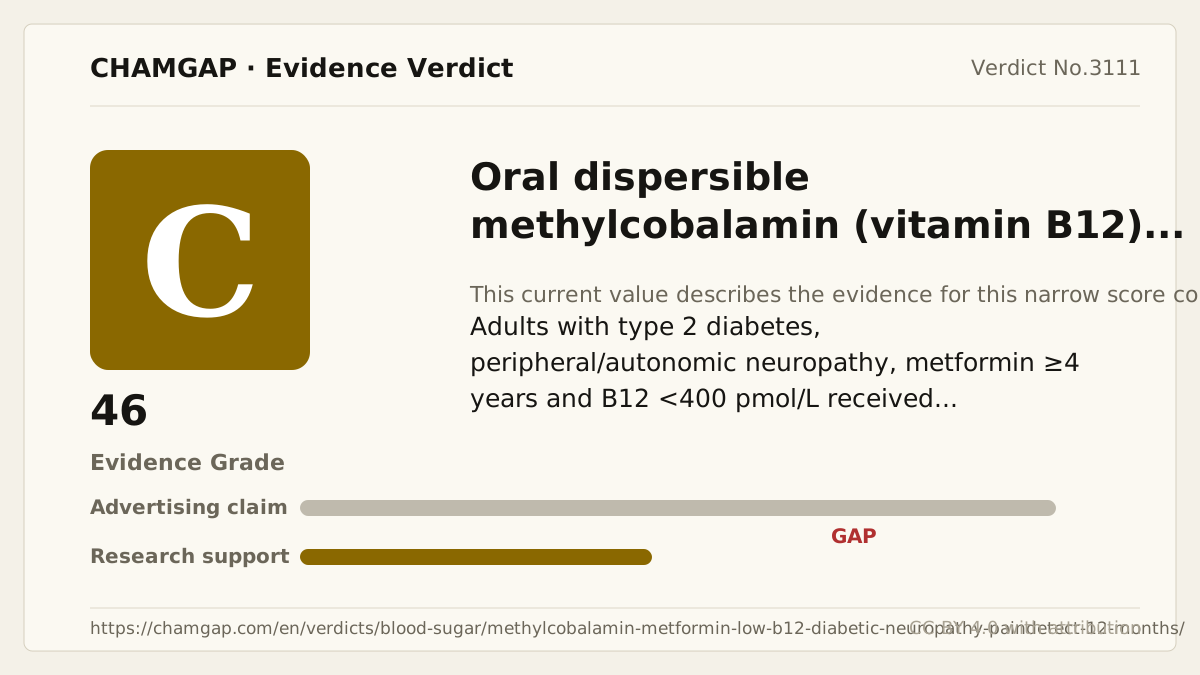
[Chamgap] Does oral methylcobalamin lower the painDETECT score in diabetic neuropathy with low B12? — Evidence Grade C·46. 12 cited sources checked. Source: https://chamgap.com/en/verdicts/blood-sugar/methylcobalamin-metformin-low-b12-diabetic-neuropathy-paindetect-12-months/ · CC BY 4.0CC BY 4.0 — free to use with attribution; do not distort grades, numbers, or verdict meaning.
What this document does and does not do
Chamgap is an information source. It reports what research has and has not confirmed; it does not tell readers what to take or buy. That decision belongs to readers and, when needed, medical or legal professionals. This verdict reflects literature available up to the search date and may change as new research appears. Nothing here is medical advice.