
Lobeglitazone,
does it really help with HbA1c improvement in type 2 diabetes leads to fewer cardiovascular and renal complications?
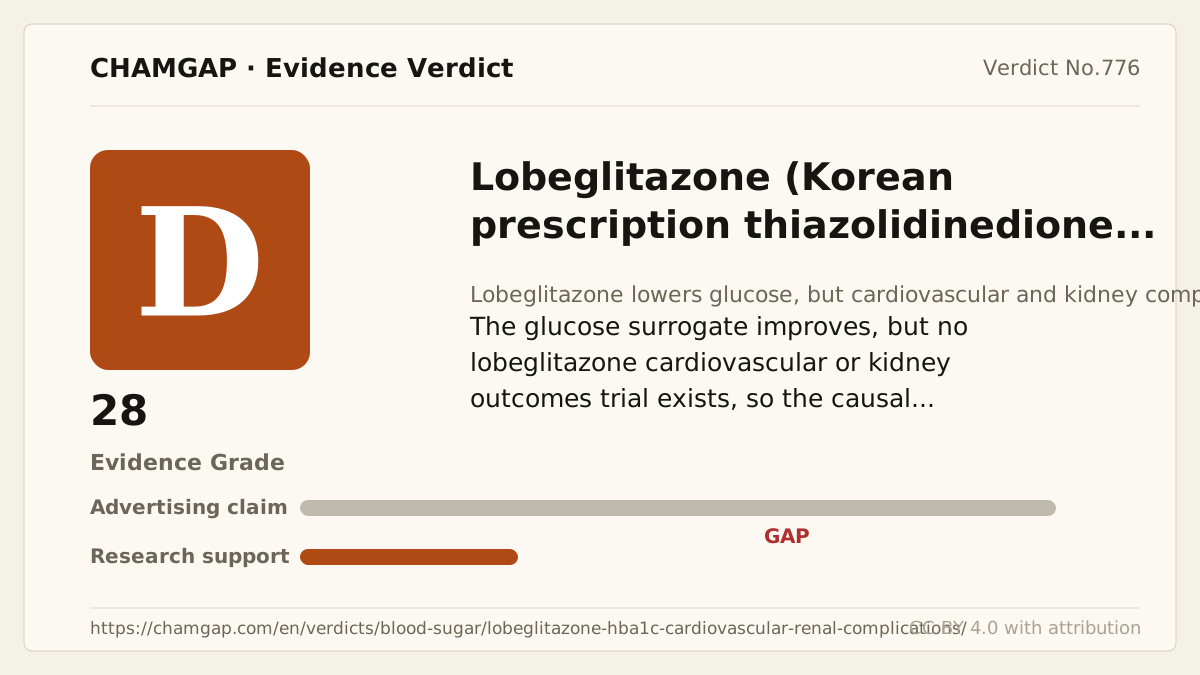
research showsLobeglitazone has short-term randomized evidence that it lowers HbA1c and glucose, but no randomized outcomes-trial evidence shows that these changes reduce cardiovascular or renal complications with this drug; the claim is rated D. In a 173-person, 24-week placebo-controlled trial, the placebo-adjusted HbA1c difference was -0.60 percentage points, but clinical complications were not study outcomes. A 24-week post hoc albuminuria analysis found no significant difference from pioglitazone, and urinary albumin is still a surrogate. Long-term evidence located through 2026 includes observational cohorts, but these cannot replace a cardiovascular or kidney outcomes trial for causal protection. Edema, weight gain, worsening heart failure, and fractures are recorded separately under safety.
ads claimPromotion can join improvements in HbA1c, insulin resistance, or albuminuria to clinical claims of heart and kidney protection. The demonstrated scope is glucose lowering; fewer complications require separate drug-specific hard-outcome trials.
Useful facts when choosing a product
- Lobeglitazone is a prescription thiazolidinedione used in Korea for glycemic control in type 2 diabetes, and the usual Duvie tablet dose is 0.5 mg once daily.
- It can be taken without regard to meals, but combination therapy, kidney and liver status, edema, and heart failure require prescriber monitoring.
- Lobeglitazone lowers HbA1c but should not be treated as a drug with independently established cardiovascular or kidney complication reduction.
- Weight gain, fluid retention, and peripheral edema can occur, and heart failure can develop or worsen. Fracture risk and other thiazolidinedione-class precautions should also be checked against the product label and the patient's condition.
Chamgap Semantic Classification Code
Candidate index · review held
M.lobeglitazone.UNK.hba1c-improvement-in-type-2-diabetes-leads-to-fewer-cardiovascular-and-renal-complications.improve.placeboMedicinal interventions > Lobeglitazone > Unknown > HbA1c improvement in type 2 diabetes leads to fewer cardiovascular and renal complications > Improvement claim > Placebo
An automated migration candidate, not an issued permanent code; exact claim scope remains under review. This machine-generated migration candidate helps retrieval but is not a permanent assignment. The original verdict ID and URL remain authoritative.
What the research actually shows
Kim and colleagues in 2014 randomized 173 people with type 2 diabetes to lobeglitazone 0.5 mg or placebo for 24 weeks. HbA1c changed by -0.44% with lobeglitazone and +0.16% with placebo, a placebo-adjusted difference of -0.60%, but the trial was neither sized nor long enough to test cardiovascular or kidney events. A 2021 post hoc analysis by Kim and colleagues used phase 3 data from 253 participants to compare 24-week UACR changes between lobeglitazone and pioglitazone; the between-group difference was not significant and eGFR did not change. A retrospective cohort released in 2026 reported renal progression broadly comparable with other diabetes drugs, but it was nonrandomized observational evidence. No large lobeglitazone-specific cardiovascular or kidney outcomes trial was located through the search date.
Why this is classified as D (28)
The placebo-adjusted HbA1c reduction of 0.60 percentage points in a 24-week randomized trial supports glucose-surrogate efficacy. Albuminuria came from a post hoc surrogate analysis, however, and no lobeglitazone trial has tested cardiovascular or kidney hard outcomes. The extrapolated complication claim receives D with 28 points; edema, weight gain, heart failure, and fractures are separate safety issues.
Counterpoint. The drug can still be useful for an individual patient's glycemic target, so this is not a finding that lobeglitazone has no glucose-lowering effect. When cardiovascular disease, heart failure, or chronic kidney disease is central, therapies with direct outcomes-trial evidence should be compared with the prescriber.
Rejudgment record. New verdict — Accepted randomized evidence for HbA1c lowering, but assigned D to the extrapolation from a surrogate to cardiovascular and kidney outcomes because lobeglitazone lacks a hard-outcome trial and the albuminuria analysis was post hoc and surrogate-based
Sub-claim grades by effect
This ingredient is marketed for several effects. A single overall grade blends strong and weak claims together, so each effect is graded separately here. The overall grade reflects the strongest disconfirming or core claim.
| Effect (sub-claim) | Grade | Basis |
|---|---|---|
| Improvement in HbA1c and blood glucose | C | A 24-week placebo-controlled trial found a placebo-adjusted HbA1c reduction of 0.60 percentage points, but it was manufacturer-supported surrogate evidence. |
| Extrapolation to fewer cardiovascular and renal complications | D | No lobeglitazone-specific hard-outcome trial exists, and the post hoc albuminuria comparison was not significant. |
| Attribution of outcomes from other thiazolidinediones to lobeglitazone | ? | Cardiovascular outcomes and safety differ among drugs in the class, and no direct human outcomes evidence supports attribution. |
Cross-check — AI research and Codex final gate
Evidence Table
| Study | Design | Sample | Funding | Endpoint | Result | Weight |
|---|---|---|---|---|---|---|
| Kim SG et al. 2014 | Multicenter randomized double-blind placebo-controlled phase 3 trial | 173 people with type 2 diabetes; 115 assigned lobeglitazone and 58 placebo | Supported by Chong Kun Dang and the Korean government; manufacturer representatives participated in design, analysis, and reporting | Change in HbA1c at 24 weeks and glycemic and lipid surrogates | HbA1c changed by -0.44% with lobeglitazone and +0.16% with placebo, a placebo-adjusted difference of -0.60 percentage points, but cardiovascular and kidney events were not assessed. | Direct randomized evidence for glucose lowering but surrogate-only for the complication claim |
| Kim KS et al. 2021 | Post hoc exploratory analysis of randomized phase 3 trial data | Analysis population of 104 lobeglitazone and 101 pioglitazone recipients | The parent phase 3 trial was supported by Chong Kun Dang; this was a post hoc analysis | Urine albumin-to-creatinine ratio and eGFR at 24 weeks | UACR changed by -4.3 mg/g with lobeglitazone and +5.2 mg/g with pioglitazone, but the between-group difference was not significant and eGFR did not change. | Limited and nonconfirmatory kidney-surrogate evidence |
| Hong SH et al. 2026 | Single-hospital electronic-record retrospective cohort with propensity-score matching | Source cohort of 14,712 adults with type 2 diabetes followed by 1:2 treatment-group matching | Supported by Chong Kun Dang | Composite renal progression comprising kidney replacement therapy, sustained eGFR decline of at least 30%, or conditional doubling of creatinine | Lobeglitazone plus metformin had hazard ratios of 0.84 versus metformin alone, 1.00 versus sulfonylurea plus metformin, and 1.10 versus a DPP-4 inhibitor plus metformin, with no significant differences. | Recent observational hard-outcome evidence but not a randomized causal trial |
Receipt — 3 References
All 3 cited sources were verified for existence at the original page (as of 2026-07-20).
Final verification and publication gate: Codex · Evidence date: 2026-07-20 · Corrections: none
Cite this verdict
[Chamgap] Lobeglitazone x extrapolation from HbA1c improvement to fewer cardiovascular and renal complications — Evidence Grade D·28. 3 cited sources checked. Source: https://chamgap.com/en/verdicts/blood-sugar/lobeglitazone-hba1c-cardiovascular-renal-complications/ · CC BY 4.0CC BY 4.0 — free to use with attribution; do not distort grades, numbers, or verdict meaning.
What this document does and does not do
Chamgap is an information source. It reports what research has and has not confirmed; it does not tell readers what to take or buy. That decision belongs to readers and, when needed, medical or legal professionals. This verdict reflects literature available up to the search date and may change as new research appears. Nothing here is medical advice.