
Liraglutide 1.8 mg,
does it really help with Reduced three-point MACE consisting of cardiovascular death, nonfatal myocardial infarction, or nonfatal stroke in patients with type 2 diabetes at high cardiovascular risk?
research showsLiraglutide 1.8 mg is rated B because, although a large hard-endpoint randomized trial showed fewer three-point MACE events, consisting of cardiovascular death, nonfatal myocardial infarction, or nonfatal stroke, in patients with type 2 diabetes at high cardiovascular risk, the only cited trial is LEADER and no replication by different investigators with different funding has been confirmed, so axis 2 R1 caps the grade at B. Over a median 3.8 years among 9,340 LEADER participants, MACE occurred in 13.0% versus 14.9%, HR 0.87 (95% CI 0.78 to 0.97; P=0.01 for superiority), cardiovascular death in 4.7% versus 6.0%, HR 0.78, and all-cause death in 8.2% versus 9.6%, HR 0.85. A 2021 meta-analysis of eight GLP-1 receptor agonist cardiovascular outcome trials involving 60,080 participants supported a class-wide MACE direction, HR 0.86, but it includes LEADER, so its evidence overlaps and it cannot count as a separate replication. The publicly funded GRADE trial's 2024 cardiovascular analysis found no significant between-group difference in MACE among 5,047 patients at low cardiovascular risk with an active-comparator design, so no independent same-direction replication has been identified in the literature. Direct hard endpoints and mortality benefit merit B with 72 points, while gastrointestinal effects, gallbladder disease, pancreatitis reports, and the thyroid C-cell tumor warning remain separate safety issues.
ads claimPromotion can recast the finding as a weight-loss injection that prevents heart disease in anyone, extending LEADER beyond high-risk type 2 diabetes to the 3.0-mg obesity dose, low-risk populations, or people without diabetes. The B grade with 72 points comes from cardiovascular outcomes added to diabetes care, not from glucose or weight change as surrogate endpoints.
Useful facts when choosing a product
- Liraglutide is a once-daily subcutaneous GLP-1 receptor agonist. Victoza is commonly started at 0.6 mg and increased to 1.2 mg and, if needed and tolerated, 1.8 mg.
- LEADER's cardiovascular evidence applies to adding up to 1.8 mg in people with type 2 diabetes at high cardiovascular risk. It should not be conflated with liraglutide 3.0 mg for obesity or with another GLP-1 product.
- Nausea, vomiting, diarrhea, constipation, and reduced appetite are common, and dehydration-related acute kidney injury, gallbladder disease, and uncommon reports of pancreatitis can occur. Persistent severe abdominal pain, repeated vomiting, or gallbladder symptoms require medical review.
- Because of thyroid C-cell tumors in rodents, liraglutide is contraindicated with a personal or family history of medullary thyroid carcinoma or MEN2. Insulin or a sulfonylurea can increase hypoglycemia risk, and pregnancy, lactation, or severe gastrointestinal motility disease requires individualized assessment.
Chamgap Semantic Classification Code
Candidate index · review held
M.liraglutide.UNK.three-point-mace-consisting-of-cardiovascular-death-nonfatal-myocardial-infarction-or-nonfatal-stroke-with-type-2-diabetes-at-high-cardiovascular-risk.reduce.placeboMedicinal interventions > Liraglutide > Unknown > three-point MACE consisting of cardiovascular death, nonfatal myocardial infarction, or nonfatal stroke with type 2 diabetes at high cardiovascular risk > Reduction claim > Placebo
An automated migration candidate, not an issued permanent code; exact claim scope remains under review. This machine-generated migration candidate helps retrieval but is not a permanent assignment. The original verdict ID and URL remain authoritative.
What the research actually shows
Marso and the LEADER Trial Investigators randomized 9,340 patients with type 2 diabetes and high cardiovascular risk to liraglutide starting at 0.6 mg and increasing to a maximum of 1.8 mg once daily or placebo, with standard diabetes and cardiovascular care in both groups. Over a median 3.8 years, first cardiovascular death, nonfatal myocardial infarction, or nonfatal stroke occurred in 608 of 4,668 participants (13.0%) versus 694 of 4,672 (14.9%), HR 0.87; cardiovascular death was 4.7% versus 6.0%, HR 0.78, and all-cause death was 8.2% versus 9.6%, HR 0.85. Sattar and colleagues' 2021 meta-analysis of eight GLP-1 receptor agonist cardiovascular outcome trials involving 60,080 participants found MACE HR 0.86 and all-cause mortality HR 0.88, showing that LEADER was not an isolated positive signal. This verdict addresses the 1.8-mg cardiovascular-outcome indication in high-risk type 2 diabetes, not obesity treatment at 3.0 mg or diabetes prevention.
Why this is classified as B (72)
Among 9,340 LEADER participants, three-point MACE occurred in 13.0% versus 14.9%, HR 0.87, cardiovascular death fell with an HR of 0.78, and all-cause mortality with an HR of 0.85; a 60,080-participant class meta-analysis supported the MACE direction but includes LEADER and is not a separate trial. Because the cited evidence rests on a single trial and no replication by different investigators with different funding has been confirmed — the publicly funded GRADE trial (5,047 low-risk patients, active comparators) found no significant between-group MACE difference — axis 2 is R1 and caps the grade at B with 72 points. Manufacturer sponsorship does not cap a large prescription-drug hard-endpoint trial, so the axis 3 cap does not apply. Product, dose, and population differences and gastrointestinal, gallbladder, pancreatic, and thyroid warnings are separate applicability and safety issues.
Counterpoint. Patients with high-risk type 2 diabetes and higher baseline MACE and mortality risk can receive greater absolute benefit. Selection should also consider atherosclerotic disease, heart failure or kidney disease, glucose and weight goals, cost, gastrointestinal tolerance, and medicines that cause hypoglycemia.
Rejudgment record. New verdict — Evaluated direct hard-endpoint evidence from a long-term double-blind randomized trial of 9,340 patients with high-risk type 2 diabetes that significantly reduced three-point MACE and cardiovascular death, with directional support from a large meta-analysis of GLP-1 receptor agonist cardiovascular outcome trials
| Endpoint | H | Hard endpoint - actual events such as death |
| Replication | R1 | Single confirmatory trial |
| Independence | I0 | Evidence comes only from manufacturer studies |
| Effect size | E+ | Meets the clinically important threshold |
Stored derived and displayed grades match; this is not a current recalculation or validity check (B).
Sub-claim grades by effect
This ingredient is marketed for several effects. A single overall grade blends strong and weak claims together, so each effect is graded separately here. The overall grade reflects the strongest disconfirming or core claim.
| Effect (sub-claim) | Grade | Basis |
|---|---|---|
| Reduced three-point MACE in type 2 diabetes at high cardiovascular risk | A | In LEADER, the prespecified direct hard endpoint fell significantly from 14.9% to 13.0%, HR 0.87. |
| Reduced cardiovascular death in type 2 diabetes at high cardiovascular risk | A | Cardiovascular death fell significantly from 6.0% to 4.7%, HR 0.78 (95% CI 0.66 to 0.93). |
| Reduced all-cause mortality in type 2 diabetes at high cardiovascular risk | A | All-cause mortality fell from 9.6% to 8.2%, HR 0.85 (95% CI 0.74 to 0.97). |
Cross-check — AI research and Codex final gate
Evidence Table
| Study | Design | Sample | Funding | Endpoint | Result | Weight |
|---|---|---|---|---|---|---|
| Marso SP et al.; LEADER Steering Committee; LEADER Trial Investigators. 2016 | Multinational randomized double-blind placebo-controlled cardiovascular outcome trial | 9,340 patients with type 2 diabetes at high cardiovascular risk | Supported by Novo Nordisk | First cardiovascular death, nonfatal myocardial infarction, or nonfatal stroke | MACE 13.0% versus 14.9%, HR 0.87 (95% CI 0.78 to 0.97); cardiovascular death HR 0.78; all-cause death HR 0.85. | Pivotal large hard-endpoint randomized trial |
| Sattar N et al. 2021 | Systematic review and meta-analysis of eight GLP-1 receptor agonist cardiovascular outcome trials | Eight trials and 60,080 patients with type 2 diabetes | No specific funding | Three-point MACE, individual cardiovascular outcomes, all-cause mortality, and kidney outcomes | GLP-1 receptor agonists reduced MACE, HR 0.86 (95% CI 0.80 to 0.93), and all-cause mortality, HR 0.88, without significant MACE heterogeneity. | Independent class-consistency synthesis |
Receipt — 2 References
All 2 cited sources were verified for existence at the original page (as of 2026-08-11).
Final verification and publication gate: Codex · Evidence date: 2026-08-11 · Corrections: 1
Correction log — 1
Corrections applied to this verdict, in chronological order. Changes are logged, not erased.
- 2026-08-11 · Grade correction for unmet independent-replication requirement — Only one actual trial, LEADER (NCT01179048), was cited; the second citation, the Sattar 2021 meta-analysis, pools eight cardiovascular outcome trials including LEADER and is not separate evidence. Chamgap's A requires axis 2 R2 (multiple RCTs by different investigators with different funding), and no independently funded RCT replicating the MACE reduction of liraglutide 1.8 mg in high-risk type 2 diabetes was identified — the publicly funded GRADE trial (2024; 5,047 low-risk patients, active comparators) found no significant between-group MACE difference and is not a same-direction replication. Axis 2 is R1, capping the grade at B — the axes were recorded as B·H·R1·I0·E+·B1 with a score of 72. The effect itself (MACE HR 0.87, 95% CI 0.78 to 0.97; cardiovascular death HR 0.78) is not disputed. Confirmed in the 2026-08-11 internal audit (workflow verification plus concordant Codex cross-check). (grade A→B)
Cite this verdict
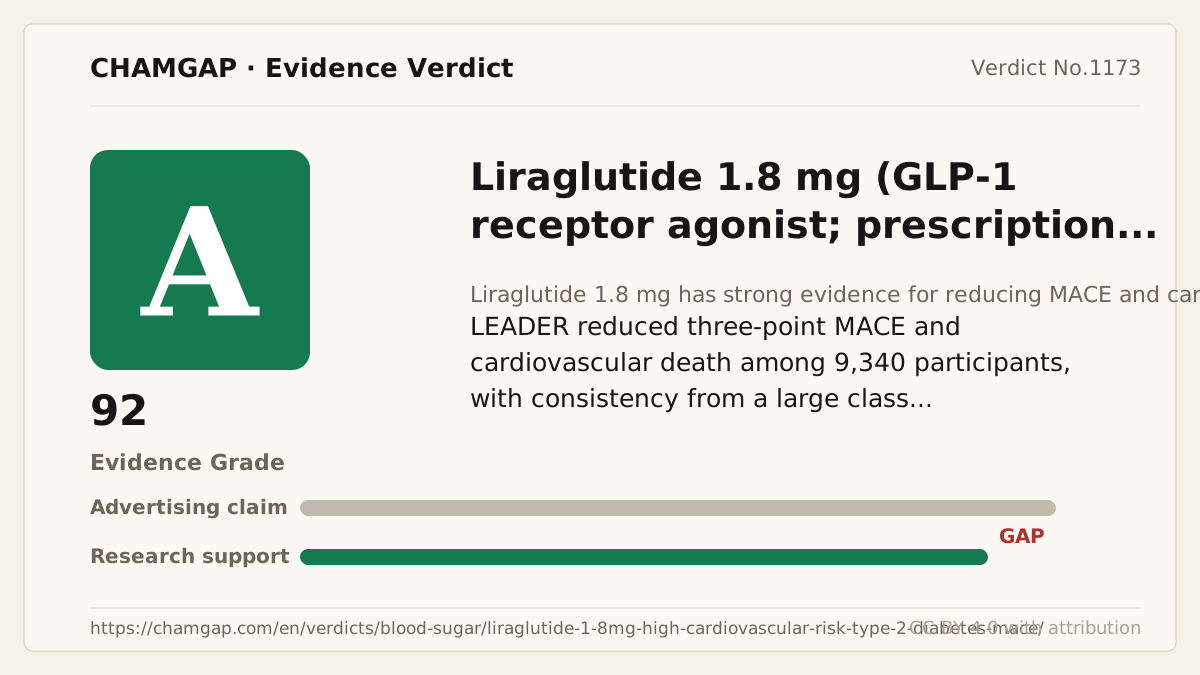
[Chamgap] Liraglutide 1.8 mg x reduced MACE in type 2 diabetes at high cardiovascular risk — Evidence Grade B·72. 2 cited sources checked. Source: https://chamgap.com/en/verdicts/blood-sugar/liraglutide-1-8mg-high-cardiovascular-risk-type-2-diabetes-mace/ · CC BY 4.0CC BY 4.0 — free to use with attribution; do not distort grades, numbers, or verdict meaning.
What this document does and does not do
Chamgap is an information source. It reports what research has and has not confirmed; it does not tell readers what to take or buy. That decision belongs to readers and, when needed, medical or legal professionals. This verdict reflects literature available up to the search date and may change as new research appears. Nothing here is medical advice.