
Irbesartan,
does it really help with Prevention of doubling of serum creatinine and progression to end-stage renal disease in proteinuric type 2 diabetic nephropathy?
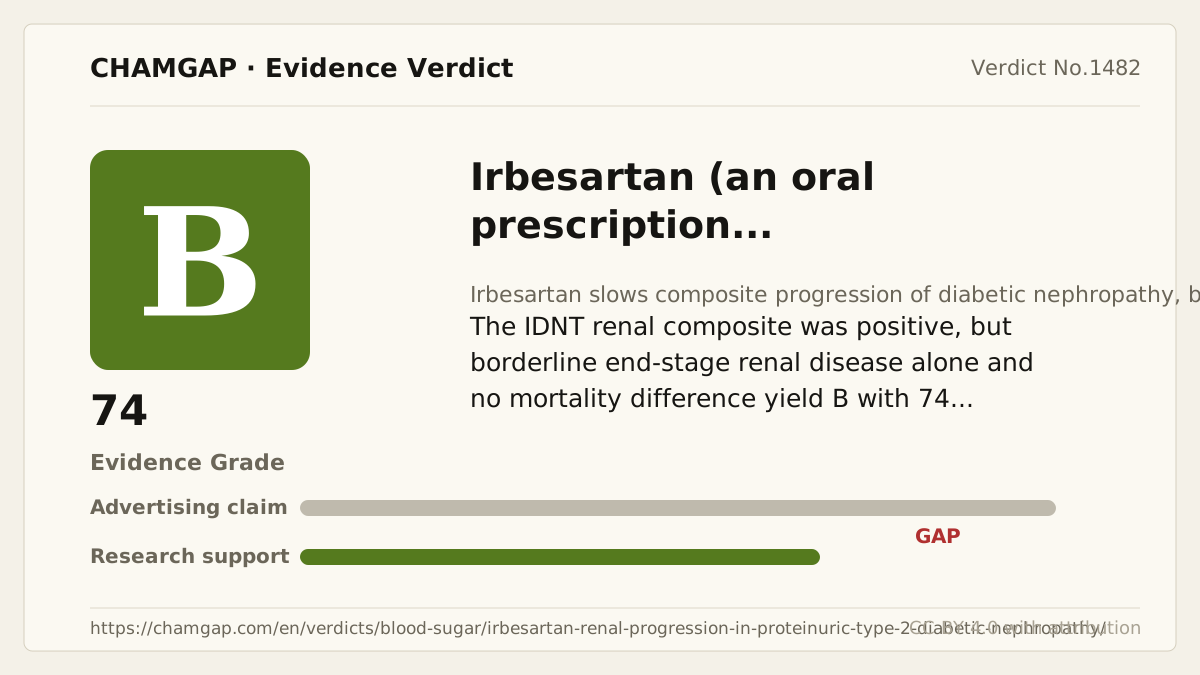
research showsIrbesartan is rated B because the randomized IDNT trial reduced a renal-progression composite in proteinuric type 2 diabetic nephropathy. Among 1,715 patients, it lowered the composite of doubling serum creatinine, end-stage renal disease, or all-cause death by about 20% versus placebo, but the benefit was driven mainly by creatinine doubling. End-stage renal disease alone fell by 23% with P=.07, and mortality did not differ.
ads claimPromotion may translate a 20% composite reduction into 20% prevention of kidney failure alone. The accurate statement is that irbesartan slowed composite renal progression, with the clearest contribution from delayed creatinine doubling.
Useful facts when choosing a product
- Irbesartan is an oral prescription angiotensin-receptor blocker used for hypertension and diabetic nephropathy, with blood pressure, serum creatinine, and potassium monitored.
- Creatinine and hyperkalemia should be checked after initiation or dose escalation; dehydration, diuretics, and nonsteroidal anti-inflammatory drugs can increase the risk of acute kidney dysfunction.
- It is contraindicated during pregnancy because fetal renal injury and death can occur, and an alternative should be arranged promptly if pregnancy is detected.
Chamgap Semantic Classification Code
Candidate index · review held
M.irbesartan.oral.doubling-of-serum-creatinine-and-progression-to-end-stage-renal-disease-in-proteinuric-type-2-diabetic-nephropathy.prevent.MULTIMedicinal interventions > Irbesartan > Oral > doubling of serum creatinine and progression to end-stage renal disease in proteinuric type 2 diabetic nephropathy > Occurrence-prevention claim > Multiple: primary unresolved
An automated migration candidate, not an issued permanent code; exact claim scope remains under review. This machine-generated migration candidate helps retrieval but is not a permanent assignment. The original verdict ID and URL remain authoritative.
What the research actually shows
Lewis and colleagues randomized 1,715 hypertensive patients with proteinuric type 2 diabetic nephropathy to irbesartan 300 mg, amlodipine 10 mg, or placebo under the same blood-pressure target. Irbesartan lowered the composite of creatinine doubling, end-stage renal disease, or all-cause death by 20% versus placebo and 23% versus amlodipine. Creatinine doubling was significantly delayed, but end-stage renal disease alone fell by 23% with P=.07 and mortality was unchanged.
Why this is classified as B (74)
A large ingredient-specific randomized trial reduced a renal hard-endpoint composite, but end-stage renal disease alone was borderline at P=.07 and mortality was unchanged, yielding B with 74 points. Hyperkalemia, renal-function changes, and pregnancy are separate safety issues.
Counterpoint. Contemporary care may combine blood-pressure control with other kidney-protective treatments such as an SGLT2 inhibitor. This verdict isolates the historical ingredient-specific evidence for irbesartan.
Rejudgment record. New verdict — Accepted the ingredient-specific randomized IDNT benefit on the renal composite, while applying the composite-endpoint boundary because creatinine doubling drove the result, end-stage renal disease alone had P=.07, and mortality was unchanged
Sub-claim grades by effect
This ingredient is marketed for several effects. A single overall grade blends strong and weak claims together, so each effect is graded separately here. The overall grade reflects the strongest disconfirming or core claim.
| Effect (sub-claim) | Grade | Basis |
|---|---|---|
| Reduction in the composite of creatinine doubling, end-stage renal disease, or death | B | IDNT showed an approximately 20% reduction versus placebo, driven mainly by creatinine doubling. |
| Delay in doubling of serum creatinine | B | This was the key significantly reduced component in the ingredient-specific randomized trial. |
| Reduction in end-stage renal disease alone | C | Relative risk was 23% lower, but the result was statistically borderline at P=.07. |
Cross-check — AI research and Codex final gate
Evidence Table
| Study | Design | Sample | Funding | Endpoint | Result | Weight |
|---|---|---|---|---|---|---|
| Lewis EJ et al. 2001 IDNT | Multinational randomized double-blind placebo- and active-controlled trial | 1,715 hypertensive patients with type 2 diabetic nephropathy | Supported by Bristol-Myers Squibb and Sanofi-Synthelabo | First occurrence of creatinine doubling, end-stage renal disease, or all-cause death | Irbesartan lowered the composite risk by 20% versus placebo, but end-stage renal disease alone fell 23% with P=.07 and mortality was unchanged. | Pivotal large ingredient-specific randomized trial |
| Berl T et al. 2003 IDNT cardiovascular analysis | Prespecified secondary cardiovascular-endpoint analysis | 1,715 IDNT participants | Supported by Bristol-Myers Squibb and Sanofi-Synthelabo | Composite cardiovascular death, myocardial infarction, heart failure, and related events | The overall cardiovascular composite did not differ significantly among groups. | Limits mortality and cardiovascular extrapolation |
Receipt — 2 References
All 2 cited sources were verified for existence at the original page (as of 2026-07-23).
Final verification and publication gate: Codex · Evidence date: 2026-07-23 · Corrections: none
Cite this verdict
[Chamgap] Irbesartan x prevention of renal progression in proteinuric type 2 diabetic nephropathy — Evidence Grade B·74. 2 cited sources checked. Source: https://chamgap.com/en/verdicts/blood-sugar/irbesartan-renal-progression-in-proteinuric-type-2-diabetic-nephropathy/ · CC BY 4.0CC BY 4.0 — free to use with attribution; do not distort grades, numbers, or verdict meaning.
What this document does and does not do
Chamgap is an information source. It reports what research has and has not confirmed; it does not tell readers what to take or buy. That decision belongs to readers and, when needed, medical or legal professionals. This verdict reflects literature available up to the search date and may change as new research appears. Nothing here is medical advice.