
Insulin icodec,
does it really help with Once-weekly dosing provides HbA1c control at least as good as once-daily glargine in insulin-naive type 2 diabetes?
research showsInsulin icodec is rated C because a large phase 3 trial showed that it lowered HbA1c at least as well as once-daily insulin glargine U100 in insulin-naive adults with type 2 diabetes. In ONWARDS 1, the 52-week HbA1c changes were -1.55 percentage points with icodec and -1.35 with glargine, and the between-group difference of -0.19 percentage points (95% CI -0.36 to -0.03) met both noninferiority and statistical superiority criteria. This was nevertheless a manufacturer-funded, open-label, treat-to-target trial using a surrogate outcome, and no trial of this comparison has established fewer cardiovascular events or deaths. Once-weekly convenience is a dosing fact rather than a hard clinical outcome, so rule ① caps the grade at C.
ads claimMarketing can turn fewer injections and a small HbA1c advantage into a claim that weekly icodec is broadly more powerful and safer than daily insulin. The demonstrated scope is appropriately titrated HbA1c and time-in-range control in insulin-naive type 2 diabetes, not superior cardiovascular protection or hypoglycemia outcomes.
Useful facts when choosing a product
- Awiqli is a prescription ultra-long-acting basal insulin containing insulin icodec. It is injected subcutaneously once weekly on the same day, with the dose individualized by a clinician according to glucose readings and patient factors.
- Authorized products are injected under the skin of the abdomen, thigh, or upper arm, with rotation of injection sites. Starting or switching doses should not be calculated independently from a daily insulin; the product information and prescription take priority.
- A single weekly dose covers a week of basal insulin needs. The consequences of a dosing error or overdose can persist, so missed doses, changes of dosing day, illness, or altered food intake require product-specific clinical instructions rather than improvised replacement dosing.
- Hypoglycemia is the principal adverse effect. The prolonged action of icodec can delay recovery from hypoglycemia, and glucose monitoring must account for driving, exercise, alcohol, kidney or liver function, and other glucose-lowering medicines.
Chamgap Semantic Classification Code
Candidate index · review held
M.insulin-icodec.UNK.once-weekly-dosing-provides-hba1c-control-at-least-as-good-as-once-daily-glargine-in-insulin-naive-type-2-diabetes.assess.UNKMedicinal interventions > Insulin icodec > Unknown > Once-weekly dosing provides HbA1c control at least as good as once-daily glargine in insulin-naive type 2 diabetes > Association or change assessment > Unknown
An automated migration candidate, not an issued permanent code; exact claim scope remains under review. This machine-generated migration candidate helps retrieval but is not a permanent assignment. The original verdict ID and URL remain authoritative.
What the research actually shows
ONWARDS 1 was a 78-week, open-label, treat-to-target phase 3 trial at 143 sites in 12 countries. It assigned 984 insulin-naive adults with type 2 diabetes 1:1 to weekly icodec or daily glargine U100. At week 52, HbA1c changes were -1.55 versus -1.35 percentage points, and time in range was 71.9% versus 66.9%, favoring icodec. Rates of clinically significant or severe hypoglycemia through week 52 were 0.30 versus 0.16 events per patient-year; absolute rates were low in both groups but numerically higher with icodec. A 2024 phase 3 meta-analysis found an HbA1c difference of -0.14 percentage points with I-squared of 68%, and the evidence remains dependent on the manufacturer ONWARDS program. No confirmatory trial with cardiovascular events or mortality as the primary hard outcome was identified.
Why this is classified as C (58)
In ONWARDS 1, involving 984 insulin-naive adults with type 2 diabetes, the 52-week HbA1c difference of -0.19 percentage points established noninferiority and superiority versus glargine U100, and meta-analysis showed a small -0.14-point signal. These remain HbA1c and time-in-range surrogate outcomes concentrated in the manufacturer ONWARDS program, with no cardiovascular or mortality hard-outcome trial. Rule ① therefore gives the high end of C, 58 points.
Counterpoint. A weekly prescription may be practically valuable for adults who struggle with daily basal injections. Its long action changes dose adjustment and hypoglycemia management, so convenience is not a reason to switch independently or alter injection intervals.
Rejudgment record. New verdict — Accepted the positive HbA1c findings from ONWARDS 1 and the phase 3 meta-analysis, but applied the rule ① ceiling of C because evidence is concentrated in manufacturer trials using surrogate outcomes and lacks cardiovascular-event or mortality hard-outcome trials
Sub-claim grades by effect
This ingredient is marketed for several effects. A single overall grade blends strong and weak claims together, so each effect is graded separately here. The overall grade reflects the strongest disconfirming or core claim.
| Effect (sub-claim) | Grade | Basis |
|---|---|---|
| HbA1c reduction in insulin-naive type 2 diabetes | C | HbA1c was 0.19 percentage points lower than with glargine at 52 weeks. Weekly dosing is convenient but is not a hard clinical outcome. |
| Improvement in glucose time in range | C | ONWARDS 1 favored icodec at 71.9% versus 66.9%, but this is a continuous-glucose-monitoring surrogate. |
| Reduction in cardiovascular events or mortality | ? | No trial establishing this hard-outcome benefit for icodec versus glargine was identified. |
Cross-check — AI research and Codex final gate
Evidence Table
| Study | Design | Sample | Funding | Endpoint | Result | Weight |
|---|---|---|---|---|---|---|
| Rosenstock J et al. ONWARDS 1, 2023 | Seventy-eight-week open-label randomized treat-to-target phase 3 trial | 984 insulin-naive adults with type 2 diabetes; 492 per group | Sponsored by Novo Nordisk | Change in HbA1c at week 52; time in range and hypoglycemia | HbA1c changed by -1.55 percentage points with icodec and -1.35 with glargine; the -0.19-point difference (95% CI -0.36 to -0.03) met noninferiority and superiority criteria. | Key large direct surrogate-outcome evidence |
| Lisco G et al. 2024 | Systematic review and meta-analysis of randomized ONWARDS phase 3 trials | Phase 3 ONWARDS 1 to 6 trials in adults with diabetes | No separate external study funding reported; included trials were from the Novo Nordisk program | HbA1c, fasting glucose, time in range, and hypoglycemia | The HbA1c difference versus daily basal insulin was slightly favorable at -0.14 percentage points (95% CI -0.25 to -0.03, P=.01; I-squared=68%). | Synthesis confirming the surrogate signal and heterogeneity |
Receipt — 3 References
All 3 cited sources were verified for existence at the original page (as of 2026-07-24).
Final verification and publication gate: Codex · Evidence date: 2026-07-24 · Corrections: none
Cite this verdict
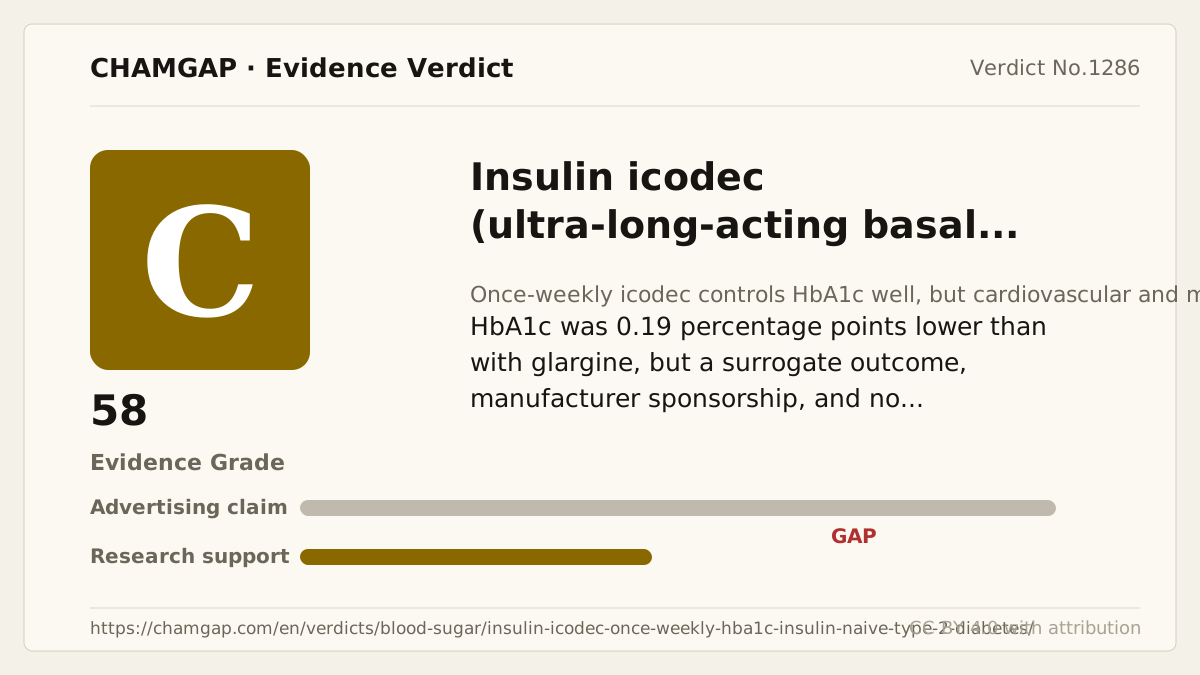
[Chamgap] Insulin icodec x once-weekly HbA1c control in insulin-naive type 2 diabetes — Evidence Grade C·58. 3 cited sources checked. Source: https://chamgap.com/en/verdicts/blood-sugar/insulin-icodec-once-weekly-hba1c-insulin-naive-type-2-diabetes/ · CC BY 4.0CC BY 4.0 — free to use with attribution; do not distort grades, numbers, or verdict meaning.
What this document does and does not do
Chamgap is an information source. It reports what research has and has not confirmed; it does not tell readers what to take or buy. That decision belongs to readers and, when needed, medical or legal professionals. This verdict reflects literature available up to the search date and may change as new research appears. Nothing here is medical advice.