
Ground pecans about 42.5 g/day,
does it really help with Improved insulin resistance?
research showsThe grade is C with 46 points. In a four-week crossover feeding trial with 26 completers analyzed, replacing foods in an isocaloric control diet with ground pecans lowered fasting insulin by −2.00±0.83 μIU/mL and HOMA-IR by −0.51±0.23. Approximate 95% CIs are −3.63 to −0.37 and −0.96 to −0.06, respectively, but these are surrogate markers rather than diabetes or complications.
ads claimPecans are fat- and energy-dense, but this result concerns a four-week isocaloric substitution and laboratory markers, not adding pecans or preventing diabetes.
Useful facts when choosing a product
- Pecans were ground into prepared meals at about 42.5 g/day for a 2,000 kcal diet.
- The pecan and control diets were matched for energy, total fat, and fiber, so the comparison replaced other foods with pecans.
- Pecans are fat- and energy-dense tree nuts. A direct energy assay of the trial product was unconfirmed.
- Pecans can cause tree-nut allergy.
- Pecans are native to North America.
Chamgap Semantic Classification Code
Candidate index · review held
F.ground-pecans-incorporated-into-prepared-meals.food.insulin-resistance.improve.UNKFoods and beverages > Ground pecans incorporated into prepared meals > Food consumption > insulin resistance > Improvement claim > Unknown
An automated migration candidate, not an issued permanent code; exact claim scope remains under review. This machine-generated migration candidate helps retrieval but is not a permanent assignment. The original verdict ID and URL remain authoritative.
What the research actually shows
The 2018 paper by McKay DL et al. and NCT01950806 were cross-checked. First submission was 2013-09-23 and study start was 2014-01, making registration prospective. Insulin-resistance measures were among several registered primary biomarkers. Support came from a USDA cooperative agreement and the National Pecan Shellers Association, which also supplied pecans.
Why this is classified as C (46)
Laboratory markers improved statistically, but the standardized contrast was below a conventional moderate effect. This was one 26-person, four-week, mixed-funded trial with no clinical events, giving C with 46 points.
Counterpoint. Independent long-term trials should measure diabetes incidence and patient-centered outcomes.
Rejudgment record. Cross-check applied — Cross-checked the 2018 paper and NCT01950806 for conflicting enrollment counts, prospective registration, multiple biomarkers, approximate confidence intervals, standardized magnitude, and funding
| Endpoint | S | Surrogate marker - laboratory or imaging measures |
| Replication | R1 | Single confirmatory trial |
| Independence | I1 | Mixed funding sources |
| Effect size | E~ | Statistically positive but below the threshold |
Stored derived and displayed grades match; this is not a current recalculation or validity check (C).
Sub-claim grades by effect
This ingredient is marketed for several effects. A single overall grade blends strong and weak claims together, so each effect is graded separately here. The overall grade reflects the strongest disconfirming or core claim.
| Effect (sub-claim) | Grade | Basis |
|---|---|---|
| Isocaloric replacement with ground pecans improves insulin-resistance markers | C | Markers improved modestly over four weeks, but clinical events were not measured. |
| Pecans are fat- and energy-dense | ? | This is a composition fact, not a graded clinical outcome. |
Cross-check — AI research and Codex final gate
Evidence Table
| Study | Design | Sample | Funding | Endpoint | Result | Weight |
|---|---|---|---|---|---|---|
| McKay DL et al., Nutrients, 2018 | Randomized crossover feeding trial matched for energy, total fat, and fiber | Paper: 30 recruited and 26 completed and analyzed; registry: actual enrollment 28 | USDA cooperative agreement and National Pecan Shellers Association | Fasting insulin and HOMA-IR | −2.00±0.83 μIU/mL, approximate 95% CI −3.63 to −0.37; −0.51±0.23, approximate 95% CI −0.96 to −0.06 | Positive surrogate markers in a small short multiple-biomarker trial |
Receipt — 3 References
All 3 cited sources were verified for existence at the original page (as of 2026-08-02).
Final verification and publication gate: Codex · Evidence date: 2026-08-02 · Corrections: none
Cite this verdict
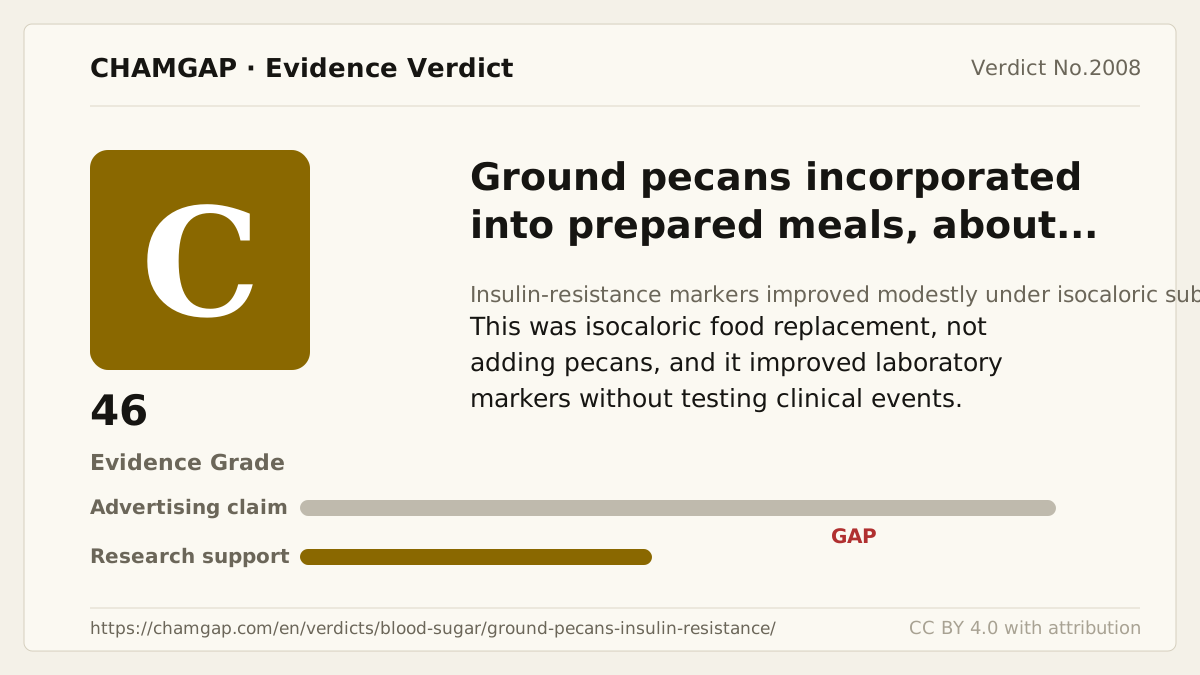
[Chamgap] Ground pecans about 42.5 g/day x insulin resistance — Evidence Grade C·46. 3 cited sources checked. Source: https://chamgap.com/en/verdicts/blood-sugar/ground-pecans-insulin-resistance/ · CC BY 4.0CC BY 4.0 — free to use with attribution; do not distort grades, numbers, or verdict meaning.
What this document does and does not do
Chamgap is an information source. It reports what research has and has not confirmed; it does not tell readers what to take or buy. That decision belongs to readers and, when needed, medical or legal professionals. This verdict reflects literature available up to the search date and may change as new research appears. Nothing here is medical advice.