
Glyburide for gestational diabetes requiring medication,
does it really help with Perinatal safety adequate to replace injected insulin?
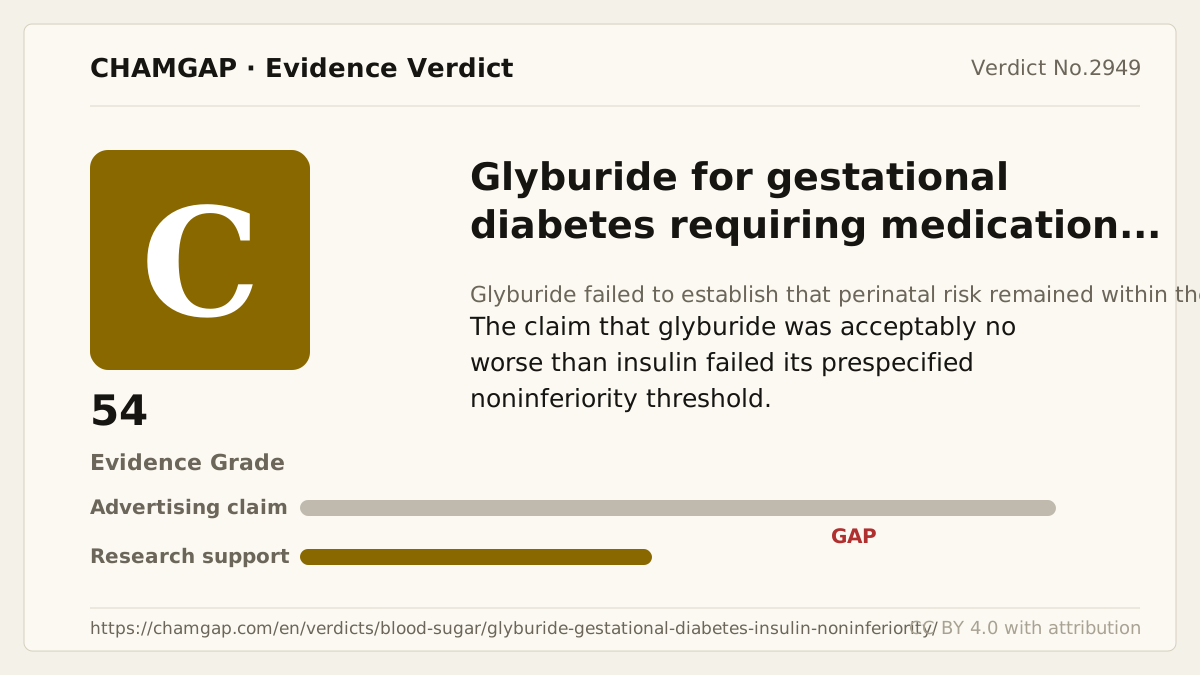
research showsGrade C. The INDAO perinatal composite occurred in 27.6% with glyburide versus 23.4% with insulin, an absolute difference of +4.2 points. The upper bound of the one-sided 97.5% CI was +10.5 points, exceeding the prespecified +7-point noninferiority margin (P=.19). Glyburide therefore failed to establish that it remained within the acceptable range. This is not the same as proving statistically significant inferiority.
ads claimConvenience of an oral drug does not establish that outcomes stay within an acceptable range versus insulin. A trial that crossed its prespecified margin must not be marketed as equivalent or noninferior.
Useful facts when choosing a product
- Glyburide is an oral sulfonylurea glucose-lowering drug.
- The trial was limited to gestational diabetes still requiring medication after 10 days of diet therapy.
- Placental transfer varies among sulfonylureas, so the result should not be generalized across the class.
Chamgap Semantic Classification Code
Candidate index · review held
UNK.glyburide.UNK.perinatal-safety-adequate-to-replace-injected-insulin.assess.UNKUnknown > Glyburide > Unknown > Perinatal safety adequate to replace injected insulin > Association or change assessment > Unknown
An automated migration candidate, not an issued permanent code; exact claim scope remains under review. This machine-generated migration candidate helps retrieval but is not a permanent assignment. The original verdict ID and URL remain authoritative.
What the research actually shows
Thirteen French university hospitals randomized 914 women, 460 to glyburide and 454 to insulin, in an open-label trial. The prespecified primary analysis was per protocol in 809, 367 versus 442; the other analysis population assessed consistency. The primary composite was macrosomia, neonatal hypoglycemia, or hyperbilirubinemia. Funding came from the French Ministry of Health Programme Hospitalier de Recherche Clinique, with Assistance Publique–Hôpitaux de Paris as public sponsor. No commercial pharmaceutical funding or free study drug was reported.
Why this is classified as C (54)
A large publicly funded randomized trial measured a hard perinatal composite but missed its prespecified noninferiority margin; noninferiority design and the per-protocol primary analysis give C with 54 points.
Counterpoint. The result did not prove statistically significant inferiority; it failed to prove that glyburide was acceptably no worse than insulin.
Rejudgment record. Cross-check applied — Failure of the prespecified INDAO noninferiority margin with noninferiority and per-protocol primary-analysis limitations
| Endpoint | H | Hard endpoint - actual events such as death |
| Replication | R1 | Single confirmatory trial |
| Independence | I2 | Decisive evidence is publicly or non-profit funded |
| Effect size | E~ | Statistically positive but below the threshold |
Stored derived and displayed grades match; this is not a current recalculation or validity check (C).
Sub-claim grades by effect
This ingredient is marketed for several effects. A single overall grade blends strong and weak claims together, so each effect is graded separately here. The overall grade reflects the strongest disconfirming or core claim.
| Effect (sub-claim) | Grade | Basis |
|---|---|---|
| Noninferiority to insulin for the perinatal composite | C | The +10.5-point upper bound exceeded the +7-point margin. |
| Superiority conclusion that glyburide is significantly more harmful | D | INDAO did not confirm that superiority claim. |
Cross-check — AI research and Codex final gate
Evidence Table
| Study | Design | Sample | Funding | Endpoint | Result | Weight |
|---|---|---|---|---|---|---|
| Sénat MV et al. 2018 INDAO | Multicenter open-label randomized noninferiority trial | 914 randomized, 460 versus 454; prespecified primary per-protocol analysis in 809, 367 versus 442 | French Ministry of Health PHRC public grant; AP-HP public sponsor | Perinatal composite of macrosomia, neonatal hypoglycemia, or hyperbilirubinemia | 27.6% vs 23.4%, difference +4.2 points, one-sided 97.5% CI upper bound +10.5 points; noninferiority P=.19 | Pivotal noninferiority evidence |
| Helal KF et al. 2020 systematic review and meta-analysis | RCT subgroup analysis within 24 studies, including 11 RCTs | 24,517 total participants; 11 RCTs | Systematic review; mixed funding across included trials | Maternal and neonatal hypoglycemia, LGA, and other outcomes | RCT subgroup found more maternal hypoglycemia and LGA with glyburide; overall pooled neonatal hypoglycemia OR 1.42 (95% CI 1.03 to 1.95) | Contextual synthesis of safety outcomes |
| Langer O et al. 2000 | Randomized trial of glyburide versus insulin | 404 randomized | As reported in the original paper | Primary glycemic control; secondary individual perinatal complications | LGA 12% vs 13% and neonatal hypoglycemia 9% vs 6%; no significant differences in individual complications; concluded clinically effective alternative | Earlier contrary-direction trial without a prespecified noninferiority test |
Receipt — 3 References
All 3 cited sources were verified for existence at the original page (as of 2026-08-26).
Final verification and publication gate: Codex · Evidence date: 2026-08-26 · Corrections: none
Cite this verdict
[Chamgap] Glyburide Failed to Establish Noninferiority to Insulin for Perinatal Complications in Gestational Diabetes — Evidence Grade C·54. 3 cited sources checked. Source: https://chamgap.com/en/verdicts/blood-sugar/glyburide-gestational-diabetes-insulin-noninferiority/ · CC BY 4.0CC BY 4.0 — free to use with attribution; do not distort grades, numbers, or verdict meaning.
What this document does and does not do
Chamgap is an information source. It reports what research has and has not confirmed; it does not tell readers what to take or buy. That decision belongs to readers and, when needed, medical or legal professionals. This verdict reflects literature available up to the search date and may change as new research appears. Nothing here is medical advice.