
Finerenone,
does it really help with Reduced kidney-failure progression and cardiovascular events in albuminuric chronic kidney disease with type 2 diabetes?
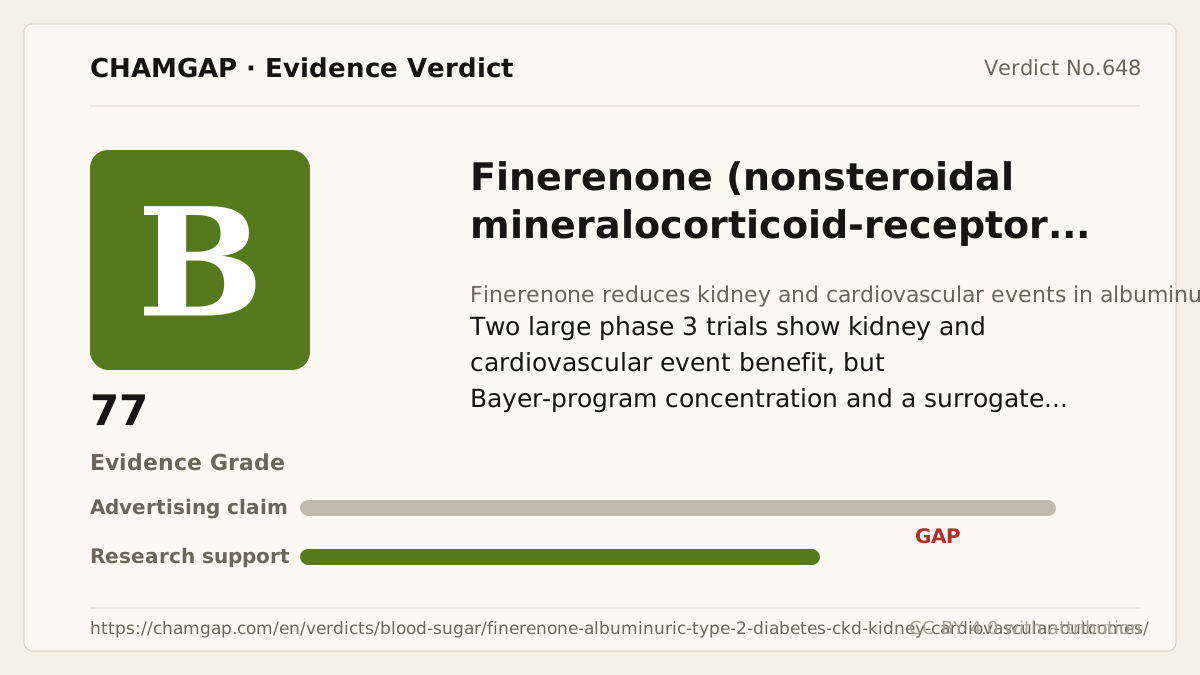
research showsFinerenone is rated B for reducing kidney-failure progression and cardiovascular events in chronic kidney disease with albuminuria and type 2 diabetes. FIDELIO-DKD, FIGARO-DKD, and the prespecified 13,026-participant FIDELITY analysis repeatedly reduced direct kidney and cardiovascular composite outcomes. The population was restricted to albuminuric diabetic CKD treated with maximally tolerated renin-angiotensin-system blockade, however, and the pivotal trials were Bayer-sponsored. This nonsteroidal mineralocorticoid-receptor mechanism differs from empagliflozin's SGLT2 inhibition and semaglutide's GLP-1 action and cannot be generalized into protection for every kidney condition.
ads claimMarketing can broaden kidney protection into universal long-term protection regardless of diabetes, albuminuria, and background therapy. The actual evidence concerns prescription finerenone added to ACE-inhibitor or ARB therapy in albuminuric CKD with type 2 diabetes.
Useful facts when choosing a product
- Finerenone is a selective nonsteroidal mineralocorticoid-receptor antagonist, mechanistically distinct from SGLT2 inhibitors such as empagliflozin and GLP-1 receptor agonists such as semaglutide.
- In CKD associated with type 2 diabetes it is generally used with a maximally tolerated ACE inhibitor or ARB, starting at 10 mg or 20 mg once daily according to eGFR and serum potassium.
- Serum potassium and eGFR should be measured before initiation and checked again about four weeks after initiation or dose change. Treatment generally should not be started when serum potassium exceeds 5.0 mEq/L.
- Hyperkalemia, hypotension, and hyponatremia occur, and strong CYP3A4 inhibitors are contraindicated. Lower kidney function or concomitant medicines and supplements that raise potassium require closer monitoring.
Chamgap Semantic Classification Code
Candidate index · review held
M.finerenone.UNK.kidney-failure-progression-and-cardiovascular-events-in-albuminuric-chronic-kidney-disease-with-type-2-diabetes.reduce.placeboMedicinal interventions > Finerenone > Unknown > kidney-failure progression and cardiovascular events in albuminuric chronic kidney disease with type 2 diabetes > Reduction claim > Placebo
An automated migration candidate, not an issued permanent code; exact claim scope remains under review. This machine-generated migration candidate helps retrieval but is not a permanent assignment. The original verdict ID and URL remain authoritative.
What the research actually shows
Bakris and colleagues' FIDELIO-DKD trial followed 5,734 people with CKD and type 2 diabetes for a median of 2.6 years and reduced the composite of kidney failure, sustained at least 40% eGFR decline, or renal death, with hazard ratio 0.82. FIGARO-DKD studied 7,437 participants across a broader and generally earlier CKD range and reduced the cardiovascular composite by about 13% relatively. Agarwal and colleagues' prespecified FIDELITY individual-participant analysis of 13,026 people reported hazard ratios of 0.86 for the cardiovascular composite and 0.77 for the stricter kidney composite. Hyperkalemia caused permanent discontinuation in 1.7% with finerenone and 0.6% with placebo, requiring potassium and eGFR monitoring independent of efficacy.
Why this is classified as B (77)
Two large randomized trials, FIDELIO-DKD and FIGARO-DKD, plus the 13,026-participant FIDELITY analysis repeatedly reduced clinical events, with hazard ratios of 0.86 for the cardiovascular composite and 0.77 for the stricter kidney composite. All pivotal evidence comes from the Bayer program, and the kidney composite mixes kidney failure with a sustained eGFR decline of at least 57%, a surrogate component. This supports high B with 77 points; hyperkalemia, hypotension, and kidney-function monitoring remain separate safety issues.
Counterpoint. Finerenone is an evidence-based add-on for high-risk diabetic CKD with persistent albuminuria. It is not a universal substitute for SGLT2 inhibition, blood-pressure control, or glycemic care; treatment sequence and potassium risk must be individualized.
Rejudgment record. New verdict — Accepted the cardiovascular-composite hazard ratio of 0.86 and stricter kidney-composite hazard ratio of 0.77 across FIDELIO-DKD, FIGARO-DKD, and 13,026 FIDELITY participants, while applying B because all pivotal evidence came from the Bayer program and the kidney composite mixed kidney failure with sustained eGFR decline of at least 57%, a surrogate component
Sub-claim grades by effect
This ingredient is marketed for several effects. A single overall grade blends strong and weak claims together, so each effect is graded separately here. The overall grade reflects the strongest disconfirming or core claim.
| Effect (sub-claim) | Grade | Basis |
|---|---|---|
| Reduced kidney and cardiovascular events in albuminuric CKD with type 2 diabetes | B | Two large phase 3 randomized trials and a prespecified pooled analysis support reductions in direct clinical outcomes. |
| General kidney protection regardless of diabetes or albuminuria | ? | No evidence establishes a universal claim outside the pivotal eligibility criteria. |
| Risk of hyperkalemia | ? | This is an established safety hazard rather than an efficacy subclaim and is monitored separately from the grade. |
Cross-check — AI research and Codex final gate
Evidence Table
| Study | Design | Sample | Funding | Endpoint | Result | Weight |
|---|---|---|---|---|---|---|
| Bakris GL et al. FIDELIO-DKD 2020 | Multinational randomized double-blind placebo-controlled phase 3 kidney-outcomes trial | 5,734 participants with albuminuric CKD and type 2 diabetes; median 2.6 years | Sponsored by Bayer | Composite of kidney failure, sustained at least 40% eGFR decline, or renal death | Finerenone reduced the primary kidney composite versus placebo, HR 0.82. | Pivotal direct kidney-outcomes evidence |
| Pitt B et al. FIGARO-DKD 2021 | Multinational randomized double-blind placebo-controlled phase 3 cardiovascular-outcomes trial | 7,437 participants with CKD and type 2 diabetes; median 3.4 years | Sponsored by Bayer | Composite of cardiovascular death, nonfatal myocardial infarction, nonfatal stroke, or heart-failure hospitalization | The primary cardiovascular composite was significantly reduced with finerenone, driven mainly by fewer heart-failure hospitalizations. | Supporting direct cardiovascular evidence |
| Agarwal R et al. FIDELITY 2022 | Prespecified individual-participant pooled analysis of two phase 3 randomized trials | 13,026 participants; median follow-up 3.0 years | Bayer-sponsored with employee coauthors | Cardiovascular composite and stricter kidney composite | The cardiovascular composite had HR 0.86 and kidney composite HR 0.77; hyperkalemia caused permanent discontinuation in 1.7% versus 0.6%. | Key pooled precision evidence |
Receipt — 3 References
Of 3 cited sources, 1 had limited original-page access (blocked or summary-only) and were verified via index/summary, marked partial; the rest were verified at the original page. As of 2026-07-19.
Final verification and publication gate: Codex · Evidence date: 2026-07-19 · Corrections: none
Cite this verdict
[Chamgap] Finerenone x reduced kidney and cardiovascular events in albuminuric CKD with type 2 diabetes — Evidence Grade B·77. 3 cited sources checked. Source: https://chamgap.com/en/verdicts/blood-sugar/finerenone-albuminuric-type-2-diabetes-ckd-kidney-cardiovascular-outcomes/ · CC BY 4.0CC BY 4.0 — free to use with attribution; do not distort grades, numbers, or verdict meaning.
What this document does and does not do
Chamgap is an information source. It reports what research has and has not confirmed; it does not tell readers what to take or buy. That decision belongs to readers and, when needed, medical or legal professionals. This verdict reflects literature available up to the search date and may change as new research appears. Nothing here is medical advice.