
Fast eating,
does it really help with Increased incidence of type 2 diabetes?
research showsThe grade is C with 54 points. Two Japanese cohorts pointed in the same direction, but their exposure response schemes had five and three categories, and use of the same question could not be established. They were therefore not counted as repetitions of the same question. Both were observational studies with self-reported exposure and residual confounding.
ads claimKorean campaigns and checkup counseling may reasonably encourage slower eating, but cohort associations do not prove that slowing down prevents diabetes.
Useful facts when choosing a product
- ISSA-CKD included 510 slow, 2,993 medium, and 1,350 fast eaters.
- Exposure was a three-category self-report, not measured bites or grams per minute.
- BMI adjustment can reduce obesity confounding while also removing part of a possible mediated pathway.
Chamgap Semantic Classification Code
Candidate index · review held
UNK.fast-eating-speed.UNK.incidence-of-type-2-diabetes.increase.UNKUnknown > Fast eating speed > Unknown > incidence of type 2 diabetes > Increase claim > Unknown
An automated migration candidate, not an issued permanent code; exact claim scope remains under review. This machine-generated migration candidate helps retrieval but is not a permanent assignment. The original verdict ID and URL remain authoritative.
What the research actually shows
The papers' bibliographies, authors, funding, exposures, and endpoints were compared. The 13 Sakurai authors and 21 Fujii authors did not overlap. The end of the Fujii author list is Kosuke Masutani, Hisatomi Arima, and Daiji Kawanami. Sakurai reported support from a Ministry of Health, Labour and Welfare research grant, MEXT grant 20390188, and the Japan Arteriosclerosis Prevention Fund; ISSA-CKD reported no external funding. Sakurai offered five exposure responses—very slow, relatively slow, medium, relatively fast, and very fast—and collapsed them into three analysis groups. Fujii used three response categories: slow, medium, and fast. Use of the same question could not be established. The cohorts pointed in the same direction, but different exposure definitions meant they were not counted as repetitions of the same question. Sakurai included 2,050 men followed for seven years with 177 cases; ISSA-CKD included 4,853 adults followed for a mean 5.1 years with 234 cases. A separate validation study reported kappa 0.219 between self-report and measured eating rate.
Why this is classified as C (54)
The cohorts pointed in the same direction, but five versus three exposure response categories and uncertainty about whether the question was identical prevented treating them as repetitions of the same question. Residual dietary confounding and no early-case analysis give R1 and C with 54 points.
Counterpoint. The grade measures evidence for the harm claim, not how severe the hazard is; these were not randomized prevention trials.
Rejudgment record. Cross-check applied — Independent prospective cohorts, absolute incidence, BMI-adjusted hazard ratios, and residual confounding
| Endpoint | H | Hard endpoint - actual events such as death |
| Replication | R1 | Single confirmatory trial |
| Independence | I1 | Mixed funding sources |
| Effect size | E+ | Meets the clinically important threshold |
Stored derived and displayed grades match; this is not a current recalculation or validity check (C).
Sub-claim grades by effect
This ingredient is marketed for several effects. A single overall grade blends strong and weak claims together, so each effect is graded separately here. The overall grade reflects the strongest disconfirming or core claim.
| Effect (sub-claim) | Grade | Basis |
|---|---|---|
| Association of fast eating with incident diabetes | C | Absolute incidence and relative hazard increased across multiple cohorts. |
| Diabetes prevention by an intervention to slow eating | ? | Cohort association cannot establish prevention by a pace-changing intervention. |
Cross-check — AI research and Codex final gate
Evidence Table
| Study | Design | Sample | Funding | Endpoint | Result | Weight |
|---|---|---|---|---|---|---|
| Fujii et al. 2021 ISSA-CKD | Population-based prospective cohort analysis | 4,853 participants, mean 5.1 years, 234 cases | Original statement: This research received no external funding. | Incident diabetes based on glucose, HbA1c, or medication | 4.9, 8.8, and 12.5 per 1,000 person-years; fast versus slow HR 2.08 (1.13-3.84), BMI model 1.94 (1.05-3.58) | Pivotal community cohort |
| Sakurai et al. 2012 | Prospective cohort of male workers | 2,050 participants, seven years, 177 cases | Ministry of Health, Labour and Welfare research grant; MEXT 20390188; Japan Arteriosclerosis Prevention Fund | Incident type 2 diabetes at annual examinations | 9.9, 15.6, and 17.3 per 1,000 person-years; no longer significant after additional BMI adjustment | A separate same-direction cohort not counted as repetition because the exposure definition differed |
Receipt — 3 References
All 3 cited sources were verified for existence at the original page (as of 2026-08-07).
Final verification and publication gate: Codex · Evidence date: 2026-08-07 · Corrections: none
Cite this verdict
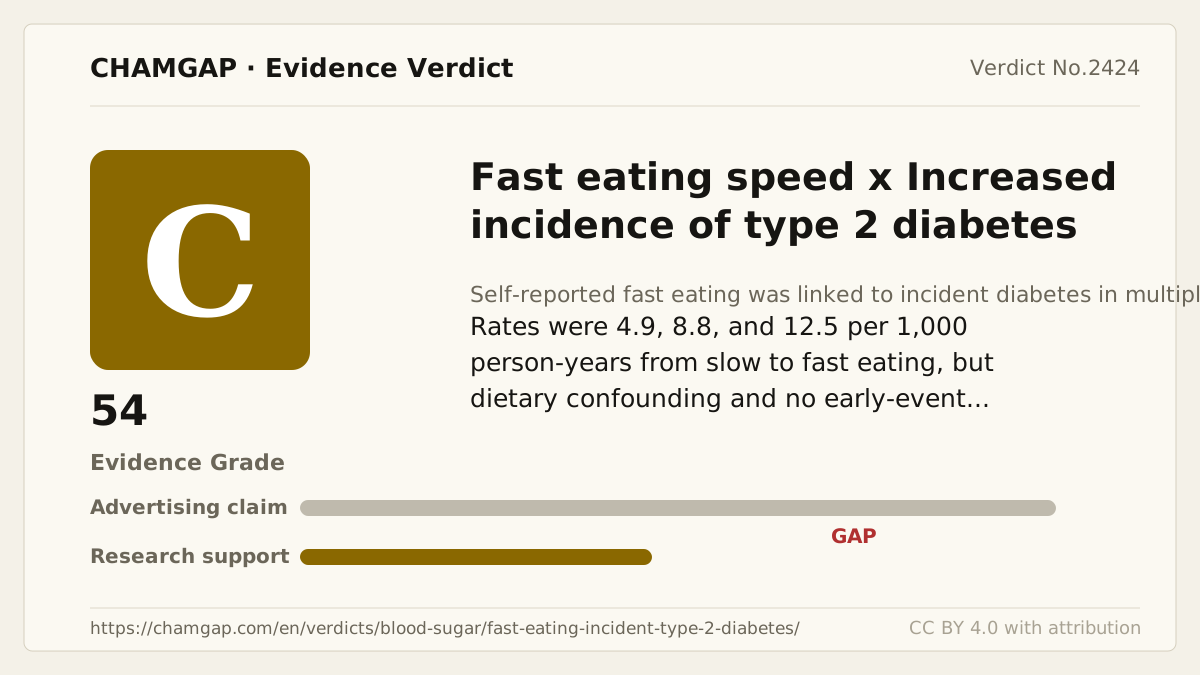
[Chamgap] Fast eating x increased type 2 diabetes incidence — Evidence Grade C·54. 3 cited sources checked. Source: https://chamgap.com/en/verdicts/blood-sugar/fast-eating-incident-type-2-diabetes/ · CC BY 4.0CC BY 4.0 — free to use with attribution; do not distort grades, numbers, or verdict meaning.
What this document does and does not do
Chamgap is an information source. It reports what research has and has not confirmed; it does not tell readers what to take or buy. That decision belongs to readers and, when needed, medical or legal professionals. This verdict reflects literature available up to the search date and may change as new research appears. Nothing here is medical advice.