
Empagliflozin,
does it really help with Reduction of kidney-disease progression or cardiovascular death in adults with chronic kidney disease at risk of progression?
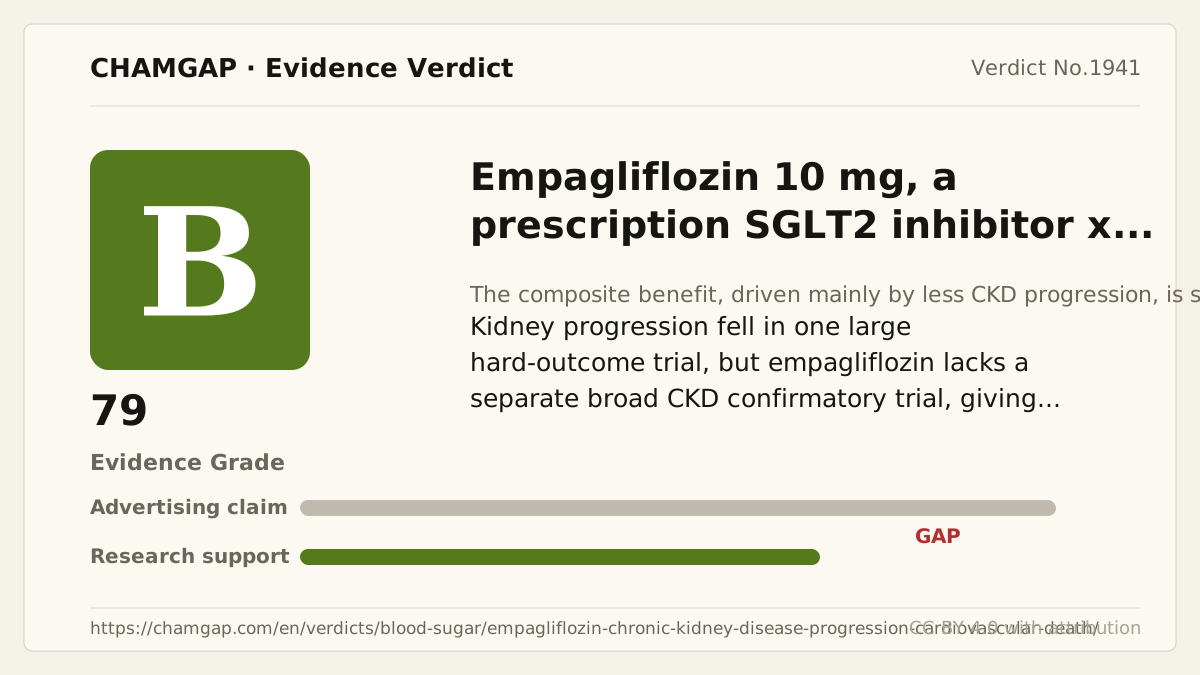
research showsThe grade is B. EMPA-KIDNEY randomized 6,609 participants, 3,304 versus 3,305, and analyzed everyone by intention to treat. The primary composite occurred in 432 versus 558, HR 0.72 (95% CI 0.64 to 0.82). Kidney-disease progression, 384 versus 504, HR 0.71 (0.62 to 0.81), effectively drove the result; cardiovascular death, 59 versus 69, HR 0.84 (0.60 to 1.19), was not significant alone. No separate broad CKD confirmatory RCT of empagliflozin exists, giving 79 points.
ads claimClaims that the drug protects both kidneys and heart should separate composite components. Kidney-progression benefit is strong, while this trial did not by itself establish cardiovascular or all-cause mortality reduction.
Useful facts when choosing a product
- Kidney-disease progression effectively drove the composite; cardiovascular death alone was nonsignificant.
- DAPA-CKD and CREDENCE provide class corroboration but are not empagliflozin replication trials.
- Evidence differs by indication: 608 is A 85 points, 1691 is B 72 points, 1865 is C 54 points, and 1921 is B 76 points.
Chamgap Semantic Classification Code
Candidate index · review held
M.empagliflozin.UNK.kidney-disease-progression-or-cardiovascular-death-with-chronic-kidney-disease-at-risk-of-progression.reduce.placeboMedicinal interventions > Empagliflozin > Unknown > kidney-disease progression or cardiovascular death with chronic kidney disease at risk of progression > Reduction claim > Placebo
An automated migration candidate, not an issued permanent code; exact claim scope remains under review. This machine-generated migration candidate helps retrieval but is not a permanent assignment. The original verdict ID and URL remain authoritative.
What the research actually shows
EMPA-KIDNEY randomized 6,609 adults with CKD, 3,304 to empagliflozin and 3,305 to placebo, and analyzed all participants as randomized. The primary composite was 432 versus 558, HR 0.72 (95% CI 0.64 to 0.82); kidney-disease progression was 384 versus 504, HR 0.71 (0.62 to 0.81); and cardiovascular death was 59 versus 69, HR 0.84 (0.60 to 1.19). Boehringer Ingelheim and Lilly funded the trial, with Oxford research organization and public research infrastructure participating. DAPA-CKD and CREDENCE studied dapagliflozin and canagliflozin, not replication of this drug. EMPA-REG OUTCOME and EMPEROR were not separate broad CKD confirmatory trials.
Why this is classified as B (76)
The large EMPA-KIDNEY hard-outcome benefit is clear, but no separate broad CKD confirmatory trial of empagliflozin exists, giving B with 76 points.
Counterpoint. Cardiovascular and all-cause death alone were not significantly reduced, so composite benefit is not assigned to every component.
Rejudgment record. Cross-check applied — Clear hard-outcome benefit in all 6,609 randomized participants, but no separate broad CKD confirmatory trial of empagliflozin; other-drug trials provide class corroboration only
| Endpoint | H | Hard endpoint - actual events such as death |
| Replication | R1 | Single confirmatory trial |
| Independence | I1 | Mixed funding sources |
| Effect size | E+ | Meets the clinically important threshold |
Stored derived and displayed grades match; this is not a current recalculation or validity check (B).
Sub-claim grades by effect
This ingredient is marketed for several effects. A single overall grade blends strong and weak claims together, so each effect is graded separately here. The overall grade reflects the strongest disconfirming or core claim.
| Effect (sub-claim) | Grade | Basis |
|---|---|---|
| Reduced kidney-disease progression or cardiovascular death | A | The primary outcome succeeded in 6,609 participants, HR 0.72. |
| Reduced cardiovascular death alone | D | The HF-hospitalization-or-CV-death composite and all-cause death were nonsignificant, so mortality benefit alone was not established. |
Cross-check — AI research and Codex final gate
Evidence Table
| Study | Design | Sample | Funding | Endpoint | Result | Weight |
|---|---|---|---|---|---|---|
| EMPA-KIDNEY Collaborative Group 2023 | Multinational double-blind placebo-controlled randomized intention-to-treat trial | 6,609 randomized and analyzed by intention to treat, 3,304 versus 3,305 | Boehringer Ingelheim regulatory sponsorship and Boehringer/Lilly funding, with Oxford MRC PHRU, MRC, and BHF public support | Primary kidney-disease progression or cardiovascular death | 432/3,304 (13.1%) versus 558/3,305 (16.9%), HR 0.72 (0.64 to 0.82), P<0.001 | Direct pivotal hard-outcome evidence |
| Heerspink et al. 2020 DAPA-CKD | Multinational double-blind placebo-controlled randomized event trial | 4,304 randomized | AstraZeneca-sponsored; a different drug, team, and program from EMPA-KIDNEY | Sustained 50% kidney-function decline, kidney failure, or kidney or cardiovascular death | HR 0.61 (0.51 to 0.72), P<0.001 | Class corroboration from a different SGLT2 inhibitor |
Receipt — 2 References
All 2 cited sources were verified for existence at the original page (as of 2026-08-02).
Final verification and publication gate: Codex · Evidence date: 2026-08-02 · Corrections: none
Cite this verdict
[Chamgap] Empagliflozin x reduced CKD progression or cardiovascular death — Evidence Grade B·76. 2 cited sources checked. Source: https://chamgap.com/en/verdicts/blood-sugar/empagliflozin-chronic-kidney-disease-progression-cardiovascular-death/ · CC BY 4.0CC BY 4.0 — free to use with attribution; do not distort grades, numbers, or verdict meaning.
What this document does and does not do
Chamgap is an information source. It reports what research has and has not confirmed; it does not tell readers what to take or buy. That decision belongs to readers and, when needed, medical or legal professionals. This verdict reflects literature available up to the search date and may change as new research appears. Nothing here is medical advice.