
Early six-hour time-restricted feeding,
does it really help with Improved insulin sensitivity with calories set to weight-maintenance needs?
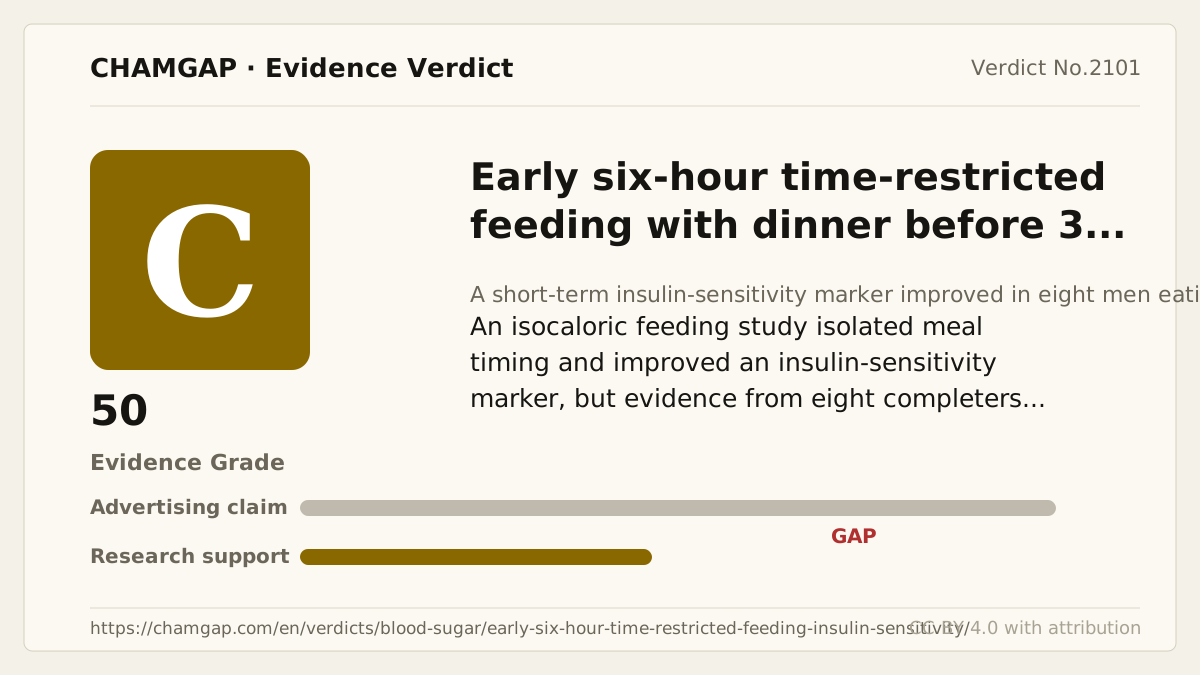
research showsThe grade is C with 54 points. In a five-week crossover trial, 12 men with prediabetes enrolled and only eight completed both conditions. With all meals calorie-matched, the three-hour incremental-AUC ratio used as an insulin-resistance index fell by 36±10 U/mg (P=0.005). The design isolated timing, but the evidence is a tiny, short completer analysis and glucose itself did not improve.
ads claimA short-term insulin marker improved when matched calories were eaten early. That does not establish lower glucose, prevention of diabetes, or fewer complications.
Useful facts when choosing a product
- The intervention used a morning six-hour eating window ending before 3 pm.
- All meals were provided and calorie-matched, and weight change did not differ significantly.
- Verdict 1647 is D with 34 points for extra weight loss from an unrestricted-calorie eight-hour window; this verdict concerns isocaloric insulin sensitivity with an early six-hour window.
Chamgap Semantic Classification Code
Candidate index · review held
D.early-time-restricted-feeding-with-dinner-before-3-pm.dietary.insulin-sensitivity-with-calories-set-to-weight-maintenance-needs.improve.UNKDietary patterns and eating practices > Early time-restricted feeding with dinner before 3 pm > Dietary regimen > insulin sensitivity with calories set to weight-maintenance needs > Improvement claim > Unknown
An automated migration candidate, not an issued permanent code; exact claim scope remains under review. This machine-generated migration candidate helps retrieval but is not a permanent assignment. The original verdict ID and URL remain authoritative.
What the research actually shows
Sutton et al. randomized 12 overweight or obese men with prediabetes in a crossover design; eight completed both five-week conditions. The early schedule placed three meals within six hours and ended before 3 pm, versus a 12-hour control window. Food, nutrients, and calories were matched. Weight change was -1.4±1.3 versus -1.0±1.1 kg, treatment effect -0.5±0.3 kg (P=0.12). The insulin-resistance index improved, while glucose did not. The trial was preregistered as NCT01895179 and used public NIH funding.
Why this is classified as C (54)
A preregistered primary endpoint and isocaloric design are strengths, but a five-week surrogate outcome in eight completers from one trial gives C with 54 points.
Counterpoint. The grade describes support for the insulin-sensitivity claim, not whether early eating is inherently good or bad.
Rejudgment record. Cross-check applied — Positive preregistered insulin-sensitivity primary endpoint in an isocaloric crossover trial, limited to eight completers, five weeks, and a surrogate marker
| Endpoint | S | Surrogate marker - laboratory or imaging measures |
| Replication | R1 | Single confirmatory trial |
| Independence | I2 | Decisive evidence is publicly or non-profit funded |
| Effect size | E+ | Meets the clinically important threshold |
Stored derived and displayed grades match; this is not a current recalculation or validity check (C).
Sub-claim grades by effect
This ingredient is marketed for several effects. A single overall grade blends strong and weak claims together, so each effect is graded separately here. The overall grade reflects the strongest disconfirming or core claim.
| Effect (sub-claim) | Grade | Basis |
|---|---|---|
| Improved insulin sensitivity from isocaloric early six-hour feeding | C | The preregistered primary endpoint was positive in eight completers. |
| Improved glucose itself | D | Glucose did not improve in the five-week trial. |
Cross-check — AI research and Codex final gate
Evidence Table
| Study | Design | Sample | Funding | Endpoint | Result | Weight |
|---|---|---|---|---|---|---|
| Sutton et al. 2018 | Randomized crossover isocaloric controlled-feeding trial | 12 enrolled; eight completed and were analyzed | Public NIH grants | Primary insulin-sensitivity endpoint derived from a three-hour OGTT | Incremental-AUC ratio treatment effect -36±10 U/mg, P=0.005; glucose did not improve | Isocaloric but extremely small single completer trial |
Receipt — 2 References
All 2 cited sources were verified for existence at the original page (as of 2026-08-03).
Final verification and publication gate: Codex · Evidence date: 2026-08-03 · Corrections: none
Cite this verdict
[Chamgap] Early six-hour time-restricted feeding x insulin sensitivity — Evidence Grade C·54. 2 cited sources checked. Source: https://chamgap.com/en/verdicts/blood-sugar/early-six-hour-time-restricted-feeding-insulin-sensitivity/ · CC BY 4.0CC BY 4.0 — free to use with attribution; do not distort grades, numbers, or verdict meaning.
What this document does and does not do
Chamgap is an information source. It reports what research has and has not confirmed; it does not tell readers what to take or buy. That decision belongs to readers and, when needed, medical or legal professionals. This verdict reflects literature available up to the search date and may change as new research appears. Nothing here is medical advice.