
Dried hijiki,
does it really help with Improved weekly mean glucose in adults with type 2 diabetes?
research showsThe grade is D with 28 points. In a five-week double-blind randomized trial of 36 overweight adults with type 2 diabetes, 5 g/day hijiki did not improve continuous-monitoring weekly mean glucose versus a 0.5-g dried-nori control. The hijiki-group mean changed from 8.2+/-2.1 to 9.0+/-0.7 mmol/L, with no significant between-group effect.
ads claimMultiplying the study batch's measured 0.45 mg/kg inorganic arsenic by 5 g dried hijiki gives 2.25 micrograms/day. This was the processed study batch, not a general commercial-hijiki value. The UK Food Standards Agency advises people not to eat hijiki, and Hong Kong's Centre for Food Safety advises avoiding its consumption and use as an ingredient. These are consumption advisories, not a comprehensive statutory ban. The safety warning and null mean-glucose result are separate facts.
Useful facts when choosing a product
- The intervention was 5 g/day dried hijiki for five weeks, not rehydrated weight.
- The test batch contained 0.45 mg/kg inorganic arsenic, about 2.25 micrograms per 5 g; general commercial values were not substituted for this measurement.
- Test-product iodine and sodium were not reported. Correcting iodine deficiency and causing thyroid dysfunction through excess are opposite claims.
Chamgap Semantic Classification Code
Candidate index · review held
F.five-grams-of-dried-sargassum-fusiforme.food.weekly-mean-glucose-with-type-2-diabetes.improve.baselineFoods and beverages > Five grams of dried Sargassum fusiforme > Food consumption > weekly mean glucose with type 2 diabetes > Improvement claim > Within-group baseline comparison
An automated migration candidate, not an issued permanent code; exact claim scope remains under review. This machine-generated migration candidate helps retrieval but is not a permanent assignment. The original verdict ID and URL remain authoritative.
What the research actually shows
Thirty-seven people consented, one failed screening, and 36 were randomized 1:1:1 to hijiki, Fucus vesiculosus, or nori control. Nine withdrew and 27 completed, while the intention-to-treat mixed model included all 36 randomized participants. The hijiki group contained 12 participants and changed from 8.2+/-2.1 to 9.0+/-0.7 mmol/L. No public trial registration number was reported; NL66189.078.18 is an ethics identifier. The study received Health~Holland public-private support, suppliers provided seaweeds, and the authors declared no conflicts of interest.
Why this is classified as D (28)
The prespecified paper-level primary mean-glucose endpoint was null in patients, but the missing between-group confidence interval prevents precise exclusion of benefit, giving D with 28 points.
Counterpoint. A larger, preregistered, longer trial with a no-seaweed control and between-group confidence intervals would be needed to narrow remaining uncertainty.
Rejudgment record. Cross-check applied — The null primary weekly-mean-glucose result from the 36-person intention-to-treat mixed model and the missing between-group interval were both applied
| Endpoint | S | Surrogate marker - laboratory or imaging measures |
| Replication | R1 | Single confirmatory trial |
| Independence | I1 | Mixed funding sources |
| Effect size | E0 | Null |
| Precision | CX | No pooled confidence interval could be confirmed |
Stored derived and displayed grades match; this is not a current recalculation or validity check (D).
Sub-claim grades by effect
This ingredient is marketed for several effects. A single overall grade blends strong and weak claims together, so each effect is graded separately here. The overall grade reflects the strongest disconfirming or core claim.
| Effect (sub-claim) | Grade | Basis |
|---|---|---|
| Improved weekly mean glucose from 5 g/day dried hijiki | D | The primary endpoint was null in the 36-person intention-to-treat mixed model. |
Cross-check — AI research and Codex final gate
Evidence Table
| Study | Design | Sample | Funding | Endpoint | Result | Weight |
|---|---|---|---|---|---|---|
| Geurts et al. 2024 | Five-week randomized double-blind nori-controlled feasibility trial | 36 randomized, 36 in intention-to-treat analysis, 27 completed; 12 assigned to hijiki | Health~Holland LSHI17004 public-private support and supplier-provided seaweeds; authors declared no conflicts of interest | Change in weekly mean continuous-monitoring glucose | Hijiki group 8.2+/-2.1 to 9.0+/-0.7 mmol/L, within-group P=0.2; no significant effect over time versus control and no between-group CI | Direct null evidence for this food and patient population |
Receipt — 2 References
All 2 cited sources were verified for existence at the original page (as of 2026-08-03).
Final verification and publication gate: Codex · Evidence date: 2026-08-03 · Corrections: none
Cite this verdict
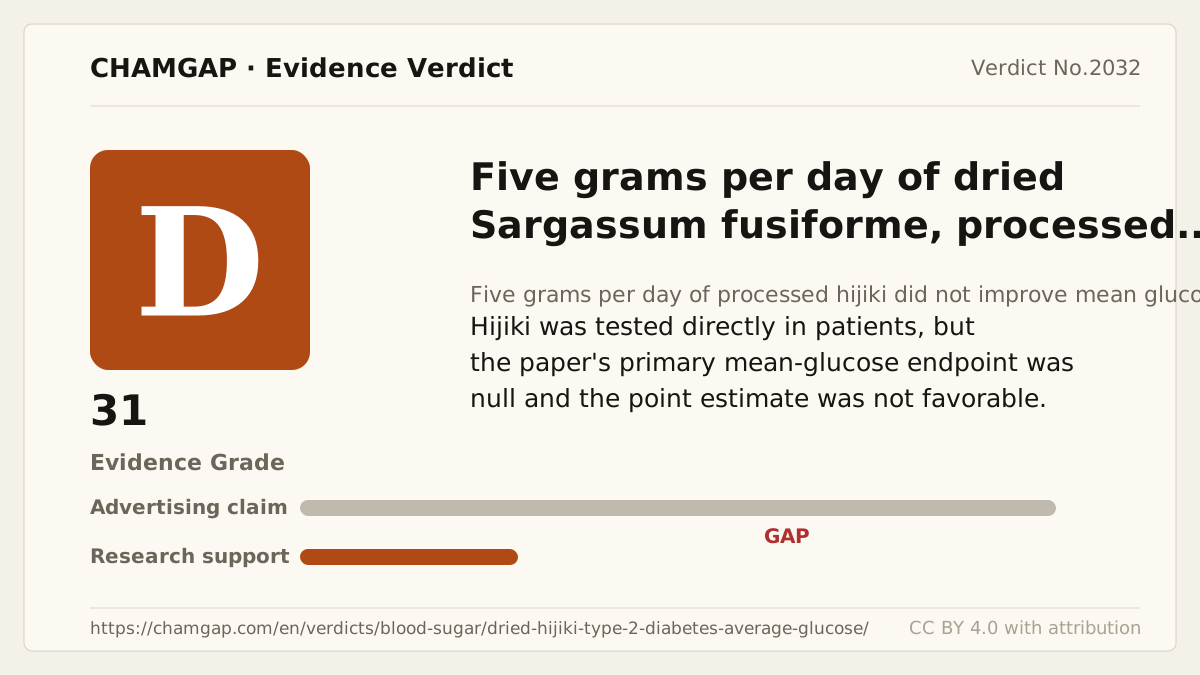
[Chamgap] Dried hijiki x improved mean glucose in type 2 diabetes — Evidence Grade D·28. 2 cited sources checked. Source: https://chamgap.com/en/verdicts/blood-sugar/dried-hijiki-type-2-diabetes-average-glucose/ · CC BY 4.0CC BY 4.0 — free to use with attribution; do not distort grades, numbers, or verdict meaning.
What this document does and does not do
Chamgap is an information source. It reports what research has and has not confirmed; it does not tell readers what to take or buy. That decision belongs to readers and, when needed, medical or legal professionals. This verdict reflects literature available up to the search date and may change as new research appears. Nothing here is medical advice.