
Dapagliflozin,
does it really help with Reduced risk of sustained 50% eGFR decline, end-stage kidney disease, and kidney or cardiovascular death in albuminuric chronic kidney disease with type 2 diabetes?
research showsDapagliflozin is rated A for reducing kidney composite events in albuminuric chronic kidney disease with type 2 diabetes. In 4,304-participant DAPA-CKD, sustained eGFR decline of at least 50%, end-stage kidney disease, or kidney or cardiovascular death occurred in 9.2% versus 14.5%, HR 0.61, and the independent data monitoring committee recommended early stopping for overwhelming efficacy. HR was 0.64 among 2,906 participants with diabetes, while a collaborative meta-analysis of 13 large trials and 90,409 participants confirmed kidney disease progression RR 0.63. The large hard-outcome effect, consistency by diabetes status, independent class synthesis, and KDIGO grade 1A recommendation firmly defend A, while the single AstraZeneca-funded pivotal trial and early stopping temper the score to A with 84 points.
ads claimMarketing can turn reduced progression risk into restoration of kidney function or universal treatment of every kidney disease. The trial reduced events in high-risk albuminuric chronic kidney disease on background renin-angiotensin system blockade; it did not reverse lost kidney function.
Useful facts when choosing a product
- Dapagliflozin is a prescription sodium-glucose cotransporter 2 inhibitor, and a common kidney-protection regimen is 10 mg once daily after checking kidney function, the indication, and the applicable label.
- DAPA-CKD enrolled eGFR 25 to 75 mL/min/1.73 m² and urinary albumin-to-creatinine ratio 200 to 5,000 mg/g, generally with a maximally tolerated angiotensin-converting enzyme inhibitor or angiotensin receptor blocker.
- Kidney function and volume status should be assessed before initiation, and temporary interruption around fasting, acute illness, or surgery should be discussed because euglycemic ketoacidosis can occur.
- It is not used for glycemic control in type 1 diabetes, and counseling should cover genital fungal infection, volume depletion or hypotension, and rare diabetic ketoacidosis.
Chamgap Semantic Classification Code
Candidate index · review held
M.dapagliflozin.UNK.risk-of-sustained-50-percent-egfr-decline-end-stage-kidney-disease-and-kidney-or-cardiovascular-death-in-albuminuric-chronic-kidney-disease-with-type-2-diabetes.reduce.placeboMedicinal interventions > Dapagliflozin > Unknown > risk of sustained 50% eGFR decline, end-stage kidney disease, and kidney or cardiovascular death in albuminuric chronic kidney disease with type 2 diabetes > Reduction claim > Placebo
An automated migration candidate, not an issued permanent code; exact claim scope remains under review. This machine-generated migration candidate helps retrieval but is not a permanent assignment. The original verdict ID and URL remain authoritative.
What the research actually shows
Heerspink 2020 reported 197 of 2,152 versus 312 of 2,152 primary events, HR 0.61, kidney-specific composite HR 0.56, and all-cause mortality HR 0.69. Wheeler 2021 reported HR 0.64 among 2,906 participants with type 2 diabetes. The Nuffield group and SGLT2 Inhibitor Meta-Analysis Cardio-Renal Trialists' Consortium synthesized 13 large trials and 90,409 participants, finding kidney disease progression RR 0.63. KDIGO 2024 recommends a sodium-glucose cotransporter 2 inhibitor with grade 1A for type 2 diabetes and chronic kidney disease with eGFR at least 20, but guidance is not counted as an efficacy trial.
Why this is classified as A (84)
DAPA-CKD combined 4,304 participants, direct kidney and mortality outcomes, HR 0.61, and a number needed to treat of 19. Consistency with and without diabetes, a 13-trial synthesis of 90,409 participants, and KDIGO grade 1A guidance make the evidence stronger than the finerenone evidence rated B and defend A. Because the pivotal evidence is one AstraZeneca-funded trial stopped early for efficacy, the prior score was overheated and is adjusted to A with 84 points. Infection, ketoacidosis, and volume depletion are separate safety issues.
Counterpoint. Protection persisted at low eGFR where glucose lowering is modest, so this is not merely an HbA1c surrogate effect. Individual kidney function, albuminuria, volume status, infection, and ketoacidosis risk still require management.
Rejudgment record. Cross-validation incorporated — Grade A was retained because DAPA-CKD randomized 4,304 participants, produced HR 0.61 and a number needed to treat of 19 for a direct hard kidney composite, was consistent with and without diabetes, and was reinforced by a 90,409-participant collaborative meta-analysis and KDIGO grade 1A guidance. The prior score was reduced to 84 because the pivotal evidence is a single AstraZeneca-funded trial stopped early for efficacy on the independent data monitoring committee's recommendation.
Sub-claim grades by effect
This ingredient is marketed for several effects. A single overall grade blends strong and weak claims together, so each effect is graded separately here. The overall grade reflects the strongest disconfirming or core claim.
| Effect (sub-claim) | Grade | Basis |
|---|---|---|
| Reduced risk of the kidney composite outcome | A | In the 4,304-participant DAPA-CKD trial, the composite of sustained at least 50% eGFR decline, end-stage kidney disease, or kidney or cardiovascular death fell by 39% relatively. |
| Reduced end-stage kidney disease and kidney-specific composite outcomes | A | The hazard ratio was 0.56 for the kidney-specific composite of sustained at least 50% eGFR decline, end-stage kidney disease, or kidney death. |
| Reduced all-cause mortality | B | All-cause mortality was reduced, but confidence is lower than for the kidney primary outcome because this was a secondary outcome in one large trial. |
Cross-check — AI research and Codex final gate
Evidence Table
| Study | Design | Sample | Funding | Endpoint | Result | Weight |
|---|---|---|---|---|---|---|
| DAPA-CKD randomized double-blind placebo-controlled trial | Event-driven multinational trial assigning patients with albuminuric chronic kidney disease to dapagliflozin 10 mg or placebo | 4,304 participants | Funded by AstraZeneca | Composite of sustained at least 50% eGFR decline, end-stage kidney disease, or kidney or cardiovascular death | The primary outcome occurred in 9.2% versus 14.5%, HR 0.61 (95% CI 0.51-0.72), with NNT 19; the trial was stopped early for overwhelming efficacy. | Very high as a large randomized trial with direct hard outcomes |
| Prespecified DAPA-CKD analysis by diabetes status | Prespecified subgroup analysis assessing consistency of treatment effect in participants with and without type 2 diabetes | 2,906 with type 2 diabetes among 4,304 participants | Funded by AstraZeneca | DAPA-CKD primary kidney and cardiovascular composite outcome | Hazard ratios were 0.64 with type 2 diabetes and 0.50 without diabetes, with no evidence of heterogeneity (interaction p=0.24). | Strengthens population relevance and consistency |
| Large collaborative meta-analysis of SGLT2 inhibitor trials | Study-level meta-analysis of 13 large placebo-controlled trials | 90,409 participants | Supported by the UK Medical Research Council and Kidney Research UK; component trials included industry funding | Kidney disease progression and acute kidney injury | The relative risk for kidney disease progression was 0.63 (95% CI 0.58-0.69), with consistent benefit irrespective of diabetes status. | Strongly reinforces class effect and consistency in a very large sample |
| KDIGO 2024 chronic kidney disease guideline | International clinical practice guideline based on systematic evidence review | Not applicable | KDIGO | Recommendation for SGLT2 inhibition to reduce CKD progression and cardiovascular risk | SGLT2 inhibitor treatment was recommended at grade 1A for type 2 diabetes with CKD and eGFR at least 20 mL/min/1.73 m². | Supports clinical applicability but is not itself an efficacy trial |
Receipt — 4 References
All 4 cited sources were verified for existence at the original page (as of 2026-07-21).
Final verification and publication gate: Codex · Evidence date: 2026-07-21 · Corrections: none
Cite this verdict
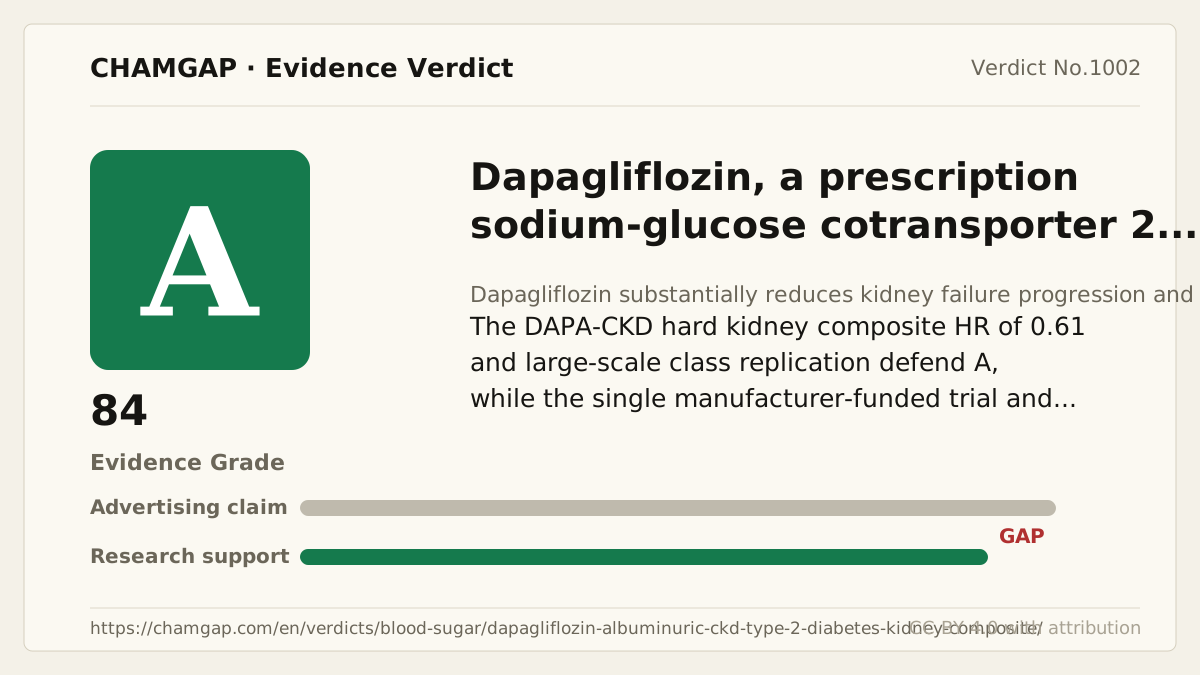
[Chamgap] Dapagliflozin x reduced kidney composite events in albuminuric chronic kidney disease — Evidence Grade A·84. 4 cited sources checked. Source: https://chamgap.com/en/verdicts/blood-sugar/dapagliflozin-albuminuric-ckd-type-2-diabetes-kidney-composite/ · CC BY 4.0CC BY 4.0 — free to use with attribution; do not distort grades, numbers, or verdict meaning.
What this document does and does not do
Chamgap is an information source. It reports what research has and has not confirmed; it does not tell readers what to take or buy. That decision belongs to readers and, when needed, medical or legal professionals. This verdict reflects literature available up to the search date and may change as new research appears. Nothing here is medical advice.