
Daily foot self-inspection,
does it really help with Independent prevention of foot lesions or ulceration?
research showsThe grade is D. In a 12-month multicomponent trial, serious foot lesions were 7/176 versus 16/175, OR 0.41 (95% CI 0.16-1.00), but education, reminders, and clinician examinations prevent isolation of daily inspection. All foot lesions, OR 0.65 (0.36-1.17), and amputations, OR 0.32 (0.05-1.86), were null. A cohort reanalysis also found no independent prediction by self-inspection frequency, giving D with 30 points.
ads claimA recommendation to check daily is not proof that this action alone lowers ulcer incidence. Marketing should not convert a package combining education, footwear, moisturizing, professional examination, and rapid care into a self-inspection-only effect.
Useful facts when choosing a product
- Foot self-inspection means visually checking daily for sores, blisters, redness, cracks, and color changes.
- The verified Litzelman citation is PMID 8498761 and DOI 10.7326/0003-4819-119-1-199307010-00006. The target memo's PMID 8512161 and DOI ending 00009 did not match the primary report.
- Existing verdicts 1933, 1936, and 2420 address adjacent diabetic-foot treatment or recurrence prevention, not primary prevention by daily self-inspection alone. The corrected pivotal PMID and DOI were not duplicated in an existing verdict.
Chamgap Semantic Classification Code
Candidate index · review held
UNK.foot-self-inspection-by-people-with-diabetes.UNK.independent-prevention-of-foot-lesions-or-ulceration.prevent.UNKUnknown > foot self-inspection by people with diabetes > Unknown > Independent prevention of foot lesions or ulceration > Occurrence-prevention claim > Unknown
An automated migration candidate, not an issued permanent code; exact claim scope remains under review. This machine-generated migration candidate helps retrieval but is not a permanent assignment. The original verdict ID and URL remain authoritative.
What the research actually shows
Suico treated 295 participants from the parent multicomponent trial as a prospective cohort and reassessed 253 after one year. Fifty-three people had 63 foot-lesion outcomes. Self-examination, barefoot behavior, assistance, and healthcare use were modeled with physiologic risk factors. Only infrequent moisturizing remained among behaviors in the final model; self-inspection frequency did not independently predict lesions. Behaviors were not randomized and were largely self-reported, and wounds were assessed only at baseline and endpoint, preventing accurate separation of incident from healed intervening wounds. The inspection-specific estimate and CI could not be reconstructed from public material.
Why this is classified as D (30)
Human foot-lesion data exist, but inspection frequency had a null independent association and its estimate and interval were not verified. The randomized multicomponent trial cannot isolate inspection, while the observational reanalysis had nonrandom exposure and could not determine lesion timing accurately. One hard-outcome strength gives D with 30 points.
Counterpoint. Daily inspection is a low-cost, low-risk early-detection behavior, so D does not mean stop doing it. It means its independent occurrence-prevention effect is unestablished.
Rejudgment record. Cross-check applied — We cross-checked the Litzelman primary citation and abstract, Suico public full text, and systematic reviews for the multicomponent intervention, denominators, cluster analysis, behavior model, and lesion definition.
| Endpoint | H | Hard endpoint - actual events such as death |
| Replication | R1 | Single confirmatory trial |
| Independence | I1 | Mixed funding sources |
| Effect size | E0 | Null |
| Precision | CX | No pooled confidence interval could be confirmed |
Stored derived and displayed grades match; this is not a current recalculation or validity check (D).
Sub-claim grades by effect
This ingredient is marketed for several effects. A single overall grade blends strong and weak claims together, so each effect is graded separately here. The overall grade reflects the strongest disconfirming or core claim.
| Effect (sub-claim) | Grade | Basis |
|---|---|---|
| Daily foot self-inspection independently prevents diabetic foot ulcer occurrence. | D | The behavior analysis found no independent association, and the multicomponent trial could not isolate inspection. |
| A multicomponent foot-care program reduces serious foot lesions. | C | OR was 0.41, but clustering was not accounted for and multiple components changed together. |
Cross-check — AI research and Codex final gate
Evidence Table
| Study | Design | Sample | Funding | Endpoint | Result | Weight |
|---|---|---|---|---|---|---|
| Litzelman et al., Ann Intern Med 1993 | Masked cluster-randomized multicomponent foot-care trial | Primary abstract: 395 initially assessed and 352 completed; later table allocation 191/205; serious-lesion event analysis 176/175 | Complete primary-paper funding statement not verified | Serious foot lesions and foot-care behavior at 12 months | Serious foot lesions 7/176 versus 16/175, OR 0.41 (95% CI 0.16-1.00); all foot lesions OR 0.65 (0.36-1.17) and amputations OR 0.32 (0.05-1.86) were null; clustering not accounted for | Background trial unable to isolate self-inspection |
| Suico et al., J Gen Intern Med 1998 | Prospective cohort behavior reanalysis of parent randomized-trial data | 253 of a 295-person cohort reassessed at one year; 63 lesion outcomes in 53 patients | VA Health Services Research and Development Service, Regenstrief, and CDC affiliations were verified, but the complete funding statement was not | Foot lesions rated at least 1.2 on the Seattle classification | Self-inspection frequency was not an independent predictor in the final multivariable model; behavior-specific OR and CI were not verified | Direct null evidence for the independent self-inspection effect |
Receipt — 2 References
Of 2 cited sources, 1 had limited original-page access (blocked or summary-only) and were verified via index/summary, marked partial; the rest were verified at the original page. As of 2026-08-14.
Final verification and publication gate: Codex · Evidence date: 2026-08-14 · Corrections: none
Cite this verdict
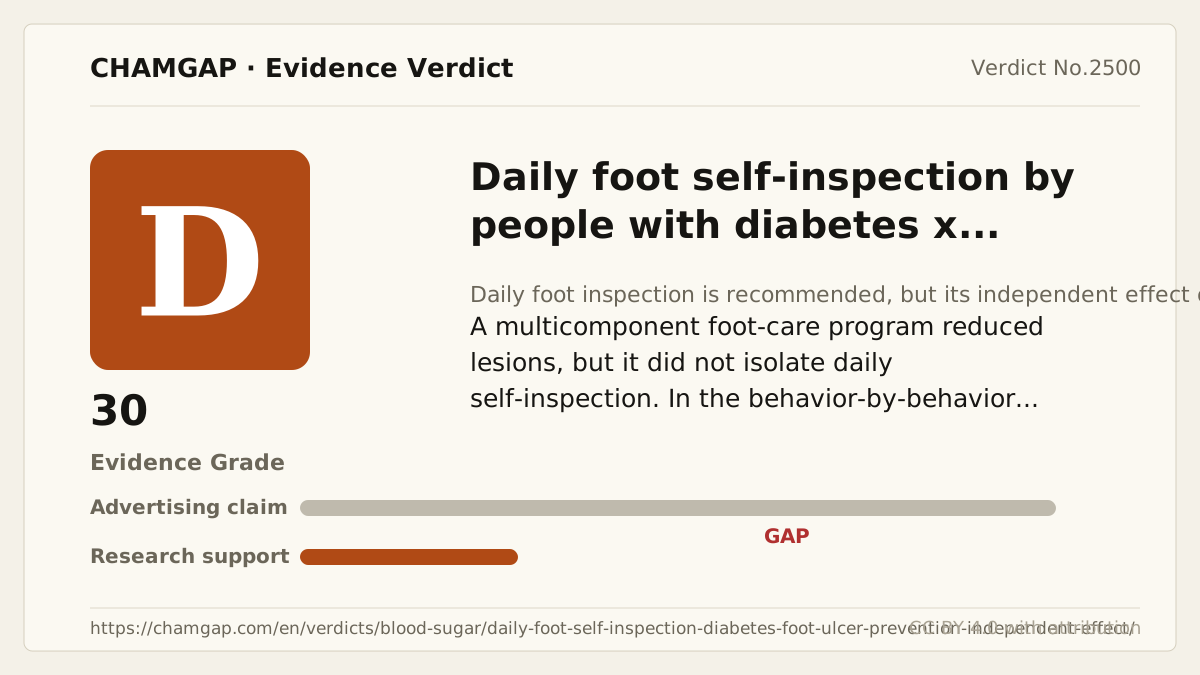
[Chamgap] Daily foot self-inspection x prevention of diabetic foot ulceration — Evidence Grade D·30. 2 cited sources checked. Source: https://chamgap.com/en/verdicts/blood-sugar/daily-foot-self-inspection-diabetes-foot-ulcer-prevention-independent-effect/ · CC BY 4.0CC BY 4.0 — free to use with attribution; do not distort grades, numbers, or verdict meaning.
What this document does and does not do
Chamgap is an information source. It reports what research has and has not confirmed; it does not tell readers what to take or buy. That decision belongs to readers and, when needed, medical or legal professionals. This verdict reflects literature available up to the search date and may change as new research appears. Nothing here is medical advice.