
D-glucose or dextrose,
does it really help with Correction of symptomatic nonsevere hypoglycemia within 15 minutes in a conscious person with diabetes?
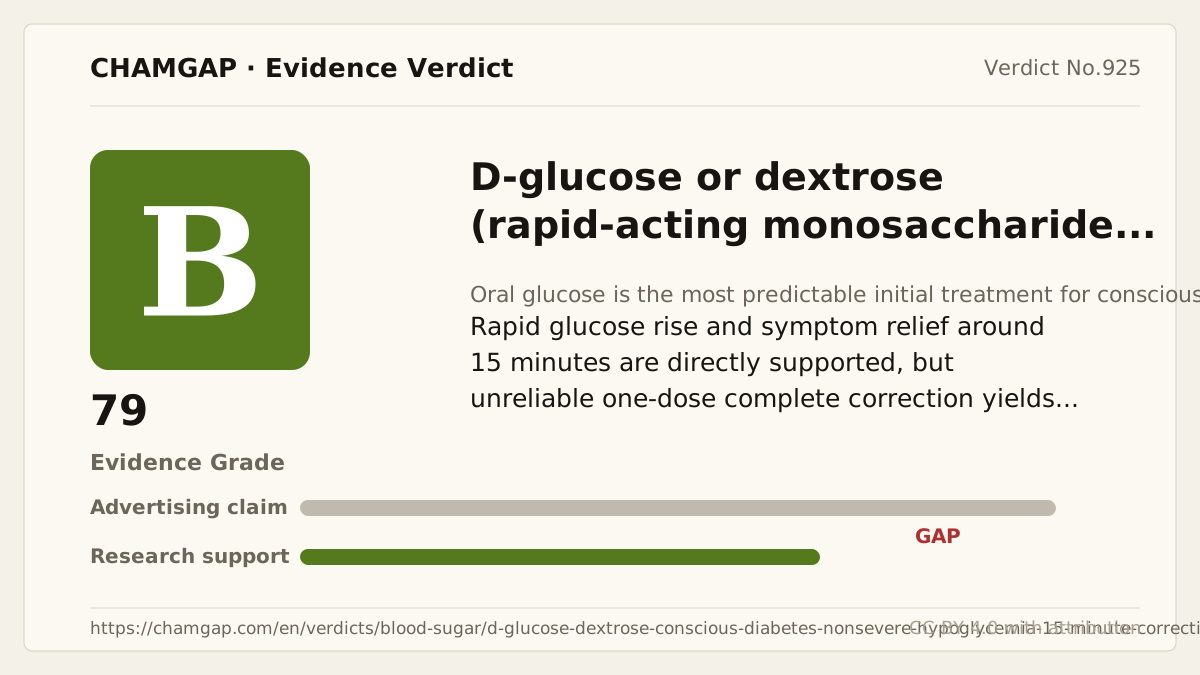
research showsOral D-glucose is the standard rapid treatment for symptomatic nonsevere hypoglycemia in a conscious person with diabetes who can swallow. The ADA-style rule of 15 is a stepwise process: ingest 15 to 20 g of fast-acting carbohydrate, recheck glucose after 15 minutes, and repeat treatment if it remains low. It is not a promise of complete correction after one dose. In a 41-person induced-hypoglycemia comparison, 15 g of glucose tablets or solution rapidly raised glucose and relieved symptoms in about 14 minutes on average. In a 2023 randomized crossover trial in adults with type 1 diabetes, however, only 19% to 21% achieved full correction at 15 minutes after one 16-g dose, depending on starting glucose, and a 2026 systematic review confirmed a small evidence base and variable responses. The stepwise recheck-and-repeat treatment therefore receives B with 79 points.
ads claimProduct promotion can simplify the evidence into guaranteed normalization in 15 minutes or imply that more is always safer. Glucose should be rechecked after 15 minutes and repeated if necessary, users of automated insulin delivery may require less, and excess treatment can cause rebound hyperglycemia.
Useful facts when choosing a product
- Oral glucose should be given only to a person who is alert and can swallow safely; nothing should be given by mouth during impaired consciousness, seizure, or inability to swallow.
- A common initial amount is 15 g of glucose followed by rechecking after 15 minutes and repeating if still low, but individualized amounts may apply in children, automated-insulin-delivery users, or situations with little active insulin.
- Foods high in fat or protein can delay glucose absorption and are unsuitable for initial correction, while a follow-up snack may be needed if the next meal is distant.
- Repeated excessive intake can cause rebound hyperglycemia, and hypoglycemia caused by a sulfonylurea or long-acting insulin can recur and require prolonged observation and medical advice.
Chamgap Semantic Classification Code
Candidate index · review held
M.d-glucose-or-dextrose.UNK.correction-of-symptomatic-nonsevere-hypoglycemia-within-in-a-conscious-person-with-diabetes.assess.UNKMedicinal interventions > D-glucose or dextrose > Unknown > Correction of symptomatic nonsevere hypoglycemia within in a conscious person with diabetes > Association or change assessment > Unknown
An automated migration candidate, not an issued permanent code; exact claim scope remains under review. This machine-generated migration candidate helps retrieval but is not a permanent assignment. The original verdict ID and URL remain authoritative.
What the research actually shows
The ADA-style rule of 15 is a stepwise treatment: ingest 15 to 20 g of fast-acting carbohydrate, recheck glucose after 15 minutes, and repeat ingestion if it remains low. Slama induced symptomatic hypoglycemia with intravenous insulin in 41 people with type 1 diabetes and compared 15 g each of glucose or sucrose tablets, solutions, or gel, a starch hydrolysate, and orange juice. Glucose tablets and solution produced a rapid glucose rise and symptom relief at about 14 minutes, but this did not guarantee complete correction after one dose. The Carlson meta-analysis pooled three randomized trials with 725 events and found lower 15-minute symptom resolution with dietary sugars than with glucose tablets (RR 0.89, 95% CI 0.83 to 0.95). Taleb gave 16 g or 32 g of glucose tablets to 32 adults with type 1 diabetes; complete correction 15 minutes after one 16-g dose was only 19% to 21%, depending on starting glucose, and retreatment was common. The Prince 2026 systematic review found variable first-recheck resolution by insulin-delivery method and a limited foundation for the traditional 15-g rule.
Why this is classified as B (79)
Direct comparison and meta-analysis support a rapid rise in glucose and symptom relief with oral glucose, and physiologic correction is the treatment goal rather than a remote surrogate. The standard is stepwise ingestion of 15 to 20 g followed by a 15-minute recheck and repetition if needed. Comparative trials are small, however, and a modern crossover trial plus a 2026 review found substantial variability in one-dose full correction and dose requirements. Stepwise treatment therefore receives B with 79 points, not a guarantee of one-dose normalization. Unsuitability of oral treatment in severe hypoglycemia is a separate safety boundary.
Counterpoint. When glucose is at or below 70 mg/dL or typical symptoms occur and the person can self-treat, glucose tablets or solution are the most predictable initial option. If recovery has not occurred after 15 minutes or consciousness worsens, repeated oral dosing alone is inadequate and glucagon or emergency care may be required.
Rejudgment record. Cross-check revision — Accepted the direct rapid glucose rise and symptom relief around 15 minutes with oral glucose, but applied upper-B because the traditional 15-g/15-minute rule rests on small induced-hypoglycemia studies and modern randomized crossover evidence plus a 2026 review show substantial variability in one-dose full correction and required dose
Sub-claim grades by effect
This ingredient is marketed for several effects. A single overall grade blends strong and weak claims together, so each effect is graded separately here. The overall grade reflects the strongest disconfirming or core claim.
| Effect (sub-claim) | Grade | Basis |
|---|---|---|
| Rapid glucose rise with oral glucose during nonsevere hypoglycemia in a conscious person with diabetes | B | Direct comparison showed a rise from ten minutes, but samples were small and responses vary with modern insulin-delivery methods. |
| Relief of hypoglycemia symptoms about 15 minutes after oral glucose | B | Mean symptom relief around 14 minutes and a 15-minute meta-analytic advantage are positive but do not mean complete resolution of every event. |
| Stepwise correction of nonsevere hypoglycemia with rechecking at 15 minutes and repetition when needed | B | This standard treatment uses 15 to 20 g followed by a 15-minute recheck and repetition if glucose remains low; complete correction with one fixed dose is low and variable according to starting glucose and active insulin. |
Cross-check — AI research and Codex final gate
Evidence Table
| Study | Design | Sample | Funding | Endpoint | Result | Weight |
|---|---|---|---|---|---|---|
| Slama G et al. 1990 | Within-person comparison of oral carbohydrates during induced hypoglycemia | 41 insulin-treated people with type 1 diabetes | Inadequately reported; comparison of medical carbohydrate formulations | Glucose rise at 10, 15, and 20 minutes and time to clinical symptom relief | Fifteen grams of glucose tablets or solution rapidly raised glucose and relieved symptoms in about 14 minutes on average. | Direct foundational trial for the 15-g/15-minute approach |
| Carlson JN et al. 2017 | Systematic review and meta-analysis | Three randomized trials with 223 glucose-tablet and 502 dietary-sugar events plus 22 events in one observational study | Independent emergency-medicine and Red Cross researchers with no commercial funding reported | Symptom resolution at 15 minutes, blood glucose, and complications | Dietary sugars had lower symptom resolution at 15 minutes than glucose tablets (RR 0.89, 95% CI 0.83 to 0.95). | Synthesis of formulation-comparison evidence |
| Taleb N et al. 2023 | Randomized four-way open-label crossover trial | 32 adults with type 1 diabetes | Public research grants from the Canadian Institutes of Health Research | Complete correction at 15 minutes and retreatment with 16 g versus 32 g of glucose at two starting glucose ranges | Complete correction with 16 g was 19% to 21%; even 32 g corrected 24% of deeper episodes, and retreatment was common. | Direct randomized evidence limiting one-dose 15-minute complete correction |
| Prince NL et al. 2026 | Systematic review of oral treatment for nonsevere hypoglycemia in type 1 diabetes | Synthesis of oral-carbohydrate studies by insulin-delivery method | Public and academic investigators with study-level funding assessment | Resolution of nonsevere hypoglycemia at the first glucose recheck | Confirmed that the 15-g recommendation rests mainly on small induced studies and expert opinion and that first-recheck resolution varies by treatment technology. | Current synthesis of evidence-base limitations |
Receipt — 4 References
All 4 cited sources were verified for existence at the original page (as of 2026-07-21).
Final verification and publication gate: Codex · Evidence date: 2026-07-21 · Corrections: none
Cite this verdict
[Chamgap] D-glucose or dextrose x 15-minute correction of nonsevere hypoglycemia in a conscious person with diabetes — Evidence Grade B·79. 4 cited sources checked. Source: https://chamgap.com/en/verdicts/blood-sugar/d-glucose-dextrose-conscious-diabetes-nonsevere-hypoglycemia-15-minute-correction/ · CC BY 4.0CC BY 4.0 — free to use with attribution; do not distort grades, numbers, or verdict meaning.
What this document does and does not do
Chamgap is an information source. It reports what research has and has not confirmed; it does not tell readers what to take or buy. That decision belongs to readers and, when needed, medical or legal professionals. This verdict reflects literature available up to the search date and may change as new research appears. Nothing here is medical advice.