
Curcumin extract,
does it really help with Delay or prevention of type 2 diabetes in adults with prediabetes?
research showsCurcumin extract is rated C because one direct randomized trial found fewer diagnoses of type 2 diabetes over nine months in adults with prediabetes. The 2012 Thai trial enrolled 240 participants, randomized 237, and was completed by 235; diabetes developed in 0 of 119 completers assigned to curcumin and 19 of 116 assigned to placebo, or 16.4%. This unusually large effect, however, comes from one country, one research group, and one extract, and it has not been replicated in a large independent prevention trial over the ensuing fourteen years. Recent meta-analyses showing changes in fasting glucose and glycated hemoglobin combine different populations and formulations and address surrogate outcomes, so they do not fill that gap.
ads claimMarketing expands a nine-month study of one extract into a claim that every turmeric powder, curcumin capsule, or enhanced-bioavailability formulation prevents diabetes. Curcuminoid content and exposure vary markedly among products, and no evidence shows that supplementation can replace lifestyle change or established prevention options for people at high risk.
Useful facts when choosing a product
- The pivotal trial used standardized curcuminoid capsules at 1.5 g per day for nine months rather than turmeric as an ordinary food. Commercial products are not necessarily compositionally equivalent.
- Oral curcumin has low bioavailability, and systemic exposure changes substantially with formulation, coadministration with fat, and the addition of piperine. Results from one formulation cannot automatically be transferred to another.
- Supplement doses are generally tolerated, but heartburn, abdominal discomfort, diarrhea, and nausea can occur, and rare liver injury has been reported.
- Enhanced-bioavailability products containing piperine can alter drug metabolism. People using anticoagulants, antiplatelet drugs, glucose-lowering medicines, or multiple medications, and those with gallbladder or liver disease, should seek clinical advice.
Chamgap Semantic Classification Code
Candidate index · review held
S.curcumin-extract.UNK.delay-or-prevention-of-type-2-diabetes-with-prediabetes.prevent.placeboSupplements and nutraceuticals > Curcumin extract > Unknown > Delay or prevention of type 2 diabetes with prediabetes > Occurrence-prevention claim > Placebo
An automated migration candidate, not an issued permanent code; exact claim scope remains under review. This machine-generated migration candidate helps retrieval but is not a permanent assignment. The original verdict ID and URL remain authoritative.
What the research actually shows
Participant flow in the 2012 Thai trial was 240 adults with prediabetes enrolled, 237 randomized, and 235 completed. Randomized participants were assigned under double masking to curcuminoids at 1.5 g per day or placebo for nine months; diabetes developed in 0 of 119 curcumin completers and 19 of 116 placebo completers. Fasting glucose, glycated hemoglobin, HOMA-IR, and measures of beta-cell function also improved. Thai traditional-medicine public funds supported the study, and the Thai Government Pharmaceutical Organization supplied the active product and placebo. A 2023 meta-analysis of 59 randomized trials reported average improvements of about 4.6 mg/dL in fasting glucose and 0.32 percentage points in glycated hemoglobin across varied adult populations, but it did not synthesize diabetes incidence. The prevention claim therefore still rests on the 2012 trial.
Why this is classified as C (50)
The randomized trial measured diabetes incidence directly, but the evidence remains largely dependent on one 240-person, nine-month study of one extract in one country. There is no large independent replication, while synthesis evidence chiefly concerns glycemic surrogates. Applying the single-trial and surrogate-outcome ceilings gives C with 50 points.
Counterpoint. Weight management, diet, physical activity, and regular glycemic monitoring remain the foundation of prediabetes care. Anyone choosing curcumin should not treat it as a substitute for prevention care and should verify the formulation and potential medication interactions.
Rejudgment record. Cross-check applied — Accepted the large positive signal from the 237-person randomized trial that directly measured type 2 diabetes incidence, but applied the C ceiling because it remains a single-country, single-extract, single-team result without large independent incidence replication and later synthesis evidence chiefly concerns glycemic surrogates
Sub-claim grades by effect
This ingredient is marketed for several effects. A single overall grade blends strong and weak claims together, so each effect is graded separately here. The overall grade reflects the strongest disconfirming or core claim.
| Effect (sub-claim) | Grade | Basis |
|---|---|---|
| Delay or prevention of type 2 diabetes in adults with prediabetes | C | The nine-month direct-incidence trial was strongly positive, but it was a single 240-person study without large independent replication. |
| Improvement of glycemic markers in adults with prediabetes or dysglycemia | C | Meta-analysis found small average improvements in fasting glucose and glycated hemoglobin, but heterogeneity was substantial and the outcomes were surrogates. |
| Replicable diabetes prevention across curcumin formulations | D | No large independent trial has replicated the incidence result across other formulations. |
Cross-check — AI research and Codex final gate
Evidence Table
| Study | Design | Sample | Funding | Endpoint | Result | Weight |
|---|---|---|---|---|---|---|
| Chuengsamarn S et al. 2012 | Randomized double-blind placebo-controlled trial | 240 adults with prediabetes enrolled; 237 randomized; 235 completed | Thai traditional-medicine public funding; the Thai Government Pharmaceutical Organization supplied active product and placebo | Nine-month type 2 diabetes incidence and glycemic, beta-cell, and insulin-resistance measures | Diabetes developed in 0 of 119 curcumin recipients and 19 of 116 placebo recipients, or 16.4%, with favorable changes in several glycemic measures. | Pivotal direct incidence evidence, but a single trial |
| Dehzad MJ et al. 2023 | GRADE-assessed systematic review and dose-response meta-analysis | 59 randomized trials in adults | Inadequately reported; academic meta-analysis | Fasting glucose, fasting insulin, glycated hemoglobin, and HOMA-IR | Curcumin or turmeric produced average improvements of about 4.6 mg/dL in fasting glucose and 0.32 percentage points in glycated hemoglobin, but diabetes incidence was not synthesized and populations and formulations were heterogeneous. | Supporting evidence for glycemic surrogates |
Receipt — 2 References
All 2 cited sources were verified for existence at the original page (as of 2026-07-23).
Final verification and publication gate: Codex · Evidence date: 2026-07-23 · Corrections: none
Cite this verdict
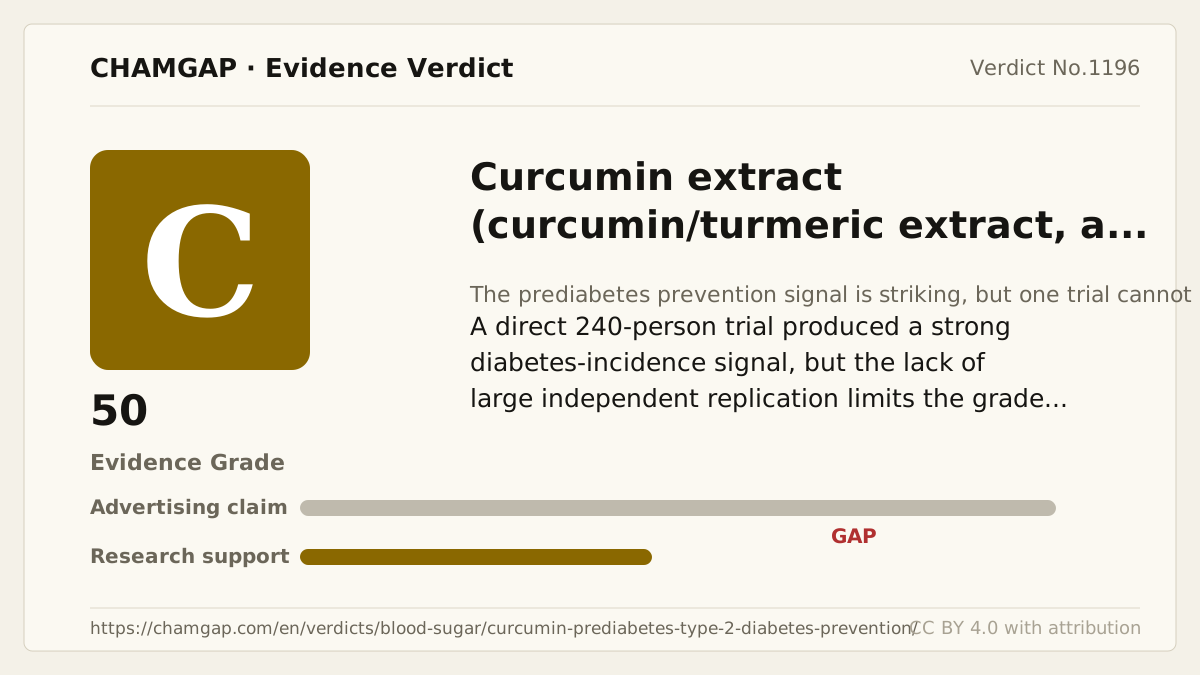
[Chamgap] Curcumin extract x delaying or preventing type 2 diabetes in adults with prediabetes — Evidence Grade C·50. 2 cited sources checked. Source: https://chamgap.com/en/verdicts/blood-sugar/curcumin-prediabetes-type-2-diabetes-prevention/ · CC BY 4.0CC BY 4.0 — free to use with attribution; do not distort grades, numbers, or verdict meaning.
What this document does and does not do
Chamgap is an information source. It reports what research has and has not confirmed; it does not tell readers what to take or buy. That decision belongs to readers and, when needed, medical or legal professionals. This verdict reflects literature available up to the search date and may change as new research appears. Nothing here is medical advice.