
Cumin,
does it really help with Reduced fasting glucose and HbA1c as an adjunct in type 2 diabetes?
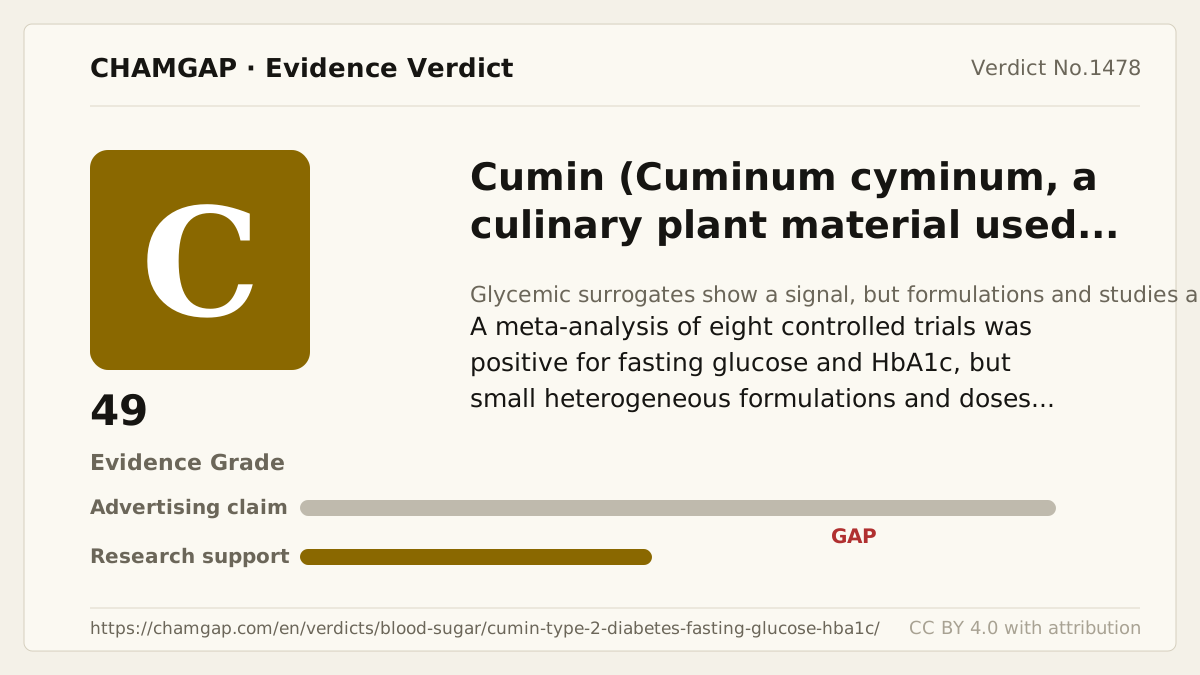
research showsCumin is rated C because adjunctive use may lower fasting glucose and HbA1c in type 2 diabetes. A 2021 meta-analysis of eight controlled trials reported significant reductions in both measures, but studies were small and differed in populations, doses, and formulations such as seeds, powder, oil, and essential oil. The surrogate glycemic signal is accepted, while evidence for complications, hospitalization, or mortality is absent.
ads claimMarketing expands possible short-term changes in glucose values into diabetes treatment, medication reduction, and prevention of complications. Cumin does not replace standard care, and different formulations cannot be assumed equivalent.
Useful facts when choosing a product
- Cumin is the seed of Cuminum cyminum used as a spice; supplements may contain powder, extract, oil, or essential oil, which are materially different formulations.
- Food-level use is generally well tolerated, while concentrated supplements may cause gastrointestinal symptoms or allergy. People using glucose-lowering medicines should monitor for possible hypoglycemia.
- People taking anticoagulant or antiplatelet medicines and those who are pregnant should avoid unsupervised concentrated high-dose products and seek professional advice.
- Cumin, Cuminum cyminum, is entirely distinct from curcumin and turmeric, Curcuma longa, addressed in verdict 064.
Chamgap Semantic Classification Code
Candidate index · review held
S.cumin.UNK.fasting-glucose-and-hba1c-as-an-adjunct-in-type-2-diabetes.reduce.UNKSupplements and nutraceuticals > Cumin > Unknown > fasting glucose and HbA1c as an adjunct in type 2 diabetes > Reduction claim > Unknown
An automated migration candidate, not an issued permanent code; exact claim scope remains under review. This machine-generated migration candidate helps retrieval but is not a permanent assignment. The original verdict ID and URL remain authoritative.
What the research actually shows
Tavakoli-Rouzbehani and colleagues in 2021 synthesized eight controlled trials through May 2021 and reported significant reductions in fasting blood sugar and HbA1c. The analysis included different cumin formulations and diverse chronic-disease populations, with substantial heterogeneity for some effects. Ghatreh Samani and colleagues randomized 95 patients with diabetes to cumin essential oil, vitamin E, or control and reported an HbA1c signal, but this was one small study and the essential-oil formulation differs from ordinary powder. Overall, glycemic surrogates show limited consistency, while long-term complication data are unavailable.
Why this is classified as C (49)
A meta-analysis of eight controlled trials found significant reductions in fasting glucose and HbA1c, supporting a positive surrogate signal across several small studies. Heterogeneous formulations, doses, durations, and populations, small samples, and no hard outcomes limit the grade to C with 49 points.
Counterpoint. Cumin can be considered only as an adjunct to standard diabetes care, diet, and activity; glucose should be monitored and medication changes require clinical supervision.
Rejudgment record. New verdict — Accepted significant fasting-glucose and HbA1c reductions in the eight-trial controlled-study meta-analysis under boundary rule ③ for consistent surrogate signals across several small trials, while limiting the grade to C for heterogeneous formulations, doses, durations, populations, and absence of hard outcomes
Sub-claim grades by effect
This ingredient is marketed for several effects. A single overall grade blends strong and weak claims together, so each effect is graded separately here. The overall grade reflects the strongest disconfirming or core claim.
| Effect (sub-claim) | Grade | Basis |
|---|---|---|
| Reduced fasting glucose | C | A significant reduction was reported across eight controlled trials, but formulations and doses were heterogeneous. |
| Reduced HbA1c | C | The meta-analysis and some small trials were positive, but precision and generalizability are limited. |
| Prevention of diabetes complications | C | Research addresses glycemic surrogates, with no evidence evaluating complications, hospitalization, or mortality. |
Cross-check — AI research and Codex final gate
Evidence Table
| Study | Design | Sample | Funding | Endpoint | Result | Weight |
|---|---|---|---|---|---|---|
| Tavakoli-Rouzbehani OM et al. 2021 | Systematic review and meta-analysis of controlled clinical trials | Eight controlled trials | Academic research as reported by the article | Fasting glucose, HbA1c, insulin, and HOMA measures | Significant reductions in fasting glucose and HbA1c were reported, with heterogeneity in formulations, doses, and populations. | Key surrogate-outcome synthesis |
| Ghatreh Samani K et al. 2016 | Randomized double-blind three-arm clinical trial | 95 patients with diabetes | Academic research associated with Shahrekord University of Medical Sciences | HbA1c, leptin, PON1, oxidized LDL, and lipids | The cumin-essential-oil group showed signals in HbA1c and related measures, but this was one small trial using a formulation distinct from ordinary powder. | Supporting direct evidence |
Receipt — 2 References
All 2 cited sources were verified for existence at the original page (as of 2026-07-23).
Final verification and publication gate: Codex · Evidence date: 2026-07-23 · Corrections: none
Cite this verdict
[Chamgap] Cumin x reduced fasting glucose and HbA1c in type 2 diabetes — Evidence Grade C·49. 2 cited sources checked. Source: https://chamgap.com/en/verdicts/blood-sugar/cumin-type-2-diabetes-fasting-glucose-hba1c/ · CC BY 4.0CC BY 4.0 — free to use with attribution; do not distort grades, numbers, or verdict meaning.
What this document does and does not do
Chamgap is an information source. It reports what research has and has not confirmed; it does not tell readers what to take or buy. That decision belongs to readers and, when needed, medical or legal professionals. This verdict reflects literature available up to the search date and may change as new research appears. Nothing here is medical advice.