
Cooled and reheated rice,
does it really help with Reduced acute postprandial glycemic response?
research showsThe grade is C with 50 points. Resistant starch in the tested IR-64 rice increased from 0.64 g/100 g when freshly cooked to 1.65 g/100 g after 24 hours at 4°C and reheating; that is a measured composition fact. In 14 healthy adults with usable glucose data, two-hour glucose iAUC fell from 152±48.3 to 125±50.1 mmol·min/L (P=0.047). This tiny acute surrogate study does not establish long-term diabetes control.
ads claimThe evidence supports more resistant starch and a lower glycemic curve at that meal. Diabetes prevention and long-term glycemic improvement require separate long-term trials.
Useful facts when choosing a product
- Measured resistant starch was 0.64 g/100 g freshly cooked, 1.30 after 10 hours at room temperature, and 1.65 after 24 hours at 4°C plus reheating.
- The study used IR-64 rice and reheated the refrigerated rice with 240 mL water in a rice cooker for about 15 minutes.
- Verdict 2011 is D with 30 points for long-term HbA1c with pressure-cooked parboiled brown rice; this verdict concerns cooling and reheating white rice and one-meal glycemia.
Chamgap Semantic Classification Code
Candidate index · review held
F.white-rice-cooled.food.acute-postprandial-glycemic-response.reduce.UNKFoods and beverages > White rice cooled > Food consumption > acute postprandial glycemic response > Reduction claim > Unknown
An automated migration candidate, not an issued permanent code; exact claim scope remains under review. This machine-generated migration candidate helps retrieval but is not a permanent assignment. The original verdict ID and URL remain authoritative.
What the research actually shows
Sonia et al. compared the same IR-64 white rice freshly cooked versus cooled at 4°C for 24 hours and reheated with added water for about 15 minutes. Fifteen entered the crossover study; glucose and iAUC were analyzed in 14 after one glucose profile was excluded. Equal rice portions were served. Two-hour iAUC was 125±50.1 versus 152±48.3 mmol·min/L, P=0.047. No trial registration was verified. The Indonesian Danone Institute Foundation provided a publication grant, and authors declared no conflict.
Why this is classified as C (50)
A measured composition change and medium acute glycemic reduction are supported, but one small 14-person surrogate study gives C with 50 points.
Counterpoint. C does not deny the resistant-starch measurement; it limits the health-outcome extrapolation.
Rejudgment record. Cross-check applied — Measured resistant-starch increase in the tested rice and reduced acute glucose iAUC in 14 healthy adults, limited by small size, acute duration, and a surrogate endpoint
| Endpoint | S | Surrogate marker - laboratory or imaging measures |
| Replication | R1 | Single confirmatory trial |
| Independence | I1 | Mixed funding sources |
| Effect size | E+ | Meets the clinically important threshold |
Stored derived and displayed grades match; this is not a current recalculation or validity check (C).
Sub-claim grades by effect
This ingredient is marketed for several effects. A single overall grade blends strong and weak claims together, so each effect is graded separately here. The overall grade reflects the strongest disconfirming or core claim.
| Effect (sub-claim) | Grade | Basis |
|---|---|---|
| Reduced acute glycemic response from cooled and reheated rice | C | A medium-sized reduction was observed in 14 analyzed participants. |
Cross-check — AI research and Codex final gate
Evidence Table
| Study | Design | Sample | Funding | Endpoint | Result | Weight |
|---|---|---|---|---|---|---|
| Sonia et al. 2015 | Randomized single-blind acute crossover trial plus food composition analysis | 15 participated; 14 included in glucose analysis | Publication grant from the Indonesian Danone Institute Foundation; underlying study funding not verified | Two-hour postprandial glucose incremental area under the curve | 125±50.1 for reheated rice versus 152±48.3 mmol·min/L for freshly cooked rice, P=0.047 | Direct positive evidence but a 14-person acute surrogate study |
Receipt — 1 References
All 1 cited sources were verified for existence at the original page (as of 2026-08-03).
Final verification and publication gate: Codex · Evidence date: 2026-08-03 · Corrections: none
Cite this verdict
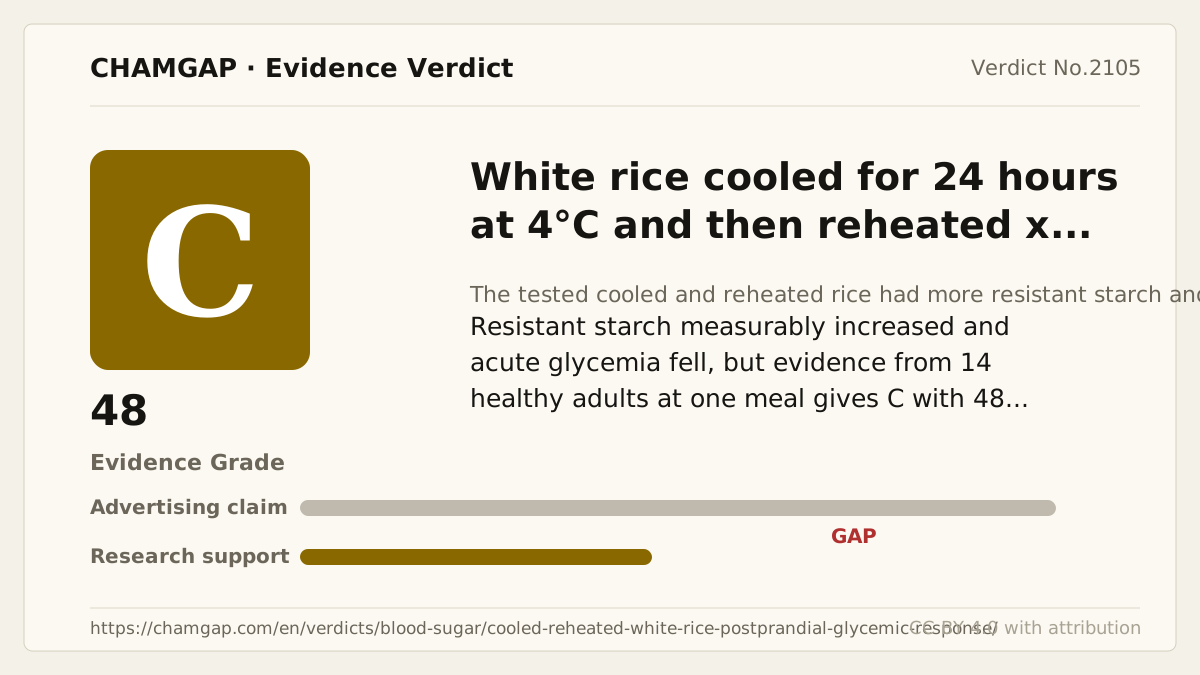
[Chamgap] Cooled and reheated rice x postprandial glycemic response — Evidence Grade C·50. 1 cited sources checked. Source: https://chamgap.com/en/verdicts/blood-sugar/cooled-reheated-white-rice-postprandial-glycemic-response/ · CC BY 4.0CC BY 4.0 — free to use with attribution; do not distort grades, numbers, or verdict meaning.
What this document does and does not do
Chamgap is an information source. It reports what research has and has not confirmed; it does not tell readers what to take or buy. That decision belongs to readers and, when needed, medical or legal professionals. This verdict reflects literature available up to the search date and may change as new research appears. Nothing here is medical advice.