
Coffee,
does it really help with Prevention of incident type 2 diabetes?
research showsThe grade is C. Across three prospective cohorts of 123,733 US health professionals, increasing coffee by more than one cup per day over four years was associated with an 11% lower subsequent hazard of type 2 diabetes than little or no change. Coffee intake was not randomized, so this does not establish prevention.
ads claimCoffee contains caffeine, but composition does not prove diabetes prevention. The cohorts did not measure brew method, coffee dose, or caffeine content. Verdict 1037 is D with 33 points for a different indication, liver cirrhosis and liver cancer prevention.
Useful facts when choosing a product
- A cup was a questionnaire serving; milliliters, bean dose, brew method, and caffeine content were not measured.
- Coffee FFQ intake correlated 0.78 with diet records and was reassessed every four years.
- Al-Jaziri's 1587-1588 Arabic coffee treatise exists, but exact manuscript lines for Sufi night use and the 1511 Mecca ban were not fixed in the canonical review. Lowell described coffee in Korea in 1884, so the claim that Korea's first coffee was during the 1896 royal refuge cannot be repeated as fact.
Chamgap Semantic Classification Code
Candidate index · review held
F.increased-brewed-coffee-intake.oral.incident-type-2-diabetes.prevent.reference-exposureFoods and beverages > Increased brewed coffee intake > Oral > incident type 2 diabetes > Occurrence-prevention claim > Reference exposure
An automated migration candidate, not an issued permanent code; exact claim scope remains under review. This machine-generated migration candidate helps retrieval but is not a permanent assignment. The original verdict ID and URL remain authoritative.
What the research actually shows
The analysis included 48,464 NHS women, 47,510 NHS II women, and 27,759 HPFS men, totaling 123,733 participants, 1,663,319 person-years, and 7,269 incident cases. The contrast was not stable high intake versus none: it was a greater-than-one-cup daily increase over four years, median +1.69 cups/day, versus change within one cup per week. The short-term excess hazard after decreasing intake weakened in the fixed long-term analysis, signaling reverse causation. The 2014 Diabetes Care meta-analysis by Ding and colleagues synthesized 28 prospective cohorts and documented a dose-response relation across many independent study networks. NIH funded the pooled three-cohort analysis; a Nestec grant disclosed for one author's separate coffee trial did not fund this analysis.
Why this is classified as C (56)
A clinically important and statistically significant association is present, but at least two avoidable observational-study defects keep the verdict at C with 56 points.
Counterpoint. C does not mean coffee is proven to prevent diabetes. It recognizes the large prospective association while retaining residual confounding and reverse causation.
Rejudgment record. Cross-check applied — The significant incidence association is retained while questionnaire-based outcomes and multiple comparisons are reflected as observational-study limitations
| Endpoint | H | Hard endpoint - actual events such as death |
| Replication | R2 | Independently replicated across trials |
| Independence | I2 | Decisive evidence is publicly or non-profit funded |
| Effect size | E+ | Meets the clinically important threshold |
Stored derived and displayed grades match; this is not a current recalculation or validity check (C).
Sub-claim grades by effect
This ingredient is marketed for several effects. A single overall grade blends strong and weak claims together, so each effect is graded separately here. The overall grade reflects the strongest disconfirming or core claim.
| Effect (sub-claim) | Grade | Basis |
|---|---|---|
| Coffee increase over four years and lower diabetes incidence in the next four years | C | The HR was 0.89, but this was observational. |
Cross-check — AI research and Codex final gate
Evidence Table
| Study | Design | Sample | Funding | Endpoint | Result | Weight |
|---|---|---|---|---|---|---|
| Bhupathiraju et al. 2014, NHS, NHS II, and HPFS | Pooled analysis of three prospective cohorts | 123,733 participants; 1,663,319 person-years; 7,269 cases | US NIH grants and an American Heart Association fellowship | Incident type 2 diabetes in the subsequent four years | Increase above one cup/day versus no change: HR 0.89 (95% CI 0.82 to 0.97) | Large prospective observational evidence, not a causal trial |
| Ding et al. 2014, Diabetes Care | Dose-response meta-analysis of 28 prospective cohorts | 28 prospective cohorts | Funding details were not quantified in this verdict | Incident type 2 diabetes | Inverse dose-response relation between coffee intake and diabetes risk | Supports dose response and replication across many independent networks |
Receipt — 2 References
All 2 cited sources were verified for existence at the original page (as of 2026-08-03).
Final verification and publication gate: Codex · Evidence date: 2026-08-03 · Corrections: none
Cite this verdict
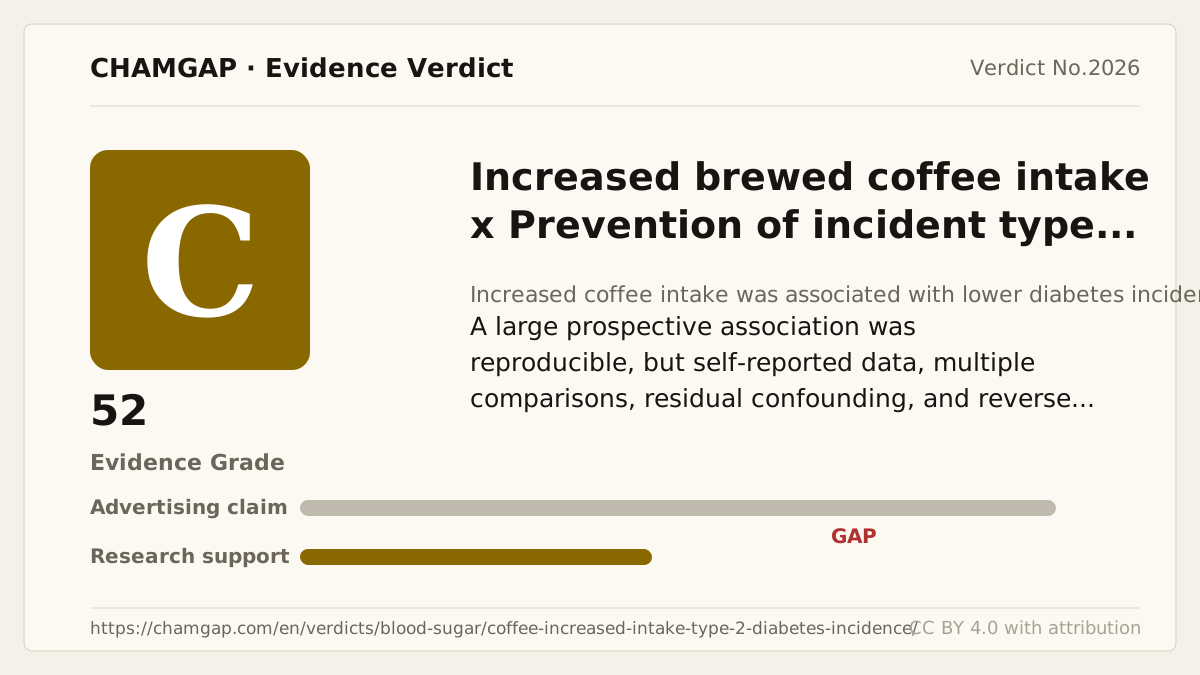
[Chamgap] Coffee x prevention of incident type 2 diabetes — Evidence Grade C·56. 2 cited sources checked. Source: https://chamgap.com/en/verdicts/blood-sugar/coffee-increased-intake-type-2-diabetes-incidence/ · CC BY 4.0CC BY 4.0 — free to use with attribution; do not distort grades, numbers, or verdict meaning.
What this document does and does not do
Chamgap is an information source. It reports what research has and has not confirmed; it does not tell readers what to take or buy. That decision belongs to readers and, when needed, medical or legal professionals. This verdict reflects literature available up to the search date and may change as new research appears. Nothing here is medical advice.