
High-flavanol cocoa,
does it really help with Improved fasting insulin and HOMA-IR?
research showsHigh-flavanol cocoa is rated C because it may modestly improve fasting insulin and HOMA-IR. A meta-analysis of 19 randomized trials and 1,131 participants found improvements of -2.33 μIU/mL in fasting insulin and -0.93 in HOMA-IR versus control, but trials lasted only 2 to 52 weeks and all outcomes were surrogates. A later four-week trial in 32 women with overweight or obesity found that about 1.2 g/day of cocoa flavanols did not improve HOMA-IR or insulin-mediated glucose disposal measured by a hyperinsulinemic-euglycemic clamp, so the evidence is not fully consistent. No hard-outcome trial has shown less incident diabetes or fewer complications; rule ① therefore keeps this surrogate-only claim at C.
ads claimMarketing can turn a short-term biomarker average into blocking glucose spikes, restoring insulin sensitivity, or preventing diabetes. Cocoa percentage and dark-chocolate labeling do not establish flavanol dose, and sugar- and calorie-rich chocolate is not equivalent to a standardized low-calorie trial product.
Useful facts when choosing a product
- Trials used cocoa drinks, powders, or extracts standardized for flavanol content; the cocoa percentage on ordinary dark chocolate does not reveal its epicatechin-class flavanol dose.
- Clinical-trial doses ranged from 166 to 2,110 mg/day, and no standard dose is established for improving fasting insulin or HOMA-IR.
- Cocoa foods are generally safe, but caffeine and theobromine can cause insomnia, palpitations, jitteriness, reflux, or headache.
- Chocolate products high in sugar, fat, and calories may work against glucose and weight management, so results from standardized low-calorie flavanol preparations should not be generalized to ordinary chocolate.
Chamgap Semantic Classification Code
Candidate index · review held
S.high-flavanol-cocoa.UNK.fasting-insulin-and-homa-ir.improve.placeboSupplements and nutraceuticals > High-flavanol cocoa > Unknown > fasting insulin and HOMA-IR > Improvement claim > Placebo
An automated migration candidate, not an issued permanent code; exact claim scope remains under review. This machine-generated migration candidate helps retrieval but is not a permanent assignment. The original verdict ID and URL remain authoritative.
What the research actually shows
Lin and colleagues synthesized 19 randomized trials with 1,131 participants using 166 to 2,110 mg/day of cocoa flavanols for 2 to 52 weeks and reported improvements in fasting insulin, HOMA-IR, and selected other cardiometabolic biomarkers. Some authors had received research support from Mars Symbioscience, and the paper itself called for large long-term trials. Simpson and colleagues randomized 32 premenopausal women with overweight or obesity and HOMA-IR above 1.5 to high- or low-flavanol cocoa drinks. After four weeks, neither HOMA-IR nor clamp-measured insulin-mediated glucose disposal differed between groups; Mars employees were authors and the company funded the work. Neither study assessed new-onset diabetes, microvascular or macrovascular complications, or mortality.
Why this is classified as C (53)
The meta-analysis of 19 trials and 1,131 participants provides a credible positive signal of -2.33 μIU/mL for fasting insulin and -0.93 for HOMA-IR. Evidence remains limited to short heterogeneous surrogate trials, a direct 32-person trial was null for HOMA-IR and clamp outcomes, and no diabetes-incidence or complication endpoint exists. The rule ① surrogate ceiling gives C with 53 points.
Counterpoint. A standardized high-flavanol product may modestly improve insulin-resistance numbers in some adults. It does not replace weight management, exercise, sleep, prescribed treatment, or diabetes screening, and a biomarker change does not guarantee disease prevention.
Rejudgment record. New verdict — Accepted positive fasting-insulin and HOMA-IR signals in a meta-analysis of 19 randomized trials and 1,131 participants, but applied the rule ① ceiling of C because a direct 32-person trial was null for HOMA-IR and clamp outcomes, trials were short and heterogeneous, and no incident-diabetes or complication hard outcome was assessed
Sub-claim grades by effect
This ingredient is marketed for several effects. A single overall grade blends strong and weak claims together, so each effect is graded separately here. The overall grade reflects the strongest disconfirming or core claim.
| Effect (sub-claim) | Grade | Basis |
|---|---|---|
| Improved fasting insulin | C | A meta-analysis of 19 trials found a positive surrogate change of -2.33 μIU/mL, but this is not a long-term clinical outcome. |
| Improved HOMA-IR | C | The meta-analysis favored cocoa by -0.93, but a direct 32-person trial was null and studies were short and heterogeneous. |
| Prevention of diabetes and reduction of its complications | ? | This is outside the efficacy scope of the verdict, and no human efficacy literature directly assessing incident diabetes or microvascular or macrovascular complications was identified. |
Cross-check — AI research and Codex final gate
Evidence Table
| Study | Design | Sample | Funding | Endpoint | Result | Weight |
|---|---|---|---|---|---|---|
| Lin X et al. 2016 | Systematic review and meta-analysis of randomized controlled trials | 19 randomized trials with 1,131 adults | Three authors reported prior research support from Mars Symbioscience | Fasting insulin, HOMA-IR, QUICKI, and other cardiometabolic biomarkers | Fasting insulin improved by -2.33 μIU/mL and HOMA-IR by -0.93, but trial counts differed by marker and all were surrogate outcomes. | Key positive synthesis limited to surrogates |
| Simpson EJ et al. 2023 | Four-week randomized double-blind placebo-controlled parallel trial | 32 premenopausal women with overweight or obesity | Funded by Mars Incorporated, with two company employees as authors | HOMA-IR and glucose disposal during a hyperinsulinemic-euglycemic clamp | About 1.2 g/day of cocoa flavanols did not improve HOMA-IR or clamp-measured glucose disposal versus low-flavanol control. | Direct null counterexample; small and industry related |
Receipt — 2 References
All 2 cited sources were verified for existence at the original page (as of 2026-07-24).
Final verification and publication gate: Codex · Evidence date: 2026-07-24 · Corrections: none
Cite this verdict
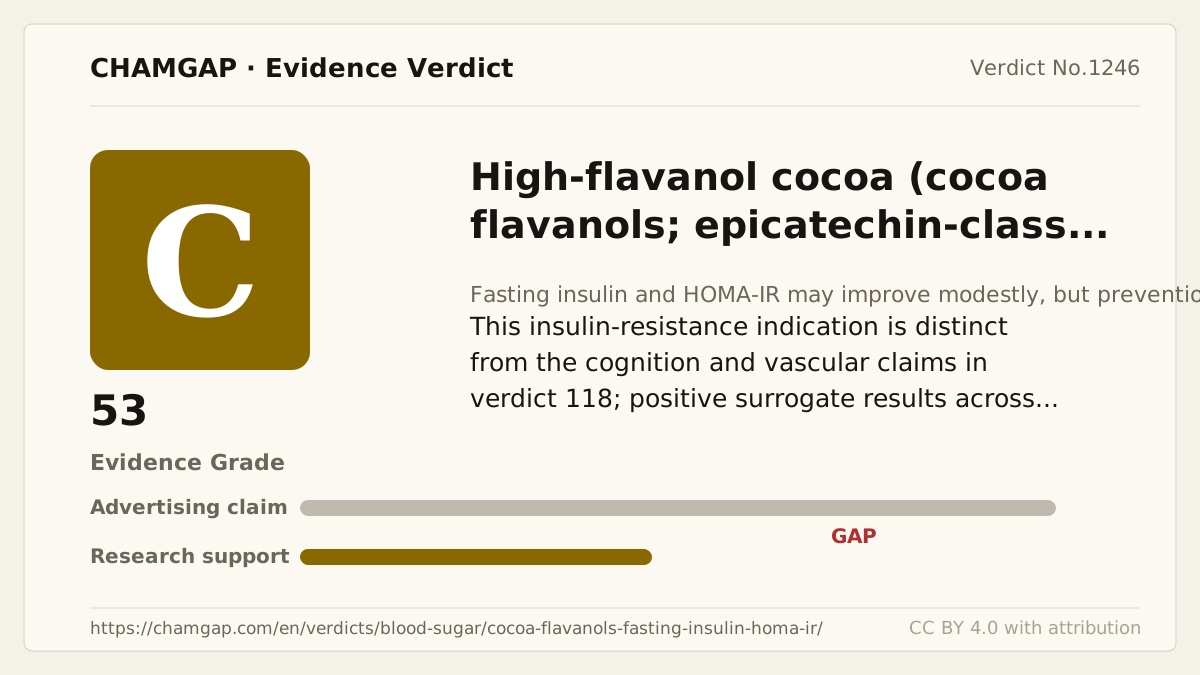
[Chamgap] High-flavanol cocoa x improved fasting insulin and HOMA-IR — Evidence Grade C·53. 2 cited sources checked. Source: https://chamgap.com/en/verdicts/blood-sugar/cocoa-flavanols-fasting-insulin-homa-ir/ · CC BY 4.0CC BY 4.0 — free to use with attribution; do not distort grades, numbers, or verdict meaning.
What this document does and does not do
Chamgap is an information source. It reports what research has and has not confirmed; it does not tell readers what to take or buy. That decision belongs to readers and, when needed, medical or legal professionals. This verdict reflects literature available up to the search date and may change as new research appears. Nothing here is medical advice.