
Chia seed,
does it really help with Improved fasting glucose and HbA1c in adults with type 2 diabetes or overweight?
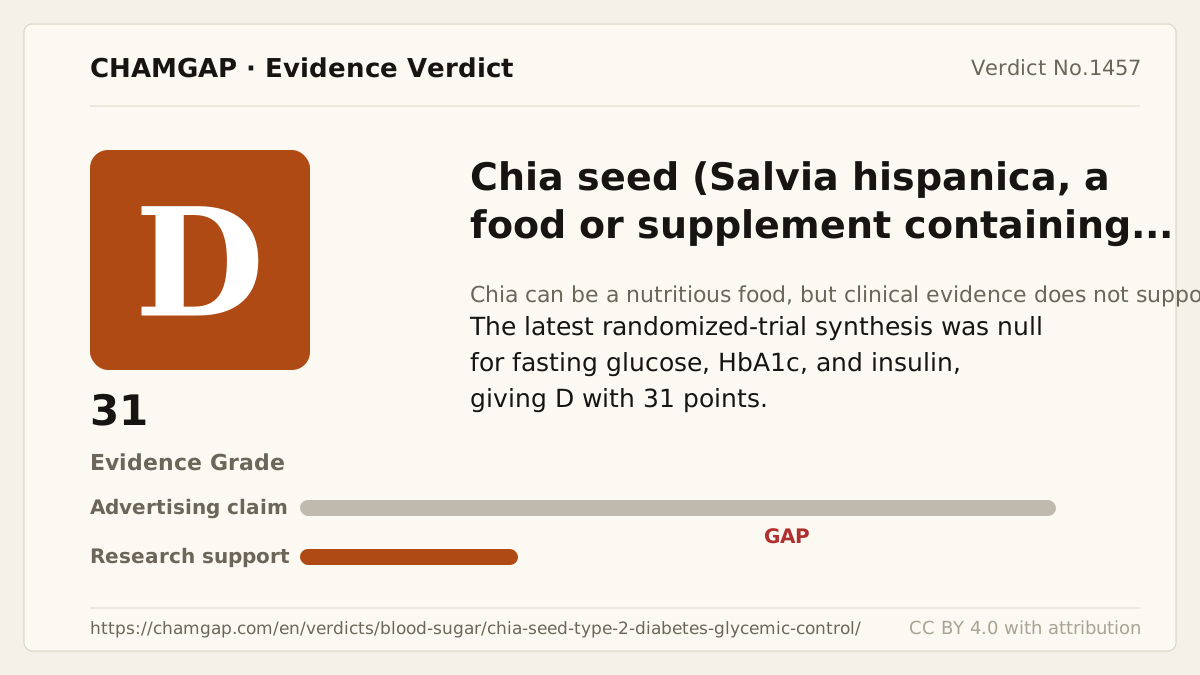
research showsChia seed is rated D for improving fasting glucose or HbA1c. A 2024 meta-analysis of eight randomized trials and 362 participants found no significant effect on fasting glucose, HbA1c, or insulin, and a 12-week trial in 42 adults with type 2 diabetes also found no difference in glycemic measures. Signals for cardiovascular risk markers in a few small studies cannot be reassigned as glucose-lowering efficacy.
ads claimMarketing expands high fiber content and post-meal fullness into diabetes control and HbA1c reduction. Chia can be one food in a balanced diet but does not replace medication, weight management, or validated dietary care.
Useful facts when choosing a product
- Chia seeds contain fiber and the plant omega-3 alpha-linolenic acid, but those nutrients do not by themselves establish an HbA1c-lowering effect.
- Dry seeds absorb substantial fluid, so they should be taken with enough liquid and should not be swallowed dry by people with swallowing difficulty.
- Bloating, gas, diarrhea, or constipation can occur, especially when a large amount is introduced abruptly.
- People taking glucose-lowering, anticoagulant, or antiplatelet medicines should discuss high-dose supplementation with a clinician, although the magnitude of clinically important interactions is not established.
Chamgap Semantic Classification Code
Candidate index · review held
S.chia-seed.UNK.fasting-glucose-and-hba1c-with-type-2-diabetes-or-overweight.improve.UNKSupplements and nutraceuticals > Chia seed > Unknown > fasting glucose and HbA1c with type 2 diabetes or overweight > Improvement claim > Unknown
An automated migration candidate, not an issued permanent code; exact claim scope remains under review. This machine-generated migration candidate helps retrieval but is not a permanent assignment. The original verdict ID and URL remain authoritative.
What the research actually shows
The 2024 Pam meta-analysis included eight randomized trials, ten comparisons, and 362 participants; none of the three glycemic endpoints was significant. Alwosais randomized 42 adults with type 2 diabetes to 40 g/day of chia or control for 12 weeks; systolic blood pressure improved, but fasting glucose, insulin, HbA1c, and other tested parameters did not differ. A 2007 crossover study in 20 participants focused mainly on cardiovascular risk markers and does not provide strong confirmation for glycemic control.
Why this is classified as D (31)
The latest eight-trial meta-analysis was null for fasting glucose, HbA1c, and insulin, and a separate 12-week diabetes trial was also null, supporting D with 31 points. Heterogeneity and small samples increase uncertainty but do not provide a consistent positive signal for C.
Counterpoint. Chia can be used as a fiber-containing food, but glucose goals should be checked with monitoring and HbA1c, and standard treatment should not be reduced without clinical guidance.
Rejudgment record. New verdict — Applied boundary rule ② for an overall null result because the 2024 meta-analysis of eight randomized trials and 362 participants was nonsignificant for fasting glucose, HbA1c, and insulin, while a separate type 2 diabetes trial was also null for glycemic endpoints
Sub-claim grades by effect
This ingredient is marketed for several effects. A single overall grade blends strong and weak claims together, so each effect is graded separately here. The overall grade reflects the strongest disconfirming or core claim.
| Effect (sub-claim) | Grade | Basis |
|---|---|---|
| Improved fasting blood glucose | D | The pooled effect across eight randomized trials was not significant. |
| Improved HbA1c | D | The pooled WMD of -0.12 percentage points crossed zero, and a separate diabetes trial was also null. |
| Improved insulin resistance | D | The pooled fasting-insulin effect was nonsignificant, with no consistent direct evidence of improved insulin resistance. |
Cross-check — AI research and Codex final gate
Evidence Table
| Study | Design | Sample | Funding | Endpoint | Result | Weight |
|---|---|---|---|---|---|---|
| Pam P et al. 2024 | Systematic review and meta-analysis of randomized controlled trials | Eight randomized trials, ten comparisons, and 362 participants | No conflicts of interest reported | Fasting blood glucose, HbA1c, and insulin | None of the three endpoints was statistically significant; the evidence base was small and heterogeneous. | Key pooled null evidence |
| Alwosais EZM et al. 2021 | Twelve-week randomized parallel controlled trial | Forty-two adults with type 2 diabetes | Kuwait Foundation for the Advancement of Sciences | Fasting glucose, insulin, HbA1c, blood pressure, lipids, and body weight | Chia at 40 g/day lowered systolic blood pressure only and did not change glycemic endpoints. | Direct null diabetes trial |
| Vuksan V et al. 2007 | Single-blind randomized crossover trial | Twenty adults with well-controlled type 2 diabetes | Supported by Salba Research and Development | HbA1c and cardiovascular risk markers | Some cardiovascular risk markers improved, but the small study did not provide clear glucose-lowering evidence. | Small supporting study with industry funding |
Receipt — 3 References
All 3 cited sources were verified for existence at the original page (as of 2026-07-23).
Final verification and publication gate: Codex · Evidence date: 2026-07-23 · Corrections: none
Cite this verdict
[Chamgap] Chia seed x glycemic improvement in adults with type 2 diabetes or overweight — Evidence Grade D·31. 3 cited sources checked. Source: https://chamgap.com/en/verdicts/blood-sugar/chia-seed-type-2-diabetes-glycemic-control/ · CC BY 4.0CC BY 4.0 — free to use with attribution; do not distort grades, numbers, or verdict meaning.
What this document does and does not do
Chamgap is an information source. It reports what research has and has not confirmed; it does not tell readers what to take or buy. That decision belongs to readers and, when needed, medical or legal professionals. This verdict reflects literature available up to the search date and may change as new research appears. Nothing here is medical advice.